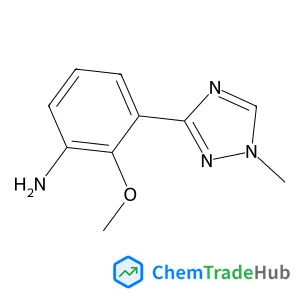
2-Methoxy-3-(1-methyl-1H-1,2,4-triazol-3-yl)aniline
CAS Number:
1609394-10-6
Molecular Formula:
C10H12N4O
Timothy G. Carter, Wassana Yantasee, Thanapon Sangvanich, Glen E. Fryxell, Darren W. Johnson, R. Shane Addleman
A new class of sorbent material, which exhibits exceptional metal capture from contaminated natural water, features aromatic thiol ligands reversibly bound to functionalized mesoporous silica through non-covalent interactions and have the potential of being regenerable.
Jun Terao, Andrew Tang, Jasper J. Michels, Alexander Krivokapic, Harry L. Anderson
DOI: 10.1039/B311762F
Hélène Audrain, Laurent Martarello, Antony Gee, Dirk Bender
DOI: 10.1039/B314982J
Fuquan Song, Roderick D. Cannon, Manfred Bochmann
DOI: 10.1039/B314845A
Michelle K. Kidder, Phillip F. Britt, Zongtao Zhang, Sheng Dai, A. C. Buchanan, III
DOI: 10.1039/B310405B
Hongzhi Wang, Xianying Li, Masato Uehara, Yoshiko Yamaguchi, Hiroyuki Nakamura, Masaya Miyazaki, Hazime Shimizu, Hideaki Maeda
DOI: 10.1039/B310644F
Aviv Hagooly, Shlomo Rozen
DOI: 10.1039/B315705A
Noureddine Khiar, Cristina S. Araújo, Bélen Suárez, Eleuterio Alvarez, Inmaculada Fernández
DOI: 10.1039/B313798H
Steven L. Cobb, Hai Deng, John T. G. Hamilton, Ryan P. McGlinchey, David O'Hagan
DOI: 10.1039/B400754A
Ilya D. Gridnev, Fabio Pichierri
DOI: 10.1039/B311885A
Christian Serre, Francis Taulelle, Gérard Ferey
DOI: 10.1039/B304703B
1H-Indazole-6-carbonitrile finds applications in pharmaceuticals, where it serve...
Waste containing Dioctyl (2E)-2-butenedioate (CAS: 2997-85-5) should be collecte...
Sodium [(1,2-benzoxazol-3-ylmethyl)sulfonyl]azanide is primarily used in pharmac...
Dimethyl 4-(4,4,5,5-tetramethyl-1,3,2-dioxaborolan-2-yl)-2,6-pyridinedicarboxyla...
Waste containing 2-Fluoro-6-hydrazinopyridine (CAS: 80714-39-2) should be manage...
6-Formyl-2-pyridinecarboxylic acid is an organic compound with the molecular for...
Research trends for this compound indicate a focus on its potential applications...
9H-Tribenzo[b,d,f]azepine is typically synthesized via a multi-step process invo...
1-Cyclopropyl-7-ethoxy-6-fluoro-8-methoxy-4-oxo-1,4-dihydro-3-quinolinecarboxyli...
Waste containing Methyl 3-oxo-1,2,3,4-tetrahydro-6-quinoxalinecarboxylate (CAS: ...

ChemComm publishes urgent research which is of outstanding significance and interest to experts in the field, while also appealing to the journal’s broad chemistry readership. Our communication format is ideally suited to short, urgent studies that are of such importance that they require accelerated publication. Our scope covers all topics in chemistry, and research at the interface of chemistry and other disciplines (such as materials science, nanoscience, physics, engineering and biology) where there is a significant novelty in the chemistry aspects. Major topic areas covered include: Analytical Chemistry Catalysis Chemical Biology and medicinal chemistry Computational Chemistry and Machine Learning Energy and sustainable chemistry Environmental Chemistry Green Chemistry Inorganic Chemistry Materials Chemistry Nanoscience Organic Chemistry Physical Chemistry Polymer Chemistry Supramolecular Chemistry
![4-Penten-1-yl 2-[(2-furylmethyl)(1H-imidazol-1-ylcarbonyl)amino]butanoate structure](https://static.chemtradehub.com/structs/101/101903-30-4-ac34.webp "4-Penten-1-yl 2-[(2-furylmethyl)(1H-imidazol-1-ylcarbonyl)amino]butanoate structure")