












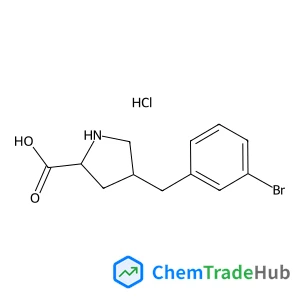
(2S,4R)-4-(3-Bromobenzyl)pyrrolidine-2-carboxylic acid hydrochloride
CAS Number:
1049734-10-2
Molecular Formula:
C12H15BrClNO2
Shitao Wang, Jihai Shang, Chaoxian Yan, Wenbo Wang, Chengshan Yuan, Hao-Li Zhang, Xiangfeng Shao
Trichalcogenasumanenes (1–3) are rich in chemistry, as they can be regio-selectively functionalized. Chalcogen atoms (S, Se, and Te) play a pivotal role in determining molecular geometry, optical properties, and reactivity. Herein, new trichalcogenasumanenes (4–9) are synthesized, all with the benzylic carbons on sumanene replaced by two kinds of chalcogen atom. Crystallographic studies show that the molecular geometry varies from bowl-shaped (4 and 6) to planar (9) as the size of the majority chalcogen atom increases from S (4) to Se (6) to Te (9). The optical properties of sulfur-rich (4–5), selenium-rich (6–7), and tellurium-rich (8–9) examples are respectively similar to those of trithia- (1), triselena- (2), and tritellura-sumanenes (3). The chemical activities of 4–7 are evaluated via reactions with Oxone, H2O2, and Br2. It is found that their reactivities are dominated by the heavier chalcogen atom rather than the one in the majority.
Sebastian Götz, Jens Künnemeyer
DOI: 10.1039/B711165G
Benjamin J. Hindson, Dora M. Gutierrez, Kevin D. Ness, Anthony J. Makarewicz, Thomas R. Metz, Ujwal S. Setlur, William B. Benett, Jeffrey M. Loge, Bill W. Colston, Jr., Paul S. Francis, Neil W. Barnett, John M. Dzenitis
DOI: 10.1039/B713332D
Matthew J. Baker, Michael D. Brown, Ehsan Gazi, John C. Vickerman, Nicholas P. Lockyer
DOI: 10.1039/B712853C
Andrew S. Brown, Richard J. C. Brown, Warren T. Corns, Peter B. Stockwell
DOI: 10.1039/B803724H
Hai-Feng Ji, Hongyan Gao, Koutilya R. Buchapudi, Xin Yang, Xiaohe Xu, Marvin K. Schulte
DOI: 10.1039/B713330H
Peggy Gunkel-Grillon, Jacques Buffle
DOI: 10.1039/B802685H
Hossam M. Nassef, Laia Civit, Alex Fragoso
DOI: 10.1039/B808499H
Xiaoying Ye, Stanislav S. Rubakhin, Jonathan V. Sweedler
DOI: 10.1039/B716174C
2-(2-Chloroacetamido)-3-phenylpropanoic acid (CAS: 7765-11-9) is generally consi...
2-(Benzyloxy)-5-bromobenzoic acid can be handled safely if appropriate precautio...
(4-Methyl-1,2,5-oxadiazol-3-yl)methanamine hydrochloride is a chemical compound ...
2-(5-Hexylthiophen-2-yl)-4,4,5,5-tetramethyl-1,3,2-dioxaborolane (CAS: 917985-54...
While 4-(8-Methyl-9H-1,3-dioxolo[4,5-h][2,3]benzodiazepin-5-yl)benzenamine (CAS:...
The market for tert-butyl 3-hydroxy-4,5,7,8-tetrahydro-2H-pyrazolo[3,4-d]azepine...
Waste containing 3,5-Diamino-1H-pyrazole-4-carbonitrile (CAS: 6844-58-2) should ...
(6-Fluoro-3-pyridinyl)boronic acid can be synthesized through the reaction of 6-...
Dibenzyl carbonimidoylbiscarbamate (CAS: 10065-79-9) finds applications in vario...
The market for (beta,beta,2,3,4,5,6-~2~H_7_)Phenylalanine (CAS: 74228-83-4) is g...

Organic Chemistry Frontiers publishes high-quality research from across organic chemistry. Emphases are placed on studies that make significant contributions to the field of organic chemistry by reporting either new or significantly improved protocols or methodologies. Topics include, but are not limited to the following: Organic synthesis Development of synthetic methodologies Catalysis Natural products Functional organic materials Supramolecular and macromolecular chemistry Physical and computational organic chemistry
![(1S)-1,5-Anhydro-2-O-alpha-L-arabinopyranosyl-1-[5-hydroxy-7-({6-O-[3-(4-hydroxy-3-methoxyphenyl)propanoyl]-beta-D-glucopyranosyl}oxy)-2-(4-hydroxyphenyl)-4-oxo-4H-chromen-6-yl]-D-glucitol structure](https://static.chemtradehub.com/structs/225/2252345-81-4-bcff.webp "(1S)-1,5-Anhydro-2-O-alpha-L-arabinopyranosyl-1-[5-hydroxy-7-({6-O-[3-(4-hydroxy-3-methoxyphenyl)propanoyl]-beta-D-glucopyranosyl}oxy)-2-(4-hydroxyphenyl)-4-oxo-4H-chromen-6-yl]-D-glucitol structure")
![Ethyl thieno[3,2-f]quinoline-2-carboxylate structure](https://static.chemtradehub.com/structs/299/29948-26-3-f62b.webp "Ethyl thieno[3,2-f]quinoline-2-carboxylate structure")



