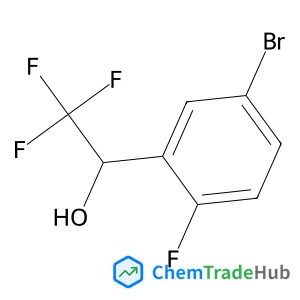
1-(5-Bromo-2-fluorophenyl)-2,2,2-trifluoroethanol
CAS Number:
1039827-16-1
Molecular Formula:
C8H5BrF4O
Benjamin J. Hindson, Dora M. Gutierrez, Kevin D. Ness, Anthony J. Makarewicz, Thomas R. Metz, Ujwal S. Setlur, William B. Benett, Jeffrey M. Loge, Bill W. Colston, Jr., Paul S. Francis, Neil W. Barnett, John M. Dzenitis
We present a fully automated DNA purification module comprised of a micro-fabricated chip and sequential injection analysis system that is designed for use within autonomous instruments that continuously monitor the environment for the presence of biological threat agents. The chip has an elliptical flow channel containing a bed (3.5 × 3.5 mm) of silica-coated pillars with height, width and center-to-center spacing of 200, 15, and 30 µm, respectively, which provides a relatively large surface area (ca. 3 cm2) for DNA capture in the presence of chaotropic agents. We have characterized the effect of various fluidic parameters on extraction performance, including sample input volume, capture flow rate, and elution volume. The flow-through design made the pillar chip completely reusable; carryover was eliminated by flushing lines with sodium hypochlorite and deionized water between assays. A mass balance was conducted to determine the fate of input DNA not recovered in the eluent. The device was capable of purifying and recovering Bacillus anthracisgenomic DNA (input masses from 0.32 to 320 pg) from spiked environmental aerosol samples, for subsequent analysis using polymerase chain reaction-based assays.
Ellie L. Uzunova, Nicola Seriani, Hans Mikosch
DOI: 10.1039/C5CP01267H
G. Fumero, S. Mukamel
DOI: 10.1039/C4CP05361C
C. Panayiotou
DOI: 10.1039/C4CP05825A
Anesh Gopal, Akinori Saeki, Shu Seki
DOI: 10.1039/C5CP01044F
Jinyan Liu, Chuansheng Zhuang, Kan Li, Tianyou Peng
DOI: 10.1039/C5CP00565E
Serena Esposito, Barbara Bonelli, Marco Armandi, Edoardo Garrone, Guido Saracco
DOI: 10.1039/C5CP00191A
Peter C. Johnsen
DOI: 10.1039/C5CP01255D
Takehiro Ohta, Tewfik Soulimane, Teizo Kitagawa, Constantinos Varotsis
DOI: 10.1039/C5CP01013F
2-(2-Chloroacetamido)-3-phenylpropanoic acid (CAS: 7765-11-9) is generally consi...
2-(Benzyloxy)-5-bromobenzoic acid can be handled safely if appropriate precautio...
(4-Methyl-1,2,5-oxadiazol-3-yl)methanamine hydrochloride is a chemical compound ...
2-(5-Hexylthiophen-2-yl)-4,4,5,5-tetramethyl-1,3,2-dioxaborolane (CAS: 917985-54...
While 4-(8-Methyl-9H-1,3-dioxolo[4,5-h][2,3]benzodiazepin-5-yl)benzenamine (CAS:...
The market for tert-butyl 3-hydroxy-4,5,7,8-tetrahydro-2H-pyrazolo[3,4-d]azepine...
Waste containing 3,5-Diamino-1H-pyrazole-4-carbonitrile (CAS: 6844-58-2) should ...
(6-Fluoro-3-pyridinyl)boronic acid can be synthesized through the reaction of 6-...
Dibenzyl carbonimidoylbiscarbamate (CAS: 10065-79-9) finds applications in vario...
The market for (beta,beta,2,3,4,5,6-~2~H_7_)Phenylalanine (CAS: 74228-83-4) is g...

Analyst publishes analytical and bioanalytical research that reports premier fundamental discoveries and inventions, and the applications of those discoveries, unconfined by traditional discipline barriers.
![Ethyl ({[(2-methyl-2-propanyl)oxy]carbonyl}amino)(2-pyridinyl)acetate structure](https://static.chemtradehub.com/structs/313/313490-90-3-dd15.webp "Ethyl ({[(2-methyl-2-propanyl)oxy]carbonyl}amino)(2-pyridinyl)acetate structure")