



Establishing SI traceability for measurements of mercury vapour
Literature Information
Publication Date
2008-04-30
DOI
10.1039/B803724H
Impact Factor
4.616
Authors
Andrew S. Brown, Richard J. C. Brown, Warren T. Corns, Peter B. Stockwell
View Original
Abstract
The majority of measurements of mercury vapour, for example those to determine mass concentration in air, are currently ultimately traceable to the vapour pressure of mercury, usually via a bell-jar calibration apparatus. This allows a saturated concentration of mercury vapour in air to develop in a confined space in equilibrium with ambient conditions, from which a known mass of mercury can be removed for calibration purposes. Several empirical equations are available to describe the vapour pressure of mercury at a given temperature, but the agreement between them is not good, with data from different equations sometimes differing by 5% or more. In order to remove the dependence of mercury vapour measurement on these empirical equations, and to provide stability, comparability and coherence for mercury vapour measurements, this paper describes work undertaken to link directly mercury vapour measurements to standards of mass, and therefore to establish traceability for these measurements to the SI system of units. This has been achieved by measuring the mass output rate of a dynamic mercury vapour generator gravimetrically, and linking this to the expected mass concentration in the bell-jar apparatus. The SI traceable mercury vapour measurements have been shown to agree with the predicted output from the bell-jar, as defined by the most commonly used empirical mercury vapour pressure equation, within the uncertainty of the measurement.
Recommended Journals

Russian Journal of General Chemistry

Current Opinion in Colloid & Interface Science

Current Opinion in Solid State & Materials Science

Saudi Pharmaceutical Journal

Nature Medicine

Journal of Peptide Science

Drug Discovery Today

Chemistry Education Research and Practice

Russian Journal of Bioorganic Chemistry

Crystallography Reports
Related Literature
A computational and conceptual DFT study on the mechanism of hydrogen activation by novel frustrated Lewis pairs
2015-03-13
Paper
DOI: 10.1039/C5CP00306G
Towards a comprehensive insight into efficient hydrogen production by self-assembled Ru(bpy)32+–polymer–Pt artificial photosystems
Huan Lin, Dan Liu, Jinlin Long, Zizhong Zhang, Huaqiang Zhuang, Yi Zheng, Xuxu Wang
2015-03-13
Paper
DOI: 10.1039/C5CP00720H
Enhancing electrochemical performance by control of transport properties in buffer layers – solid oxide fuel/electrolyser cells
Devaraj Ramasamy, Narendar Nasani, Ana D. Brandão, Domingo Pérez Coll, Duncan P. Fagg
2015-04-02
Paper
DOI: 10.1039/C5CP00778J
Electrochemistry at highly oriented pyrolytic graphite (HOPG): lower limit for the kinetics of outer-sphere redox processes and general implications for electron transfer models
Guohui Zhang, Anatolii S. Cuharuc, Aleix G. Güell, Patrick R. Unwin
2015-03-31
Paper
DOI: 10.1039/C5CP00383K
Enhancement of the thermoelectric figure of merit in DNA-like systems induced by Fano and Dicke effects
Hua-Hua Fu, Lei Gu, Dan-Dan Wu, Zu-Quan Zhang
2015-03-25
Paper
DOI: 10.1039/C4CP04382K
Tuning the reactivity of a dissociative force field: proton transfer properties of aqueous H3O+ and their dependence on the three-body interaction
Martin J. Wiedemair, Manuel Hitzenberger, Thomas S. Hofer
2015-03-20
Paper
DOI: 10.1039/C4CP05607H
Outside rules inside: the role of electron-active substituents in thiophene-based heterophenoquinones
L. Brambilla, E. Parisini, C. Castiglioni
2015-02-16
Paper
DOI: 10.1039/C4CP05748A
On the importance of shear dissipative forces in coarse-grained dynamics of molecular liquids
Sergei Izvekov, Betsy M. Rice
2015-03-23
Paper
DOI: 10.1039/C4CP06116K
Electrolyte ion adsorption and charge blocking effect at the hematite/aqueous solution interface: an electrochemical impedance study using multivariate data analysis
K. Shimizu, J. Nyström, P. Geladi, B. Lindholm-Sethson, J.-F. Boily
2015-03-31
Paper
DOI: 10.1039/C4CP05927A
Design of PAMAM-COO dendron-grafted surfaces to promote Pb(ii) ion adsorption
Leebyn Chong, Meenakshi Dutt
2015-03-17
Paper
DOI: 10.1039/C5CP00309A
You might also like
Compound Q&A
Is 2-(2-chloroacetamido)-3-phenylpropanoic acid (CAS: 7765-11-9) safe?
2-(2-Chloroacetamido)-3-phenylpropanoic acid (CAS: 7765-11-9) is generally consi...
7765-11-92-(2-chloroacetamido...
Compound Q&A
Is 2-(Benzyloxy)-5-bromobenzoic acid (CAS: 62176-31-2) safe?
2-(Benzyloxy)-5-bromobenzoic acid can be handled safely if appropriate precautio...
62176-31-22-(Benzyloxy)-5-brom...
Compound Q&A
What is (4-Methyl-1,2,5-oxadiazol-3-yl)methanamine hydrochloride (CAS: 1159825-48-5)?
(4-Methyl-1,2,5-oxadiazol-3-yl)methanamine hydrochloride is a chemical compound ...
1159825-48-5(4-Methyl-1,2,5-oxad...
Compound Q&A
What is 2-(5-Hexylthiophen-2-yl)-4,4,5,5-tetramethyl-1,3,2-dioxaborolane (CAS: 917985-54-7)?
2-(5-Hexylthiophen-2-yl)-4,4,5,5-tetramethyl-1,3,2-dioxaborolane (CAS: 917985-54...
917985-54-72-(5-Hexylthiophen-2...
Compound Q&A
Are there alternatives to 4-(8-Methyl-9H-1,3-dioxolo[4,5-h][2,3]benzodiazepin-5-yl)benzenamine (CAS: 102771-26-6) in synthesis?
While 4-(8-Methyl-9H-1,3-dioxolo[4,5-h][2,3]benzodiazepin-5-yl)benzenamine (CAS:...
102771-26-64-(8-Methyl-9H-1,3-d...
Compound Q&A
What is the market or research trend for tert-butyl 3-hydroxy-4,5,7,8-tetrahydro-2H-pyrazolo[3,4-d]azepine-6-carboxylate (CAS: 851376-80-2)?
The market for tert-butyl 3-hydroxy-4,5,7,8-tetrahydro-2H-pyrazolo[3,4-d]azepine...
851376-80-2tert-butyl 3-hydroxy...
Compound Q&A
How should waste containing 3,5-Diamino-1H-pyrazole-4-carbonitrile (CAS: 6844-58-2) be handled?
Waste containing 3,5-Diamino-1H-pyrazole-4-carbonitrile (CAS: 6844-58-2) should ...
6844-58-23,5-Diamino-1H-pyraz...
Compound Q&A
How is (6-Fluoro-3-pyridinyl)boronic acid (CAS: 351019-18-6) typically synthesized?
(6-Fluoro-3-pyridinyl)boronic acid can be synthesized through the reaction of 6-...
351019-18-6(6-Fluoro-3-pyridiny...
Compound Q&A
What industries use Dibenzyl carbonimidoylbiscarbamate (CAS: 10065-79-9)?
Dibenzyl carbonimidoylbiscarbamate (CAS: 10065-79-9) finds applications in vario...
10065-79-9Dibenzyl carbonimido...
Compound Q&A
What is the market or research trend for (beta,beta,2,3,4,5,6-~2~H_7_)Phenylalanine (CAS: 74228-83-4)?
The market for (beta,beta,2,3,4,5,6-~2~H_7_)Phenylalanine (CAS: 74228-83-4) is g...
74228-83-4(beta,beta,2,3,4,5,6...
Source Journal
Analyst

CiteScore:
7.8
Self-citation Rate:
5.6%
Articles per Year:
653
Analyst publishes analytical and bioanalytical research that reports premier fundamental discoveries and inventions, and the applications of those discoveries, unconfined by traditional discipline barriers.
Recommended Compounds
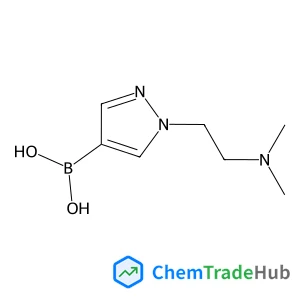
(1-(2-(Dimethylamino)ethyl)-1H-pyrazol-4-yl)boronic acid
CAS Number:
1086063-73-1
Molecular Formula:
C7H14BN3O2
![3,7-Di(1,1':3',1''-terphenyl-5'-yl)-10,11,12,13-tetrahydrodiindeno[7,1-de:1',7'-fg][1,3,2]dioxaphosphocin-5-ol 5-oxide structure](https://static.chemtradehub.com/structs/135/1352810-38-8-3f10.webp "3,7-Di(1,1':3',1''-terphenyl-5'-yl)-10,11,12,13-tetrahydrodiindeno[7,1-de:1',7'-fg][1,3,2]dioxaphosphocin-5-ol 5-oxide structure")
3,7-Di(1,1':3',1''-terphenyl-5'-yl)-10,11,12,13-tetrahydrodiindeno[7,1-de:1',7'-fg][1,3,2]dioxaphosphocin-5-ol 5-oxide
CAS Number:
1352810-38-8
Molecular Formula:
C53H39O4P
Recommended Suppliers





Disclaimer
This page provides academic journal information for reference and research purposes only. We are not affiliated with any journal publishers and do not handle publication submissions. For publication-related inquiries, please contact the respective journal publishers directly.
If you notice any inaccuracies in the information displayed, please contact us at support@chemtradehub.com. We will promptly review and address your concerns.