


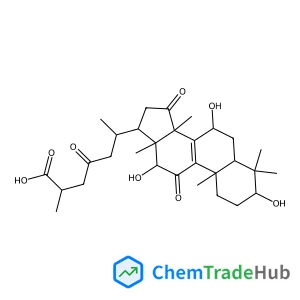
(3beta,7beta,12beta)-3,7,12-Trihydroxy-11,15,23-trioxolanost-8-en-26-oic acid
CAS Number:
98665-22-6
Molecular Formula:
C30H44O8
Yanjie Zhao, Yan Wu, Bai Xue, Xin Jin, Xinyuan Zhu
As is well known, amphipathic polymers play a great role in drug delivery and bioimaging fields. However, the hydrophilic part always results in the poor internalization ability to tumor cells for drug delivery and bioimaging. Here, we designed and synthesized a new type of NIR-fluorescence polymer, PMMA-b-P(GATH-co-BOD), glucose-based hydrophilic segment conjugated with an NIR-fluorescence agent. Due to its amphiphilicity, the copolymer could self-assemble into micelles, with polyhydroxy glucose as the shell and a PMMA chain as the core. Such strategy provided high glucose density on the surface of the micelles. During cell internalization, the cluster glycoside effect will provide stronger recognition towards GLUT1 and act as an internal driving force. The copolymer PMMA-b-P(GATH-co-BOD) exhibited excellent advantages including low cytotoxicity and high targeting specificity for tumor cells. This near-infrared copolymer fluorescent probe system initiated a broad platform for drug delivery and bioimaging detection systems.

Herald of the Russian Academy of Sciences

Bioorganic & Medicinal Chemistry

Journal of Chemical Sciences

Polycyclic Aromatic Compounds

Colloid Journal

Acta Metallurgica Sinica-English Letters

Journal of the Indian Institute of Science

Heteroatom Chemistry

Bioorganic & Medicinal Chemistry Letters

Chinese Journal of Chemistry
Bethany R. Lettiere, Gareth Seward, Nisha Verma, Yichi Zhang
DOI: 10.1039/C3CP50918D
Xuefeng Lu, Hongjie Wang, Meng Chen, Lei Fan, Chao Wang, Shuhai Jia
DOI: 10.1039/C3CP50372K
Ruguang Ma, Mingjun Hu, Hua Cheng, Yang Yang Li
DOI: 10.1039/C3CP50588J
Guilherme Oliveira Siqueira, Tulio Matencio, Herculano Vieira da Silva, Yara Gonçalves de Souza, José Domingos Ardisson, Geraldo Magela de Lima, Arilza de Oliveira Porto
DOI: 10.1039/C3CP50549A
Yilun Liu
DOI: 10.1039/C3CP43854F
T. J. A. Wolf, R. Radloff, P. Lang, A. Stolow, A.-N. Unterreiner
DOI: 10.1039/C3CP44295K
V. Epp, Ö. Gün, H.-J. Deiseroth, M. Wilkening
DOI: 10.1039/C3CP44379E
Marc-Oliver Winghart, Michael Kühn, Andreas-Neil Unterreiner, Thomas J. A. Wolf, Phuong D. Dau, Hong-Tao Liu, Dao-Ling Huang, Lai-Sheng Wang
DOI: 10.1039/C3CP50497B
Mega Kar, Bjorn Winther-Jensen, Maria Forsyth, Douglas R. MacFarlane
DOI: 10.1039/C3CP51102B
ZhenHua Zeng, Mårten E. Björketun, Sune Ebbesen, Mogens B. Mogensen, Jan Rossmeisl
DOI: 10.1039/C3CP51099A
When handling 4-(2-Furylmethyl)thiomorpholine 1,1-dioxide (CAS: 79206-94-3), it ...
When handling 4-Chloro-N-[2-(4-morpholinyl)ethyl]benzamide (CAS: 71320-77-9), it...
Waste containing this compound (CAS: 62921-74-8) should be handled according to ...
Waste containing (S)-Methyl 2-amino-3-cyclohexylpropanoate should be collected i...
This compound can be synthesized using a multi-step process involving the conjug...
There are several alternatives to (2E)-3-(3,4-Dichlorophenyl)acrylic acid in syn...
Ethyl 6-(2-nitrophenyl)imidazo[2,1-b][1,3]thiazole-3-carboxylate (CAS: 925437-84...
Waste containing 2-(1,3-Thiazol-2-yl)ethanamine (CAS: 18453-07-1) should be coll...
Methyl 5-iodo-2-methylbenzoate can be synthesized through the iodination of meth...
5-Chloro[1,2,4]triazolo[1,5-a]pyridine is commonly synthesized via the condensat...

Polymer Chemistry welcomes submissions in all areas of polymer science that have a strong focus on macromolecular chemistry. Manuscripts may cover a broad range of fields, yet no direct application focus is required.

![1,2-Diphenyl-4-[2-(phenylsulfinyl)ethyl]-3,5-pyrazolidinedione structure](https://static.chemtradehub.com/structs/57-/57-96-5-efcc.webp "1,2-Diphenyl-4-[2-(phenylsulfinyl)ethyl]-3,5-pyrazolidinedione structure")
![5-Acetyl-2,3-dihydrobenzo[b]furan structure](https://static.chemtradehub.com/structs/908/90843-31-5-eea4.webp "5-Acetyl-2,3-dihydrobenzo[b]furan structure")





