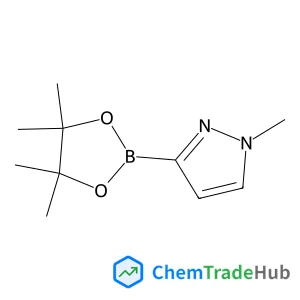
1-Methyl-3-(4,4,5,5-tetramethyl-1,3,2-dioxaborolan-2-yl)-1H-pyrazole
CAS Number:
1020174-04-2
Molecular Formula:
C10H17BN2O2
Shin-nosuke Nishimura, Nobuyuki Higashi, Tomoyuki Koga
Significant efforts have been dedicated toward designing conjugated sequence-controlled peptides and synthetic vinyl polymers as a new class of polymeric materials with ordered structures and specific biofunctions. The creation of novel synthetic strategies that enables the precise incorporation of multiple tailored peptides along a vinyl polymer backbone remains highly challenging. Herein, we report a useful method for preparing multiblock architectures composed of alternately aligned sequential peptides and various vinyl polymers through nitroxide-mediated polymerization (NMP). A new cyclic oligopeptide was developed containing a 2,2,5-trimethyl-4-phenyl-3-azahexane-3-nitroxide (TIPNO)-derived alkoxyamine bond in the framework. Controlled radical polymerization in a homogeneous liquid phase using this peptide initiator successfully provided a well-defined multiblock hybrid polymer in one step, in which chain extension and multimerization proceeded simultaneously. This method was applied to the polymerizations of a wide range of vinyl monomers, including styrene, acrylamides, acrylates and acrylonitrile. Expanding the compatibility of monomers with this approach is valuable for constructing complex multiblock architectures with structural and functional diversity.
Bingfeng Shi, Jianhua Lü, Ying Liu, Yang Xiao, Changli Lü
DOI: 10.1039/D1PY00308A
Alexis Theodorou, Petros Mandriotis, Athina Anastasaki, Kelly Velonia
DOI: 10.1039/D0PY01608J
Marc Schmutz
DOI: 10.1039/D1PY00139F
Jiaxin Shi, Tianze Zheng, Yao Zhang, Baohua Guo, Jun Xu
DOI: 10.1039/D1PY00157D
Anaïs Pitto-Barry
DOI: 10.1039/D0PY01392G
Takahiro Kawatsu, Keita Fuchise, Katsuhiko Takeuchi, Jun-Chul Choi, Kazuhiko Sato, Kazuhiro Matsumoto
DOI: 10.1039/D0PY01503B
Jacob J. Lessard, Georg M. Scheutz, Angie B. Korpusik, Rebecca A. Olson, C. Adrian Figg, Brent S. Sumerlin
DOI: 10.1039/D1PY00208B
When handling 4-(2-Furylmethyl)thiomorpholine 1,1-dioxide (CAS: 79206-94-3), it ...
When handling 4-Chloro-N-[2-(4-morpholinyl)ethyl]benzamide (CAS: 71320-77-9), it...
Waste containing this compound (CAS: 62921-74-8) should be handled according to ...
Waste containing (S)-Methyl 2-amino-3-cyclohexylpropanoate should be collected i...
This compound can be synthesized using a multi-step process involving the conjug...
There are several alternatives to (2E)-3-(3,4-Dichlorophenyl)acrylic acid in syn...
Ethyl 6-(2-nitrophenyl)imidazo[2,1-b][1,3]thiazole-3-carboxylate (CAS: 925437-84...
Waste containing 2-(1,3-Thiazol-2-yl)ethanamine (CAS: 18453-07-1) should be coll...
Methyl 5-iodo-2-methylbenzoate can be synthesized through the iodination of meth...
5-Chloro[1,2,4]triazolo[1,5-a]pyridine is commonly synthesized via the condensat...

Polymer Chemistry welcomes submissions in all areas of polymer science that have a strong focus on macromolecular chemistry. Manuscripts may cover a broad range of fields, yet no direct application focus is required.
![[4-Amino-2-(methylsulfanyl)-5-pyrimidinyl]methanol structure](https://static.chemtradehub.com/structs/588/588-36-3-fc73.webp "[4-Amino-2-(methylsulfanyl)-5-pyrimidinyl]methanol structure")