












Well-defined hydrogen and organofunctional polysiloxanes with spiro-fused siloxane backbones
Literature Information
Publication Date
2021-03-18
DOI
10.1039/D0PY01503B
Impact Factor
5.582
Authors
Takahiro Kawatsu, Keita Fuchise, Katsuhiko Takeuchi, Jun-Chul Choi, Kazuhiko Sato, Kazuhiro Matsumoto
View Original
Abstract
Organofunctional polysiloxanes with functionalized substituents on their silicon atoms form a class of silicone material with widespread applications. A well-established synthetic route to an organofunctional polysiloxane involves the post-functional hydrosilylation of a functionalized olefin with a ready-made polysiloxane bearing a Si–H group. In this paper, structurally well-defined macrocyclic polysiloxanes with unique spirosiloxane units and regularly arranged Si–H groups along the main chain are selectively synthesized by the B(C6F5)3-catalyzed dehydrocarbonative cross-couplings of spirosiloxane monomers bearing two isopropoxysilane moieties with trihydrosilanes (the Piers–Rubinsztajn reaction). Macrocyclic polysiloxanes bearing Si–H groups prepared in this manner are successfully transformed into novel organofunctional polysiloxanes without degrading their well-defined macrocyclic and spiro structures by the Pt-catalyzed hydrosilylations of functionalized olefins.
Related Literature
SAXS data modelling for the characterisation of ion tracks in polymers
Shankar Dutt, Christian Notthoff, Alexander Kiy, Pablo Mota-Santiago, Stephen T. Mudie, Maria E. Toimil-Molares, Yugang Wang, Patrick Kluth
2022-03-23
Paper
DOI: 10.1039/D1CP05813D
Potential energy surfaces of a stacked dimer of benzene and its radical cation: what remains and what appears
Irina V. Beregovaya, Lyudmila N. Shchegoleva
2022-06-29
Paper
DOI: 10.1039/D2CP01691E
A SERS platform based on diatomite modified by gold nanoparticles using a combination of layer-by-layer assembly and a freezing-induced loading method
Julijana Cvjetinovic, Anastasiia A. Merdalimova, Maria A. Kirsanova, Pavel A. Somov, Daniil V. Nozdriukhin, Alexey I. Salimon, Alexander M. Korsunsky, Dmitry A. Gorin
2022-03-23
Paper
DOI: 10.1039/D2CP00647B
Zooming in on the initial steps of catalytic NO reduction using metal clusters
Joost M. Bakker, Fumitaka Mafuné
2022-03-04
Perspective
DOI: 10.1039/D1CP05760J
Improving the performance of silicon monoxide anodes via tuning a multiple pre-doping system: a first-principles study
Wei Xie, Chunlei Pang, Peng He, Chengmao Xiao, Michihisa Koyama, Jiantao Wang, Xiaopeng Qi, Jianguo Ren, Xueqin He
2022-02-25
Paper
DOI: 10.1039/D2CP00498D
Temperature-dependent Li vacancy diffusion in Li4Ti5O12 by means of first principles molecular dynamic simulations
Janine Lorenz, Timo Jacob
2022-02-18
Paper
DOI: 10.1039/D1CP05126A
Molecular insights into the allosteric coupling mechanism between an agonist and two different transducers for μ-opioid receptors
Fuhui Zhang, Yuan Yuan, Yichi Chen, Jianfang Chen, Yanzhi Guo, Xuemei Pu
2022-01-31
Paper
DOI: 10.1039/D1CP05736G
Cohesive properties of PbBi/Fe3O4 and PbBi/(Fe,Cr)3O4 interfaces
L. Sun, P. Deng, J. Zhao, H. R. Gong, C. P. Liang
2022-02-16
Paper
DOI: 10.1039/D1CP05953J
The mechanism and impact of mono/bis(iodoimidazolium) halogen bond donor catalysts on Michael addition of indole with trans-crotonophenone: DFT calculations
Yuanyuan Sun, Ying Li, Xiaoyan Li, Yanli Zeng
2022-02-18
Paper
DOI: 10.1039/D2CP00075J
Inverse vulcanization of trimethoxyvinylsilane particles
Alexander P. Grimm, Johannes M. Scheiger, Peter W. Roesky
2022-09-28
Paper
DOI: 10.1039/D2PY00773H
You might also like
Compound Q&A
What precautions should be taken when handling lithium chloride hydrate (1:1:1) (CAS: 16712-20-2)?
When handling lithium chloride hydrate (1:1:1) (CAS: 16712-20-2), it is importan...
16712-20-2Lithium chloride hyd...
Compound Q&A
Is 4-(4H-1,2,4-Triazol-4-yl)piperidine (CAS: 690261-92-8) safe?
4-(4H-1,2,4-Triazol-4-yl)piperidine is generally considered safe for use in phar...
690261-92-84-(4H-1,2,4-Triazol-...
Compound Q&A
How should waste containing 1,3-Thiazole-2-carboxamide (CAS: 16733-85-0) be handled?
Waste containing 1,3-Thiazole-2-carboxamide (CAS: 16733-85-0) should be collecte...
16733-85-01,3-Thiazole-2-carbo...
Compound Q&A
What regulatory guidelines apply to 5-(Difluoromethyl)-2-fluorobenzonitrile (CAS: 934175-58-3)?
5-(Difluoromethyl)-2-fluorobenzonitrile (CAS: 934175-58-3) is subject to regulat...
934175-58-35-(Difluoromethyl)-2...
Compound Q&A
How is Methyl 3-acetamido-2-thiophenecarboxylate (CAS: 22288-79-5) typically synthesized?
Methyl 3-acetamido-2-thiophenecarboxylate can be synthesized by the reaction of ...
22288-79-5Methyl 3-acetamido-2...
Compound Q&A
What is 4-Isoquinolinecarbonitrile (CAS: 34846-65-6)?
4-Isoquinolinecarbonitrile is a chemical compound with the CAS number 34846-65-6...
34846-65-64-Isoquinolinecarbon...
Compound Q&A
How should Methyl 1H-1,2,3-triazole-4-carboxylate (CAS: 877309-59-6) be stored?
Store Methyl 1H-1,2,3-triazole-4-carboxylate (CAS: 877309-59-6) in a cool, dry p...
877309-59-6Methyl 1H-1,2,3-tria...
Compound Q&A
What regulatory guidelines apply to 6-Bromo[1,3]thiazolo[5,4-b]pyridin-2-amine (CAS: 1160791-13-8)?
6-Bromo[1,3]thiazolo[5,4-b]pyridin-2-amine (CAS: 1160791-13-8) is subject to the...
1160791-13-86-Bromo[1,3]thiazolo...
Compound Q&A
Is (2S,3S)-2-Ammonio-3-(3,4-dihydroxyphenyl)-3-hydroxypropanoate (CAS: 23651-95-8) safe?
(2S,3S)-2-Ammonio-3-(3,4-dihydroxyphenyl)-3-hydroxypropanoate (CAS: 23651-95-8) ...
23651-95-8(2S,3S)-2-Ammonio-3-...
Compound Q&A
What are the physical and chemical properties of 7-bromo-3-methyl-3,4-dihydroquinazolin-4-one (CAS: 1293987-84-4)?
7-Bromo-3-methyl-3,4-dihydroquinazolin-4-one is a solid with a crystalline form....
1293987-84-47-bromo-3-methyl-3,4...
Source Journal
Polymer Chemistry

CiteScore:
8.6
Self-citation Rate:
7.3%
Articles per Year:
457
Polymer Chemistry welcomes submissions in all areas of polymer science that have a strong focus on macromolecular chemistry. Manuscripts may cover a broad range of fields, yet no direct application focus is required.
Recommended Compounds
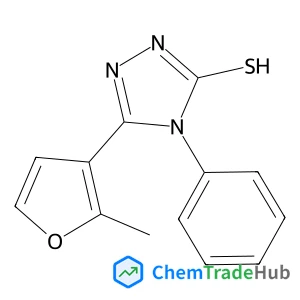
5-(2-Methyl-3-furyl)-4-phenyl-2,4-dihydro-3H-1,2,4-triazole-3-thione
CAS Number:
346464-59-3
Molecular Formula:
C13H11N3OS
![6,6-Dimethylbicyclo[3.1.1]hept-2-ene-2-carbaldehyde structure](https://static.chemtradehub.com/structs/564/564-94-3-e746.webp "6,6-Dimethylbicyclo[3.1.1]hept-2-ene-2-carbaldehyde structure")

4-(Bromomethyl)-1-cyclohexyl-2-(trifluoromethyl)benzene
CAS Number:
800381-60-6
Molecular Formula:
C14H16BrF3
Recommended Suppliers






Disclaimer
This page provides academic journal information for reference and research purposes only. We are not affiliated with any journal publishers and do not handle publication submissions. For publication-related inquiries, please contact the respective journal publishers directly.
If you notice any inaccuracies in the information displayed, please contact us at support@chemtradehub.com. We will promptly review and address your concerns.