












A versatile synthetic platform for amphiphilic nanogels with tunable hydrophobicity
Literature Information
Publication Date
2018-10-25
DOI
10.1039/C8PY01123K
Impact Factor
5.582
Authors
Alexandra Gruber, Doğuş Işık, Bianca Bueno Fontanezi, Christoph Böttcher, Monika Schäfer-Korting, Daniel Klinger
View Original
Abstract
We present a new versatile synthetic strategy for amphiphilic nanogels with tunable amphiphilicity. Our approach is based on crosslinked reactive precursor particles, which serve as a platform for secondary functionalization with hydrophilic and hydrophobic moieties: the functionalization of reactive poly(pentafluorophenyl methacrylate) (PPFPMA) nanogels with different amines allows precise adjustment of the internal network composition. Since nanogels with varying amphiphilicity originate from the same uniform precursor particles, they exhibit similar particle sizes, size distributions and homogeneous morphologies. This comparability between nanogels allows accurate investigation of their structure–property relationships. For example, by tuning the amphiphilic network composition, the loading and release profiles for Nile red as a hydrophobic model compound can be controlled through adjusting the hydrophobic interactions with the network. Consequently, our strategy represents a powerful platform for the generation of a new type of amphiphilic nanocarrier that combines the exceptional biocompatibility of hydrophilic nanogels with the transport of hydrophobic cargoes.
Related Literature
Adsorption of diferrocenylacetylene on Au(111) studied by scanning tunneling microscopy
Rebecca C. Quardokus, Natalie A. Wasio, Ryan P. Forrest, Craig S. Lent, Steven A. Corcelli, John A. Christie, Kenneth W. Henderson, S. Alex Kandel
2013-03-19
Paper
DOI: 10.1039/C3CP50225B
Rotational spectroscopy meets theory
Cristina Puzzarini
2013-02-19
Perspective
DOI: 10.1039/C3CP44301A
Long-range Li+ dynamics in the lithium argyrodite Li7PSe6 as probed by rotating-frame spin–lattice relaxation NMR
V. Epp, Ö. Gün, H.-J. Deiseroth, M. Wilkening
2013-03-18
Paper
DOI: 10.1039/C3CP44379E
The reaction force constant as an indicator of synchronicity/nonsynchronicity in [4+2] cycloaddition processes
Diana Yepes, Oscar Donoso-Tauda, Patricia Pérez, Pablo Jaque
2013-01-18
Paper
DOI: 10.1039/C3CP44197K
Visible light initiated and collapsed resistive switching in TbMnO3/Nb:SrTiO3 heterojunctions
Yimin Cui, Wei Liu, Rongming Wang
2013-03-14
Paper
DOI: 10.1039/C3CP00132F
Switching kinetics of electrochemical metallization memory cells
Stephan Menzel, Stefan Tappertzhofen, Ilia Valov
2013-03-14
Paper
DOI: 10.1039/C3CP50738F
Origin of electrolyte-dopant dependent sulfur poisoning of SOFC anodes
ZhenHua Zeng, Mårten E. Björketun, Sune Ebbesen, Mogens B. Mogensen, Jan Rossmeisl
2013-03-14
Communication
DOI: 10.1039/C3CP51099A
The effect of size on the optical properties of guanine nanostructures: a femtosecond to nanosecond study
Ying Hua, Pascale Changenet-Barret, Thomas Gustavsson, Dimitra Markovitsi
2013-03-26
Paper
DOI: 10.1039/C3CP00060E
Role of the organic linker in the early stages of the templated synthesis of PMOs
Ryusuke Futamura, Miguel Jorge, José R. B. Gomes
2013-03-06
Communication
DOI: 10.1039/C3CP50193K
Effects of intramolecular hydrogen bonding on the excited state dynamics of phenol chromophores
Yi Lin Yang, Yu-Chieh Ho, Yuri A. Dyakov, Wen-Hsin Hsu, Yi-Lun Sun, Wan-Chen Tsai, Wei-Ping Hu
2013-03-15
Paper
DOI: 10.1039/C3CP44674C
You might also like
Compound Q&A
What precautions should be taken when handling 4-(2-Furylmethyl)thiomorpholine 1,1-dioxide (CAS: 79206-94-3)?
When handling 4-(2-Furylmethyl)thiomorpholine 1,1-dioxide (CAS: 79206-94-3), it ...
79206-94-34-(2-Furylmethyl)thi...
Compound Q&A
What precautions should be taken when handling 4-Chloro-N-[2-(4-morpholinyl)ethyl]benzamide (CAS: 71320-77-9)?
When handling 4-Chloro-N-[2-(4-morpholinyl)ethyl]benzamide (CAS: 71320-77-9), it...
71320-77-94-Chloro-N-[2-(4-mor...
Compound Q&A
How should waste containing 2-[2-(2-Methoxyethoxy)ethoxy]ethyl 4-methylbenzenesulfonate (CAS: 62921-74-8) be handled?
Waste containing this compound (CAS: 62921-74-8) should be handled according to ...
62921-74-82-[2-(2-Methoxyethox...
Compound Q&A
How should waste containing (S)-Methyl 2-amino-3-cyclohexylpropanoate be handled?
Waste containing (S)-Methyl 2-amino-3-cyclohexylpropanoate should be collected i...
40056-18-6(S)-Methyl 2-amino-3...
Compound Q&A
How is 5-({4-[(2S,4R)-4-Hydroxy-2-methyltetrahydro-2H-pyran-4-yl]-2-thienyl}sulfanyl)-1-methyl-1,3-dihydro-2H-indol-2-one (CAS: 166882-70-8) typically synthesized?
This compound can be synthesized using a multi-step process involving the conjug...
166882-70-85-({4-[(2S,4R)-4-Hyd...
Compound Q&A
Are there alternatives to (2E)-3-(3,4-Dichlorophenyl)acrylic acid (CAS: 7312-27-8) in synthesis?
There are several alternatives to (2E)-3-(3,4-Dichlorophenyl)acrylic acid in syn...
7312-27-8(2E)-3-(3,4-Dichloro...
Compound Q&A
How should Ethyl 6-(2-nitrophenyl)imidazo[2,1-b][1,3]thiazole-3-carboxylate (CAS: 925437-84-9) be stored?
Ethyl 6-(2-nitrophenyl)imidazo[2,1-b][1,3]thiazole-3-carboxylate (CAS: 925437-84...
925437-84-9Ethyl 6-(2-nitrophen...
Compound Q&A
How should waste containing 2-(1,3-Thiazol-2-yl)ethanamine (CAS: 18453-07-1) be handled?
Waste containing 2-(1,3-Thiazol-2-yl)ethanamine (CAS: 18453-07-1) should be coll...
18453-07-12-(1,3-Thiazol-2-yl)...
Compound Q&A
How is Methyl 5-iodo-2-methylbenzoate (CAS: 103440-54-6) typically synthesized?
Methyl 5-iodo-2-methylbenzoate can be synthesized through the iodination of meth...
103440-54-6Methyl 5-iodo-2-meth...
Compound Q&A
How is 5-Chloro[1,2,4]triazolo[1,5-a]pyridine (CAS: 1427399-34-5) typically synthesized?
5-Chloro[1,2,4]triazolo[1,5-a]pyridine is commonly synthesized via the condensat...
1427399-34-55-Chloro[1,2,4]triaz...
Source Journal
Polymer Chemistry

CiteScore:
8.6
Self-citation Rate:
7.3%
Articles per Year:
457
Polymer Chemistry welcomes submissions in all areas of polymer science that have a strong focus on macromolecular chemistry. Manuscripts may cover a broad range of fields, yet no direct application focus is required.
Recommended Compounds

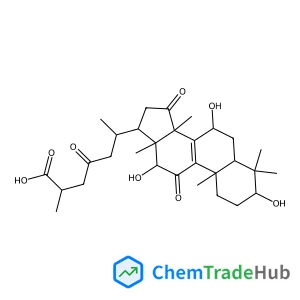
(3beta,7beta,12beta)-3,7,12-Trihydroxy-11,15,23-trioxolanost-8-en-26-oic acid
CAS Number:
98665-22-6
Molecular Formula:
C30H44O8
Recommended Suppliers






Disclaimer
This page provides academic journal information for reference and research purposes only. We are not affiliated with any journal publishers and do not handle publication submissions. For publication-related inquiries, please contact the respective journal publishers directly.
If you notice any inaccuracies in the information displayed, please contact us at support@chemtradehub.com. We will promptly review and address your concerns.