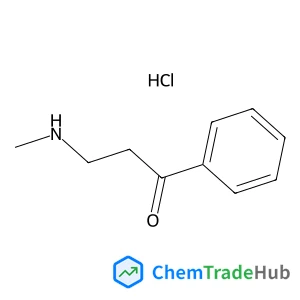
3-(Methylamino)-1-phenyl-1-propanone hydrochloride (1:1)
CAS Number:
2538-50-3
Molecular Formula:
C10H14ClNO
Min Zeng, Decheng Wu, Yen Wei, Jinying Yuan
The influence of polymer topology on the nanostructure of amphiphilic copolymer assemblies has been less studied. In this contribution, we regulated the topology of the solvophobic block of poly(N,N-dimethylamino ethyl methacrylate)-b-poly(benzyl methacrylate-co-2-perfluorooctyl ethyl methacrylate) [PDMA-b-P(BzMA-co-FMA)] by reversible addition–fragmentation chain transfer (RAFT) dispersion copolymerization of BzMA and FMA at varying feed ratios. The influence of the variation in the polymer topology on the nanostructure of the corresponding assemblies was evaluated. With the increment of the FMA wt% within the solvophobic block, the size of the PDMA-b-P(BzMA-co-FMA) vesicles increases accordingly. Besides, for PDMA-b-P(BzMA-co-FMA) copolymers whose molecular weights of the solvophobic block range from 88 to 141k, by adjusting the feed ratio of BzMA/FMA, a rich variety of nanostructures were fabricated, including large compound micelles, large compound vesicles, hexagonally packed hollow hoops and nanoporous spheres. Our results indicate that topological engineering of the amphiphilic copolymers via RAFT dispersion copolymerization could be an efficient approach for regulating the nanostructure of polymer assemblies.

Pure and Applied Chemistry

Science

Journal of Catalysis

Journal of Organometallic Chemistry

European Journal of Wood and Wood Products

Journal of Medicinal Chemistry

Proceedings of the National Academy of Sciences of the United States of America

Fibre Chemistry

Journal of Heterocyclic Chemistry

Helvetica Chimica Acta
Giuliano Alagona, Caterina Ghio, Susanna Monti
DOI: 10.1039/B004476H
Thomas Gutsmann, Andra B. Schromm, Michel H. J. Koch, S. Kusumoto, K. Fukase, M. Oikawa, Ulrich Seydel, Klaus Brandenburg
DOI: 10.1039/B004188M
Camilla Haavik, Svein Stølen, Michael Hanfland, C. Richard A. Catlow
DOI: 10.1039/B006026G
Marina Fix, Manfred Sieber, Michael Overs, Hans J. Schäfer, Hans-Joachim Galla
DOI: 10.1039/B003996I
DOI: 10.1039/B004928J
Stephan L. Grage, Dorit R. Gauger, Carsten Selle, Walter Pohle, Walter Richter, Anne S. Ulrich
DOI: 10.1039/B003902K
When handling 4-(2-Furylmethyl)thiomorpholine 1,1-dioxide (CAS: 79206-94-3), it ...
When handling 4-Chloro-N-[2-(4-morpholinyl)ethyl]benzamide (CAS: 71320-77-9), it...
Waste containing this compound (CAS: 62921-74-8) should be handled according to ...
Waste containing (S)-Methyl 2-amino-3-cyclohexylpropanoate should be collected i...
This compound can be synthesized using a multi-step process involving the conjug...
There are several alternatives to (2E)-3-(3,4-Dichlorophenyl)acrylic acid in syn...
Ethyl 6-(2-nitrophenyl)imidazo[2,1-b][1,3]thiazole-3-carboxylate (CAS: 925437-84...
Waste containing 2-(1,3-Thiazol-2-yl)ethanamine (CAS: 18453-07-1) should be coll...
Methyl 5-iodo-2-methylbenzoate can be synthesized through the iodination of meth...
5-Chloro[1,2,4]triazolo[1,5-a]pyridine is commonly synthesized via the condensat...

Polymer Chemistry welcomes submissions in all areas of polymer science that have a strong focus on macromolecular chemistry. Manuscripts may cover a broad range of fields, yet no direct application focus is required.
![1,2-Diphenyl-4-[2-(phenylsulfinyl)ethyl]-3,5-pyrazolidinedione structure](https://static.chemtradehub.com/structs/57-/57-96-5-efcc.webp "1,2-Diphenyl-4-[2-(phenylsulfinyl)ethyl]-3,5-pyrazolidinedione structure")
![1-Naphthalenesulfonic acid, 2-[(2-hydroxy-1-naphthalenyl)azo]-, bariumsalt (2:1) structure](https://static.chemtradehub.com/structs/110/1103-38-4-0b33.webp "1-Naphthalenesulfonic acid, 2-[(2-hydroxy-1-naphthalenyl)azo]-, bariumsalt (2:1) structure")