












![[4-Amino-2-(methylsulfanyl)-5-pyrimidinyl]methanol structure](https://static.chemtradehub.com/structs/588/588-36-3-fc73.webp "[4-Amino-2-(methylsulfanyl)-5-pyrimidinyl]methanol structure")
The amphiphilic drug flufenamic acid can induce a hexagonal phase in DMPC: a solid state 31P- and 19F-NMR study
Literature Information
Publication Date
2000-08-23
DOI
10.1039/B003902K
Impact Factor
3.676
Authors
Stephan L. Grage, Dorit R. Gauger, Carsten Selle, Walter Pohle, Walter Richter, Anne S. Ulrich
View Original
Abstract
Established solid state 31P-NMR and novel 19F-NMR experiments are used in a complementary approach to describe the behaviour of a fluorinated drug, flufenamic acid (FFA), in phospholipid model membranes. The non-steroidal anti-inflammatory agent FFA was dissolved at 5% (w/w) in dimyristoylphosphatidylcholine (DMPC), and the system was investigated at low hydration (3 H2O per lipid) where morphological transitions of the lipid are strongly affected by additives. It is demonstrated that FFA induces a fluid HII phase in DMPC at ambient temperatures, i.e. much below its regular chain-melting transition which occurs around 50°C at low hydration. The guest molecules are preferentially accommodated in the hexagonal phase of the lipid, which coexists with the usual crystalline state of pure DMPC. The peculiar transition sequence LC→HII→Lα with increasing temperature is explained by a re-distribution of FFA in the lipid matrix and a concomitant phase separation under conditions of limiting hydration. Small-angle X-ray diffraction and freeze–fracture electron microscopy are used to confirm the existence of the hexagonal and bilayer phases, and to determine their respective dimensions. When the drug FFA dissolves in the bilayer, its structural effect on the surrounding lipid molecules may be related to its pharmacological activity in membranes. For example, FFA is known to modulate ion channel function, and it has been suggested that it inhibits phospholipase activity by accelerating the transbilayer flip-flop of lipids.
Recommended Journals
Related Literature
Preparation of novel polythioether dendrons on a solid support
Adi Dahan, Avi Weissberg, Moshe Portnoy
2003-04-22
Communication
DOI: 10.1039/B302324A
Understanding the building-up process of three dimensional open-framework metal phosphates: Acid degradation of the 3D structures to lower dimensional structures
Amitava Choudhury
2003-01-06
Communication
DOI: 10.1039/B210037C
A new dark quencher for use in genetic analysis
Jonathan P. May, Lynda J. Brown, Ivo Rudloff, Tom Brown
2003-03-18
Communication
DOI: 10.1039/B300934C
Structural and magnetic properties of a self-assembled spheroidal triakonta-hexanuclear Cu36 cluster
Tareque S. M. Abedin, Laurence K. Thompson, David O. Miller, Erik Krupicka
2003-02-14
Communication
DOI: 10.1039/B211401C
A simple and efficient method for synthesis of 5-substituted 2′-deoxyuridine nucleosides using metal–halogen exchange reaction of 5-iodo-2′-deoxyuridine sodium salt
Mariko Aso, Toshiyuki Kaneko, Morihide Nakamura, Noboru Koga, Hiroshi Suemune
2003-04-02
Communication
DOI: 10.1039/B301425H
Optical and electrical properties of the wide gap, n-type semiconductors: ZnBi2O6 and MgBi2O6
Hiroshi Mizoguchi, Nattamai S. P. Bhuvanesh, Patrick M. Woodward
2003-04-07
Communication
DOI: 10.1039/B300635B
Structure and magnetism of the first strictly dinuclear compound containing paramagnetic 3d and 5f metal ions. Major influence of the CuII ion coordination on the exchange CuII–UIV interaction
Lionel Salmon, Pierre Thuéry, Eric Rivière, Jean-Jacques Girerd, Michel Ephritikhine
2003-02-25
Communication
DOI: 10.1039/B212635D
The diatropic σ ring currents of [π2s + π2s + π2s] pericyclic transition states
Leonardus W. Jenneskens, Patrick W. Fowler, Erich Steiner
2003-02-20
Communication
DOI: 10.1039/B212251K
Synthesis and crystallographic structure of a novel photoresponsive azobenzene-containing organosilane
Nanguo Liu, Darren R. Dunphy, Mark A. Rodriguez, Sarany Singer
2003-04-10
Communication
DOI: 10.1039/B301569F
Non-covalent switch for intramolecular energy transfer
Joe Otsuki, Akane Yasuda, Toshio Takido
2003-02-05
Communication
DOI: 10.1039/B212912D
You might also like
Compound Q&A
What precautions should be taken when handling 4-(2-Furylmethyl)thiomorpholine 1,1-dioxide (CAS: 79206-94-3)?
When handling 4-(2-Furylmethyl)thiomorpholine 1,1-dioxide (CAS: 79206-94-3), it ...
79206-94-34-(2-Furylmethyl)thi...
Compound Q&A
What precautions should be taken when handling 4-Chloro-N-[2-(4-morpholinyl)ethyl]benzamide (CAS: 71320-77-9)?
When handling 4-Chloro-N-[2-(4-morpholinyl)ethyl]benzamide (CAS: 71320-77-9), it...
71320-77-94-Chloro-N-[2-(4-mor...
Compound Q&A
How should waste containing 2-[2-(2-Methoxyethoxy)ethoxy]ethyl 4-methylbenzenesulfonate (CAS: 62921-74-8) be handled?
Waste containing this compound (CAS: 62921-74-8) should be handled according to ...
62921-74-82-[2-(2-Methoxyethox...
Compound Q&A
How should waste containing (S)-Methyl 2-amino-3-cyclohexylpropanoate be handled?
Waste containing (S)-Methyl 2-amino-3-cyclohexylpropanoate should be collected i...
40056-18-6(S)-Methyl 2-amino-3...
Compound Q&A
How is 5-({4-[(2S,4R)-4-Hydroxy-2-methyltetrahydro-2H-pyran-4-yl]-2-thienyl}sulfanyl)-1-methyl-1,3-dihydro-2H-indol-2-one (CAS: 166882-70-8) typically synthesized?
This compound can be synthesized using a multi-step process involving the conjug...
166882-70-85-({4-[(2S,4R)-4-Hyd...
Compound Q&A
Are there alternatives to (2E)-3-(3,4-Dichlorophenyl)acrylic acid (CAS: 7312-27-8) in synthesis?
There are several alternatives to (2E)-3-(3,4-Dichlorophenyl)acrylic acid in syn...
7312-27-8(2E)-3-(3,4-Dichloro...
Compound Q&A
How should Ethyl 6-(2-nitrophenyl)imidazo[2,1-b][1,3]thiazole-3-carboxylate (CAS: 925437-84-9) be stored?
Ethyl 6-(2-nitrophenyl)imidazo[2,1-b][1,3]thiazole-3-carboxylate (CAS: 925437-84...
925437-84-9Ethyl 6-(2-nitrophen...
Compound Q&A
How should waste containing 2-(1,3-Thiazol-2-yl)ethanamine (CAS: 18453-07-1) be handled?
Waste containing 2-(1,3-Thiazol-2-yl)ethanamine (CAS: 18453-07-1) should be coll...
18453-07-12-(1,3-Thiazol-2-yl)...
Compound Q&A
How is Methyl 5-iodo-2-methylbenzoate (CAS: 103440-54-6) typically synthesized?
Methyl 5-iodo-2-methylbenzoate can be synthesized through the iodination of meth...
103440-54-6Methyl 5-iodo-2-meth...
Compound Q&A
How is 5-Chloro[1,2,4]triazolo[1,5-a]pyridine (CAS: 1427399-34-5) typically synthesized?
5-Chloro[1,2,4]triazolo[1,5-a]pyridine is commonly synthesized via the condensat...
1427399-34-55-Chloro[1,2,4]triaz...
Source Journal
Physical Chemistry Chemical Physics

CiteScore:
5.5
Self-citation Rate:
10.3%
Articles per Year:
3036
Physical Chemistry Chemical Physics (PCCP) is an international journal co-owned by 19 physical chemistry and physics societies from around the world. This journal publishes original, cutting-edge research in physical chemistry, chemical physics and biophysical chemistry. To be suitable for publication in PCCP, articles must include significant innovation and/or insight into physical chemistry; this is the most important criterion that reviewers and Editors will judge against when evaluating submissions. The journal has a broad scope and welcomes contributions spanning experiment, theory, computation and data science. Topical coverage includes spectroscopy, dynamics, kinetics, statistical mechanics, thermodynamics, electrochemistry, catalysis, surface science, quantum mechanics, quantum computing and machine learning. Interdisciplinary research areas such as polymers and soft matter, materials, nanoscience, energy, surfaces/interfaces, and biophysical chemistry are welcomed if they demonstrate significant innovation and/or insight into physical chemistry. Joined experimental/theoretical studies are particularly appreciated when complementary and based on up-to-date approaches.
Recommended Compounds
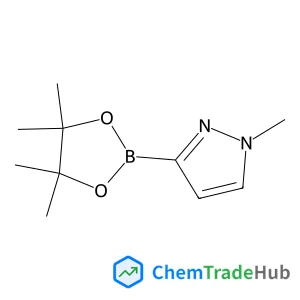
1-Methyl-3-(4,4,5,5-tetramethyl-1,3,2-dioxaborolan-2-yl)-1H-pyrazole
CAS Number:
1020174-04-2
Molecular Formula:
C10H17BN2O2
Recommended Suppliers




Disclaimer
This page provides academic journal information for reference and research purposes only. We are not affiliated with any journal publishers and do not handle publication submissions. For publication-related inquiries, please contact the respective journal publishers directly.
If you notice any inaccuracies in the information displayed, please contact us at support@chemtradehub.com. We will promptly review and address your concerns.