












![[4-(Heptyloxy)phenyl]boronic acid structure](https://static.chemtradehub.com/structs/136/136370-19-9-ad33.webp "[4-(Heptyloxy)phenyl]boronic acid structure")
Lipopolysaccharide-binding protein-mediated interaction of lipid A from different origin with phospholipid membranes Invited Lecture
Literature Information
Publication Date
2000-09-25
DOI
10.1039/B004188M
Impact Factor
3.676
Authors
Thomas Gutsmann, Andra B. Schromm, Michel H. J. Koch, S. Kusumoto, K. Fukase, M. Oikawa, Ulrich Seydel, Klaus Brandenburg
View Original
Abstract
Investigations are reported into the interaction of lipid A, the ‘endotoxic principle’ of bacterial lipopolysaccharide (LPS), with phospholipid membranes in the absence and presence of an acute-phase lipid transport protein, lipopolysaccharide-binding protein (LBP) applying Fourier-transform infrared (FTIR) and fluorescence resonance energy transfer (FRET) spectroscopy. In the absence of LBP, intermixing of phospholipids with lipid A takes place on the time-scale of hours, while in the presence of LBP this process takes place in the order of minutes. A comparison of chemically different lipid A shows that a prerequisite for the intercalation of lipid A into the phospholipid membrane is a sufficiently high negative charge density of lipid A. Variations in the lipid A acyl chain fluidity may modulate the intercalation, whereas the type of lipid A aggregate structure has no influence on the intercalation.The intercalation is a necessary, but not sufficient prerequisite for cell activation. Only lipid A with a conical molecular shape and a tilt angle of more than 40° of the backbone with respect to the direction of the acyl chains induces cytokine induction in human mononuclear cells, while lipid A with a cylindrical shape and a small tilt angle does not exhibit this biological activity but may act antagonistically. This antagonistic effect may be explained by blocking of the binding-sites of the putative signal-transducing protein, possibly an ion channel, by the antagonist.
Related Literature
Zn-Proline catalyzed direct aldol reaction in aqueous media
Tamis Darbre, Miguel Machuqueiro
2003-03-31
Communication
DOI: 10.1039/B301117H
Control of Al distribution in ZSM-5 by conditions of zeolite synthesis
2003-04-23
Communication
DOI: 10.1039/B301634J
The diatropic σ ring currents of [π2s + π2s + π2s] pericyclic transition states
Leonardus W. Jenneskens, Patrick W. Fowler, Erich Steiner
2003-02-20
Communication
DOI: 10.1039/B212251K
Transfer hydrogenation using recyclable polyurea-encapsulated palladium: efficient and chemoselective reduction of aryl ketones
Jin-Quan Yu, Hai-Chen Wu, Chandrashekar Ramarao, Jonathan B. Spencer, Steven V. Ley
2003-02-12
Communication
DOI: 10.1039/B300074P
A new strategy towards ultra stable mesoporous titania with nanosized anatase walls
K. Cassiers, T. Linssen, V. Meynen, P. Van Der Voort, P. Cool, E. F. Vansant
2003-04-16
Communication
DOI: 10.1039/B302116E
Photomediated asymmetric synthesis of (−)-cuparene
Richard S. Grainger, Aslam Patel
2003-03-31
Communication
DOI: 10.1039/B300815K
Towards “designer” surfaces: functionalisation of self-assembled monolayer (SAM) on colloidal gold by alkene metathesis‡
Debasis Samanta, Nicolas Faure, Francis Rondelez, Amitabha Sarkar
2003-04-16
Communication
DOI: 10.1039/B300833A
The first NH aldimineorganometallic compound. Isolation and crystal structure
Joan Albert, J. Magali Cadena, Asensio González, Jaume Granell, Xavier Solans, Mercè Font-Bardia
2003-01-20
Communication
DOI: 10.1039/B211808D
A new dark quencher for use in genetic analysis
Jonathan P. May, Lynda J. Brown, Ivo Rudloff, Tom Brown
2003-03-18
Communication
DOI: 10.1039/B300934C
Preparation of novel polythioether dendrons on a solid support
Adi Dahan, Avi Weissberg, Moshe Portnoy
2003-04-22
Communication
DOI: 10.1039/B302324A
You might also like
Compound Q&A
What precautions should be taken when handling 4-(2-Furylmethyl)thiomorpholine 1,1-dioxide (CAS: 79206-94-3)?
When handling 4-(2-Furylmethyl)thiomorpholine 1,1-dioxide (CAS: 79206-94-3), it ...
79206-94-34-(2-Furylmethyl)thi...
Compound Q&A
What precautions should be taken when handling 4-Chloro-N-[2-(4-morpholinyl)ethyl]benzamide (CAS: 71320-77-9)?
When handling 4-Chloro-N-[2-(4-morpholinyl)ethyl]benzamide (CAS: 71320-77-9), it...
71320-77-94-Chloro-N-[2-(4-mor...
Compound Q&A
How should waste containing 2-[2-(2-Methoxyethoxy)ethoxy]ethyl 4-methylbenzenesulfonate (CAS: 62921-74-8) be handled?
Waste containing this compound (CAS: 62921-74-8) should be handled according to ...
62921-74-82-[2-(2-Methoxyethox...
Compound Q&A
How should waste containing (S)-Methyl 2-amino-3-cyclohexylpropanoate be handled?
Waste containing (S)-Methyl 2-amino-3-cyclohexylpropanoate should be collected i...
40056-18-6(S)-Methyl 2-amino-3...
Compound Q&A
How is 5-({4-[(2S,4R)-4-Hydroxy-2-methyltetrahydro-2H-pyran-4-yl]-2-thienyl}sulfanyl)-1-methyl-1,3-dihydro-2H-indol-2-one (CAS: 166882-70-8) typically synthesized?
This compound can be synthesized using a multi-step process involving the conjug...
166882-70-85-({4-[(2S,4R)-4-Hyd...
Compound Q&A
Are there alternatives to (2E)-3-(3,4-Dichlorophenyl)acrylic acid (CAS: 7312-27-8) in synthesis?
There are several alternatives to (2E)-3-(3,4-Dichlorophenyl)acrylic acid in syn...
7312-27-8(2E)-3-(3,4-Dichloro...
Compound Q&A
How should Ethyl 6-(2-nitrophenyl)imidazo[2,1-b][1,3]thiazole-3-carboxylate (CAS: 925437-84-9) be stored?
Ethyl 6-(2-nitrophenyl)imidazo[2,1-b][1,3]thiazole-3-carboxylate (CAS: 925437-84...
925437-84-9Ethyl 6-(2-nitrophen...
Compound Q&A
How should waste containing 2-(1,3-Thiazol-2-yl)ethanamine (CAS: 18453-07-1) be handled?
Waste containing 2-(1,3-Thiazol-2-yl)ethanamine (CAS: 18453-07-1) should be coll...
18453-07-12-(1,3-Thiazol-2-yl)...
Compound Q&A
How is Methyl 5-iodo-2-methylbenzoate (CAS: 103440-54-6) typically synthesized?
Methyl 5-iodo-2-methylbenzoate can be synthesized through the iodination of meth...
103440-54-6Methyl 5-iodo-2-meth...
Compound Q&A
How is 5-Chloro[1,2,4]triazolo[1,5-a]pyridine (CAS: 1427399-34-5) typically synthesized?
5-Chloro[1,2,4]triazolo[1,5-a]pyridine is commonly synthesized via the condensat...
1427399-34-55-Chloro[1,2,4]triaz...
Source Journal
Physical Chemistry Chemical Physics

CiteScore:
5.5
Self-citation Rate:
10.3%
Articles per Year:
3036
Physical Chemistry Chemical Physics (PCCP) is an international journal co-owned by 19 physical chemistry and physics societies from around the world. This journal publishes original, cutting-edge research in physical chemistry, chemical physics and biophysical chemistry. To be suitable for publication in PCCP, articles must include significant innovation and/or insight into physical chemistry; this is the most important criterion that reviewers and Editors will judge against when evaluating submissions. The journal has a broad scope and welcomes contributions spanning experiment, theory, computation and data science. Topical coverage includes spectroscopy, dynamics, kinetics, statistical mechanics, thermodynamics, electrochemistry, catalysis, surface science, quantum mechanics, quantum computing and machine learning. Interdisciplinary research areas such as polymers and soft matter, materials, nanoscience, energy, surfaces/interfaces, and biophysical chemistry are welcomed if they demonstrate significant innovation and/or insight into physical chemistry. Joined experimental/theoretical studies are particularly appreciated when complementary and based on up-to-date approaches.
Recommended Compounds
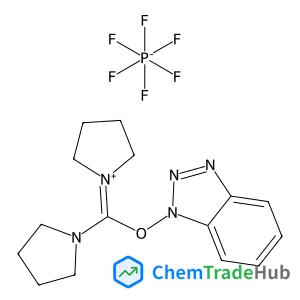
(1H-Benzotriazol-1-yloxy)(di-1-pyrrolidinyl)methylium hexafluorophosphate
CAS Number:
105379-24-6
Molecular Formula:
C15H21F6N5OP

![4-{2-[4-(2-Methyl-2-propanyl)phenyl]ethoxy}quinazoline structure](https://static.chemtradehub.com/structs/120/120928-09-8-d3db.webp "4-{2-[4-(2-Methyl-2-propanyl)phenyl]ethoxy}quinazoline structure")
4-{2-[4-(2-Methyl-2-propanyl)phenyl]ethoxy}quinazoline
CAS Number:
120928-09-8
Molecular Formula:
C20H22N2O
Recommended Suppliers





Disclaimer
This page provides academic journal information for reference and research purposes only. We are not affiliated with any journal publishers and do not handle publication submissions. For publication-related inquiries, please contact the respective journal publishers directly.
If you notice any inaccuracies in the information displayed, please contact us at support@chemtradehub.com. We will promptly review and address your concerns.