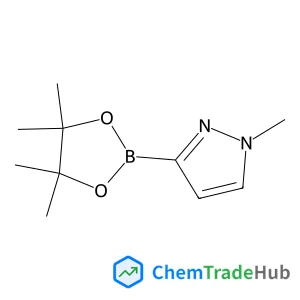
1-Methyl-3-(4,4,5,5-tetramethyl-1,3,2-dioxaborolan-2-yl)-1H-pyrazole
CAS Number:
1020174-04-2
Molecular Formula:
C10H17BN2O2
Dilini N. Kekulandara, Kusal T. G. Samarasinghe, Dhanushka N. P. Munkanatta Godage, Young-Hoon Ahn
Correction for ‘Clickable glutathione using tetrazine-alkene bioorthogonal chemistry for detecting protein glutathionylation’ by Dilini N. Kekulandara et al., Org. Biomol. Chem., 2016, 14, 10886–10893.
X. Q. Yu, J. P. Sun, K. Tang, H. Li, X. J. Huang, L. Dupont, J. Maier
DOI: 10.1039/B908149F
Joseph Zakzeski, Sarah Burton, Andrew Behn, Martin Head-Gordon, Alexis T. Bell
DOI: 10.1039/B906883J
Sunghyun Uhm, Hye Jin Lee
DOI: 10.1039/B909525J
Paramaconi Rodriguez, Marc T. M. Koper
DOI: 10.1039/B926365A
Yang-Xin Yu
DOI: 10.1039/B911901A
José Alejandro Heredia-Guerrero, Miguel Angel San-Miguel, Mark S. P. Sansom, Antonio Heredia, José Jesús Benítez
DOI: 10.1039/C0CP00163E
Grant D. Smith, Oleg Borodin, Salvy P. Russo, Robert J. Rees, Anthony F. Hollenkamp
DOI: 10.1039/B912820D
Grant Paterson, Sarandis Marinakis, Jacek Kłos, Matthew L. Costen, Kenneth G. McKendrick
DOI: 10.1039/B909050A
Xiang Wang, Mohammad R. Islam, Emily J. Danoff, Douglas S. English
DOI: 10.1039/B908523H
Waste containing N-Methoxy-N-methyl-1,3-thiazole-5-carboxamide (CAS: 898825-89-3...
N-(4-Biphenylyl)dibenzo[b,d]furan-4-amine should be stored in a tightly sealed c...
The market for 3-Acetamido-5-amino-2,4,6-triiodobenzoic acid (CAS: 1713-07-1) is...
Benzyl 2-O-acetyl-3,4,6-tri-O-benzyl-beta-D-galactopyranoside (CAS: 61820-03-9) ...
2-Ethylpiperazine dihydrochloride (CAS: 438050-52-3) is regulated under the Glob...
1,1'-[1,3-Phenylenebis(methylene)]bis(3-methyl-1H-pyrrole-2,5-dione) (CAS: 11946...
Several alternatives can be used in the synthesis of 5-Fluoro-2-(1-pyrrolidinyl)...
Proper personal protective equipment (PPE) must be worn when handling this compo...
When handling 6-Bromoimidazo[1,2-a]pyridin-8-amine, it is important to wear appr...
Alternatives to (2S,4R)-4-(4-Nitrobenzyl)pyrrolidine-2-carboxylic acid hydrochlo...

Organic & Biomolecular Chemistry (OBC) publishes original and high impact research and reviews in organic chemistry. We welcome research that shows new or significantly improved protocols or methodologies in total synthesis, synthetic methodology or physical and theoretical organic chemistry as well as research that shows a significant advance in the organic chemistry or molecular design aspects of chemical biology, catalysis, supramolecular and macromolecular chemistry, theoretical chemistry, mechanism-oriented physical organic chemistry, medicinal chemistry or natural products. Articles published in the journal should report new work which makes a highly-significant impact in the field. Routine and incremental work is generally not suitable for publication in the journal. More details about key areas of our scope are below. In all cases authors should include in their article clear rationale for why their research has been carried out.
![1-Naphthalenesulfonic acid, 2-[(2-hydroxy-1-naphthalenyl)azo]-, bariumsalt (2:1) structure](https://static.chemtradehub.com/structs/110/1103-38-4-0b33.webp "1-Naphthalenesulfonic acid, 2-[(2-hydroxy-1-naphthalenyl)azo]-, bariumsalt (2:1) structure")