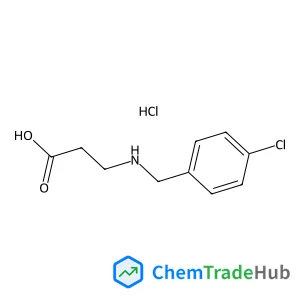
N-(4-Chlorobenzyl)-beta-alanine hydrochloride (1:1)
CAS Number:
1172479-10-5
Molecular Formula:
C10H13Cl2NO2
Joseph Zakzeski, Sarah Burton, Andrew Behn, Martin Head-Gordon, Alexis T. Bell
A spectroscopic investigation of complexes used to catalyze the oxidative carbonylation of toluene to p-toluic acid was conducted. Rhodium complexes were analyzed by 103Rh and 13C NMR, UV-visible spectroscopy, and infrared spectroscopy. In the presence of vanadium and oxygen, the resting state of the Rh-catalyst was found to exist as a Rh(III) complex with carbonyl and trifluoroacetate ligands, consistent with the structure Rh(CO)2(TFA)3. The 13C NMR spectrum of Rh(13CO)2(TFA)3 complex exhibited a carbonyl peak with an unusual degree of shielding, which resulted in the appearance of the carbonyl peak at an unprecedented upfield position in the 13C NMR spectrum. This shielding was caused by interaction of the carbonyl group with the trifluoroacetate ligand. In the absence of oxygen, the Rh(III) complex reduced to Rh(I), and the reduced form exhibited properties resembling the catalyst precursor. Structures and spectroscopic properties calculated using density functional theory agreed closely with the experimental results. The vanadium co-catalyst used to reoxidize Rh(I) to Rh(III) was similarly characterized by 51V NMR and UV-visible spectroscopy. The oxidized species corresponded to [(VO2)(TFA)]2, whereas the reduced species corresponded to (VO)(TFA)2. The spectroscopic results obtained in this study confirm the identity of the species that have been proposed to be involved in the Rh-catalyzed oxidative carbonylation of toluene to toluic acid.
Diana Paiva, Galya Ivanova, Maria do Carmo Pereira, Sandra Rocha
DOI: 10.1039/C3CP51215K
Devin T. Edwards, Zhidong Ma, Daniella Goldfarb
DOI: 10.1039/C3CP43787F
Divya Nayar, Charusita Chakravarty
DOI: 10.1039/C3CP51114F
Richard H. Heyn, Ivan Saldan, Magnus H. Sørby, Christoph Frommen, Bjørnar Arstad, Aud M. Bougza, Helmer Fjellvåg, Bjørn C. Hauback
DOI: 10.1039/C3CP52070F
Jaume Puy, Joan Cecília, Josep Galceran
DOI: 10.1039/C3CP51038G
Satheesh Sambandam, Javier Parrondo, Vijay Ramani
DOI: 10.1039/C3CP51450A
Yungang Zhou, Chengfei Yang, Xia Xiang, Xiaotao Zu
DOI: 10.1039/C3CP51518D
Bas C. van der Wiel, René M. Williams
DOI: 10.1039/C3CP52148F
Iakov Polyak, Eliot Boulanger, Kakali Sen, Walter Thiel
DOI: 10.1039/C3CP51669E
Je Hyun Bae, Yang-Rae Kim, R. Soyoung Kim, Taek Dong Chung
DOI: 10.1039/C3CP50175B
Waste containing N-Methoxy-N-methyl-1,3-thiazole-5-carboxamide (CAS: 898825-89-3...
N-(4-Biphenylyl)dibenzo[b,d]furan-4-amine should be stored in a tightly sealed c...
The market for 3-Acetamido-5-amino-2,4,6-triiodobenzoic acid (CAS: 1713-07-1) is...
Benzyl 2-O-acetyl-3,4,6-tri-O-benzyl-beta-D-galactopyranoside (CAS: 61820-03-9) ...
2-Ethylpiperazine dihydrochloride (CAS: 438050-52-3) is regulated under the Glob...
1,1'-[1,3-Phenylenebis(methylene)]bis(3-methyl-1H-pyrrole-2,5-dione) (CAS: 11946...
Several alternatives can be used in the synthesis of 5-Fluoro-2-(1-pyrrolidinyl)...
Proper personal protective equipment (PPE) must be worn when handling this compo...
When handling 6-Bromoimidazo[1,2-a]pyridin-8-amine, it is important to wear appr...
Alternatives to (2S,4R)-4-(4-Nitrobenzyl)pyrrolidine-2-carboxylic acid hydrochlo...

Physical Chemistry Chemical Physics (PCCP) is an international journal co-owned by 19 physical chemistry and physics societies from around the world. This journal publishes original, cutting-edge research in physical chemistry, chemical physics and biophysical chemistry. To be suitable for publication in PCCP, articles must include significant innovation and/or insight into physical chemistry; this is the most important criterion that reviewers and Editors will judge against when evaluating submissions. The journal has a broad scope and welcomes contributions spanning experiment, theory, computation and data science. Topical coverage includes spectroscopy, dynamics, kinetics, statistical mechanics, thermodynamics, electrochemistry, catalysis, surface science, quantum mechanics, quantum computing and machine learning. Interdisciplinary research areas such as polymers and soft matter, materials, nanoscience, energy, surfaces/interfaces, and biophysical chemistry are welcomed if they demonstrate significant innovation and/or insight into physical chemistry. Joined experimental/theoretical studies are particularly appreciated when complementary and based on up-to-date approaches.
![2-Methyl-2-propanyl {3-[4-(4,4,5,5-tetramethyl-1,3,2-dioxaborolan-2-yl)phenyl]-3-oxetanyl}carbamate structure](https://static.chemtradehub.com/structs/127/1279090-25-3-1b84.webp "2-Methyl-2-propanyl {3-[4-(4,4,5,5-tetramethyl-1,3,2-dioxaborolan-2-yl)phenyl]-3-oxetanyl}carbamate structure")