![1-{3-[4-Amino-3-(4-phenoxyphenyl)-1H-pyrazolo[3,4-d]pyrimidin-1-yl]-1-piperidinyl}-2,3-dihydroxy-1-propanone structure](https://static.chemtradehub.com/structs/122/1226872-27-0-e037.webp "1-{3-[4-Amino-3-(4-phenoxyphenyl)-1H-pyrazolo[3,4-d]pyrimidin-1-yl]-1-piperidinyl}-2,3-dihydroxy-1-propanone structure")
1-{3-[4-Amino-3-(4-phenoxyphenyl)-1H-pyrazolo[3,4-d]pyrimidin-1-yl]-1-piperidinyl}-2,3-dihydroxy-1-propanone
CAS Number:
1226872-27-0
Molecular Formula:
C25H26N6O4
Tao Li, Guangmiao Wu, Shangbiao Feng, Zemin Wang, Xingang Xie, Xuegong She
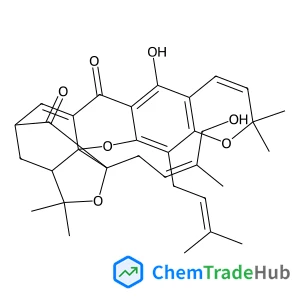
The construction of the ABC tricyclic skeleton of malabanone A with the required 4 stereocenters was accomplished in a concise route starting from R-carvone. The synthesis featured an intramolecular [3 + 2] cycloaddition reaction to assemble its A ring and an intramolecular Diels–Alder reaction to construct its C ring.

Current Opinion in Colloid & Interface Science

Chemistry Education Research and Practice

Russian Journal of Applied Chemistry

Organic Process Research & Development

Saudi Pharmaceutical Journal

Drug Discovery Today

Russian Journal of Coordination Chemistry

Journal of Saudi Chemical Society

Current Opinion in Solid State & Materials Science

Journal of Peptide Science
Jiajia Tan, Jinming Hu, Shiyong Liu
DOI: 10.1039/D1PY01095F
Daiki Ito, Yoshihiko Kimura, Makoto Ouchi, Takaya Terashima
DOI: 10.1039/D0PY00758G
Monika Topa-Skwarczyńska, Mariusz Galek, Magdalena Jankowska, Fabrice Morlet-Savary, Bernadette Graff, Jacques Lalevée, Roman Popielarz
DOI: 10.1039/D1PY01263K
DOI: 10.1039/D1PY01301G
Yi-Cong Wang, Pei-Yi Cheng, Zhi-Qian Zhang, Ke-Xin Fan, Rui-Qi Lu, Shu Zhang, Yi-Xian Wu
DOI: 10.1039/D1PY01140E
Kostas Parkatzidis, Manon Rolland, Nghia P. Truong, Athina Anastasaki
DOI: 10.1039/D1PY01044A
Wanan Cai, Zhicheng Wang, Zhaohui Shu, Wenbin Liu, Jun Wang, Jian Qiu
DOI: 10.1039/D1PY01451J
Khalaf A. Jasim, Ibrahim F. Waheed
DOI: 10.1039/D1PY00964H
N-(4-Methoxybenzyl)-2-pyridinamine (CAS: 52818-63-0) is increasingly being used ...
When handling Ethyl 4-(2-chlorophenyl)-1,3-thiazole-2-carboxylate, appropriate p...
Diethyldiselane (CAS: 628-39-7) is classified under the Globally Harmonized Syst...
The market for oxocopper (CAS: 12053-18-8) is primarily driven by its use in cat...
The market for 5-{[(2-Methyl-2-propanyl)oxy]carbonyl}-5-azaspiro[2.4]heptane-7-c...
2-(1-Pyrrolidinyl)-4-pyridinamine is a chemical compound with the CAS number 359...
2-(3-Pyridinyl)-1-azabicyclo[2.2.2]octane (CAS: 91556-75-1) is a crystalline sol...
(S)-Alpha-allyl-proline hydrochloride is usually synthesized via a Wittig reacti...
3-Methyl-1,2-oxazole-5-carboxylic acid (CAS: 4857-42-5) is an organic compound w...
Lys-SMCC-DM1 is synthesized via a multi-step process involving the coupling of S...

Organic & Biomolecular Chemistry (OBC) publishes original and high impact research and reviews in organic chemistry. We welcome research that shows new or significantly improved protocols or methodologies in total synthesis, synthetic methodology or physical and theoretical organic chemistry as well as research that shows a significant advance in the organic chemistry or molecular design aspects of chemical biology, catalysis, supramolecular and macromolecular chemistry, theoretical chemistry, mechanism-oriented physical organic chemistry, medicinal chemistry or natural products. Articles published in the journal should report new work which makes a highly-significant impact in the field. Routine and incremental work is generally not suitable for publication in the journal. More details about key areas of our scope are below. In all cases authors should include in their article clear rationale for why their research has been carried out.