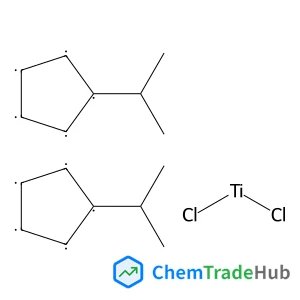
BIS(I-PROPYLCYCLOPENTADIENYL)TITANIUM DICHLORIDE
CAS Number:
12130-65-3
Molecular Formula:
C16H22Cl2Ti
Anjali Dahiya, Wajid Ali, Tipu Alam, Bhisma K. Patel
A catalyst and solvent free synthesis of S-allyl benzoylcarbamothioates has been achieved from the in situ generated benzoylcarbonimidothioates obtained by reacting MBH alcohols with aroyl isothiocyanates. An intramolecular thia-Michael addition of the in situ generated adduct triggers a Mumm-type rearrangement leading to a stereoselective synthesis of highly functionalised S-allyl benzoylcarbamothioates.
Peter A. Bayliss, Eduardo Pérez, Sihai Yang, Chiu C. Tang, Martyn Poliakoff, Martin Schröder
DOI: 10.1039/C4GC00313F
P. P. Giovannini, O. Bortolini, A. Cavazzini, R. Greco, G. Fantin, A. Massi
DOI: 10.1039/C4GC00838C
Patrick Wagner, Maud Bollenbach, Christelle Doebelin, Frédéric Bihel, Jean-Jacques Bourguignon, Martine Schmitt
DOI: 10.1039/C4GC00853G
Zhicheng Jiang, Ting He, Jianmei Li, Changwei Hu
DOI: 10.1039/C4GC00620H
Shuang-Shuang Liu, Xiang Liu, Lei Yu, Yong-Mei Liu, He-Yong He, Yong Cao
DOI: 10.1039/C4GC00869C
Emily A. Peterson, Barry Dillon, Izzat Raheem, Paul Richardson, Daniel Richter, Rachel Schmidt, Helen F. Sneddon
DOI: 10.1039/C4GC00615A
Qi Xiao, Sarina Sarina, Esa Jaatinen, Jianfeng Jia, Dennis P. Arnold, Hongwei Liu, Huaiyong Zhu
DOI: 10.1039/C4GC00588K
Hilda Gómez Bernal, Luca Bernazzani
DOI: 10.1039/C4GC00450G
Ana R. C. Morais, Ana C. Mata, Rafal Bogel-Lukasik
DOI: 10.1039/C4GC01093K
DOI: 10.1039/C4GC90034K
2-Methylbenzene-1,4-diamine dihydrochloride (CAS: 615-45-2) should be stored in ...
(1S,4S)-2,5-Diazabicyclo[2.2.1]heptane dihydrobromide is generally considered sa...
(6-Chloropyridazin-3-YL)methanamine finds applications in the pharmaceutical ind...
2-Fluoro-3-methylphenol is primarily used in the synthesis of pharmaceuticals, p...
When handling 3-Methoxy-4-nitrobenzonitrile, it is important to wear appropriate...
When handling 1,3-Oxazolo[4,5-b]pyridine-2(3H)-thione (CAS: 211949-57-4), it is ...
4-Ethynylbenzamide (CAS: 90347-86-7) falls under various regulatory guidelines i...
3-(2-Ethylphenyl)-2-thioxo-4-imidazolidinone is primarily used as an intermediat...
(2-Fluoro-6-methoxyphenyl)acetic acid, also known as 4-fluoro-3-methoxybenzoic a...
Market trends for 2-[4-(Hydroxymethyl)phenoxy]ethanol (CAS: 102196-18-9) indicat...

Organic & Biomolecular Chemistry (OBC) publishes original and high impact research and reviews in organic chemistry. We welcome research that shows new or significantly improved protocols or methodologies in total synthesis, synthetic methodology or physical and theoretical organic chemistry as well as research that shows a significant advance in the organic chemistry or molecular design aspects of chemical biology, catalysis, supramolecular and macromolecular chemistry, theoretical chemistry, mechanism-oriented physical organic chemistry, medicinal chemistry or natural products. Articles published in the journal should report new work which makes a highly-significant impact in the field. Routine and incremental work is generally not suitable for publication in the journal. More details about key areas of our scope are below. In all cases authors should include in their article clear rationale for why their research has been carried out.
![5-Bromo-3-isopropyl-1H-pyrrolo[2,3-b]pyridine structure](https://static.chemtradehub.com/structs/125/1256819-54-1-8620.webp "5-Bromo-3-isopropyl-1H-pyrrolo[2,3-b]pyridine structure")