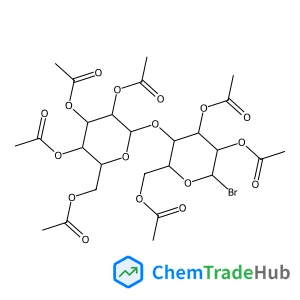
2,3,6-Tri-O-acetyl-4-O-(2,3,4,6-tetra-O-acetyl-beta-D-galactopyranosyl)-alpha-D-glucopyranosyl bromide
CAS Number:
4753-07-5
Molecular Formula:
C26H35BrO17
Shuang-Shuang Liu, Xiang Liu, Lei Yu, Yong-Mei Liu, He-Yong He, Yong Cao
Liquid-phase selective monohydrogenation of various substituted dinitroaromatics to the corresponding valuable nitroanilines was investigated on gold-based catalysts. Special attention was paid to the effect of Au particle size on this monoreduction reaction. Interestingly, TiO2 supported gold catalysts containing a relatively larger mean Au particle size (>5 nm) showed far superior chemoselectivity for specific mono-hydrogenation of dinitroaromatics, with the highest performance attainable for the catalyst bearing Au particles of ca. 7.5 nm. Results in the intermolecular competitive hydrogenation showed that the intrinsic higher accumulation rates of the desired nitroanilines associated with the catalyst possessing larger Au particles were responsible for the high chemoselectivity observed.
Benedetto Bozzini, Alessandra Gianoncelli, Burkhard Kaulich, Maya Kiskinova, Claudio Mele, Mauro Prasciolu
DOI: 10.1039/C0CP02618B
Bong-Hyun Jun, Gunsung Kim, Jongho Baek, Homan Kang, Taeho Kim, Taeghwan Hyeon
DOI: 10.1039/C0CP02055A
M. Weser, E. N. Voloshina, K. Horn, Yu. S. Dedkov
DOI: 10.1039/C1CP00014D
Christine Lapouge, Jean-Paul Cornard
DOI: 10.1039/C0CP00714E
Pavel Kubát, Jakub Šebera, Stanislav Záliš, Jan Langmaier, Marcel Fuciman, Tomáš Polívka, Kamil Lang
DOI: 10.1039/C0CP01726D
Christian van der Linde, Martin K. Beyer
DOI: 10.1039/C1CP00048A
Annemarie McCarthy, Albert A. Ruth
DOI: 10.1039/C0CP02601H
B. Grüner, M. Schlesinger, Ph. Heister, W. T. Strunz, F. Stienkemeier, M. Mudrich
DOI: 10.1039/C0CP02355H
Jianmin Shi, Holger Fritze, Günter Borchardt, Klaus-Dieter Becker
DOI: 10.1039/C0CP02703K
2-Methylbenzene-1,4-diamine dihydrochloride (CAS: 615-45-2) should be stored in ...
(1S,4S)-2,5-Diazabicyclo[2.2.1]heptane dihydrobromide is generally considered sa...
(6-Chloropyridazin-3-YL)methanamine finds applications in the pharmaceutical ind...
2-Fluoro-3-methylphenol is primarily used in the synthesis of pharmaceuticals, p...
When handling 3-Methoxy-4-nitrobenzonitrile, it is important to wear appropriate...
When handling 1,3-Oxazolo[4,5-b]pyridine-2(3H)-thione (CAS: 211949-57-4), it is ...
4-Ethynylbenzamide (CAS: 90347-86-7) falls under various regulatory guidelines i...
3-(2-Ethylphenyl)-2-thioxo-4-imidazolidinone is primarily used as an intermediat...
(2-Fluoro-6-methoxyphenyl)acetic acid, also known as 4-fluoro-3-methoxybenzoic a...
Market trends for 2-[4-(Hydroxymethyl)phenoxy]ethanol (CAS: 102196-18-9) indicat...

Green Chemistry provides a unique forum for the publication of innovative research on the development of alternative green and sustainable technologies. The scope of Green Chemistry is based on, but not limited to, the definition proposed by Anastas and Warner (Green Chemistry: Theory and Practice, P T Anastas and J C Warner, Oxford University Press, Oxford, 1998). Green chemistry is the utilisation of a set of principles that reduces or eliminates the use or generation of hazardous substances in the design, manufacture and application of chemical products. Green Chemistry is at the frontiers of this continuously-evolving interdisciplinary science and publishes research that attempts to reduce the environmental impact of the chemical enterprise by developing a technology base that is inherently non-toxic to living things and the environment. Submissions on all aspects of research relating to the endeavour are welcome. The journal publishes original and significant cutting-edge research that is likely to be of wide general appeal. To be published, work must present a significant advance in green chemistry. Papers must contain a comparison with existing methods and demonstrate advantages over those methods before publication can be considered. For more information please see this Editorial. Coverage includes the following, but is not limited to: Design (e.g. biomimicry, design for degradation/recycling/reduced toxicity…) Reagents & Feedstocks (e.g. renewables, CO2, solvents, auxiliary agents, waste utilization…) Synthesis (e.g. organic, inorganic, synthetic biology…) Catalysis (e.g. homogeneous, heterogeneous, enzyme, whole cell…) Process (e.g. process design, intensification, separations, recycling, efficiency…) Energy (e.g. renewable energy, fuels, photovoltaics, fuel cells, energy storage, energy carriers…) Applications (e.g. electronics, dyes, consumer products, coatings, pharmaceuticals, preservatives, building materials, chemicals for industry/agriculture/mining…) Impact (e.g. safety, metrics, LCA, sustainability, (eco)toxicology…) Green chemistry is, by definition, a continuously-evolving frontier. Therefore, the inclusion of a particular material or technology does not, of itself, guarantee that a paper is suitable for the journal. To be suitable, the novel advance should have the potential for reduced environmental impact relative to the state of the art. Green Chemistry does not normally deal with research associated with 'end-of-pipe' or remediation issues.
![Methyl 2-[5-(3-Phenoxyphenyl)-2H-tetrazol-2-yl]acetate structure](https://static.chemtradehub.com/structs/130/1305320-60-8-84b4.webp "Methyl 2-[5-(3-Phenoxyphenyl)-2H-tetrazol-2-yl]acetate structure")