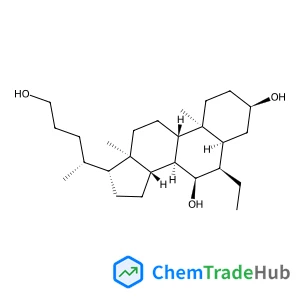
(3alpha,5beta,6alpha,7alpha)-6-Ethylcholane-3,7,24-triol
CAS Number:
1537866-49-1
Molecular Formula:
C26H46O3
Gyan H. Aryal, Kenneth W. Hunter, Liming Huang
Water-soluble and fluorescent perylene dyes PMI1 and PMI2 with red to near-infrared (red-NIR) emission and a large Stokes shift were designed and synthesized. These dyes were designed to have two binding units (an aromatic perylene-core and a cationic side group) that allow PMI1 and PMI2 to form strong host–guest complexes with cucurbit[8]uril (CB8) through hydrophobic and electrostatic interactions. As a result, the binding constant of the resulting complexes was determined to be in the range of 106 M−1 which increased about 2 orders of magnitude compared to the previously reported perylene dye with only one binding unit. The results also revealed that the fluorescence emission of PMI1 or PMI2 only in aqueous solution is very low due to the aggregation effect. Upon complexation with CB8, the fluorescence intensity increased about 10-fold while the red-NIR emission and the large Stokes shift were preserved. These host–guest complexes can serve as red-NIR fluorescent displacement probes for the detection of CB8 binding guests. The successful detection of addictive drugs in urine was further demonstrated using the host–guest CB8·PMI1 complex and the interference of autofluorescence from the urine sample was successfully eliminated.
Maolin Chen, Lijun Deng, Xucong Lin, Zenghong Xie
DOI: 10.1039/C8AN01531G
Shivani Sathish, Sébastien G. Ricoult, Kazumi Toda-Peters, Amy Q. Shen
DOI: 10.1039/C7AN00273D
N. E. Dina, H. Zhou, A. Colniţă, N. Leopold, C. Coman, C. Haisch
DOI: 10.1039/C7AN00106A
G. R. Lloyd, J. Nallala, M. Isabelle, L. M. Almond, N. A. Shepherd, C. A. Kendall, A. C. Shore, N. Stone
DOI: 10.1039/C6AN01871H
A. F. Payam, W. Trewby, K. Voïtchovsky
DOI: 10.1039/C6AN02674E
Jiawei Wu, Lixia Zhang, Xiangfeng Bu, Peng Li, Bing Zhao, Yuan Tian
DOI: 10.1039/C8AN01286E
Miguela Martin, David Perez-Guaita, Dean W. Andrew, Bayden R. Wood
DOI: 10.1039/C6AN02075E
Paweł M. Nowak, Michał Woźniakiewicz
DOI: 10.1039/C8AN01191E
Fabrício Augusto de Lima, Cyril Gobinet, Ganesh Sockalingum, Sérgio Britto Garcia, Michel Manfait, Valérie Untereiner, Olivier Piot, Luciano Bachmann
DOI: 10.1039/C6AN01975G
B. Bird, J. Rowlette
DOI: 10.1039/C6AN01916A
N-(4-Methoxybenzyl)-2-pyridinamine (CAS: 52818-63-0) is increasingly being used ...
When handling Ethyl 4-(2-chlorophenyl)-1,3-thiazole-2-carboxylate, appropriate p...
Diethyldiselane (CAS: 628-39-7) is classified under the Globally Harmonized Syst...
The market for oxocopper (CAS: 12053-18-8) is primarily driven by its use in cat...
The market for 5-{[(2-Methyl-2-propanyl)oxy]carbonyl}-5-azaspiro[2.4]heptane-7-c...
2-(1-Pyrrolidinyl)-4-pyridinamine is a chemical compound with the CAS number 359...
2-(3-Pyridinyl)-1-azabicyclo[2.2.2]octane (CAS: 91556-75-1) is a crystalline sol...
(S)-Alpha-allyl-proline hydrochloride is usually synthesized via a Wittig reacti...
3-Methyl-1,2-oxazole-5-carboxylic acid (CAS: 4857-42-5) is an organic compound w...
Lys-SMCC-DM1 is synthesized via a multi-step process involving the coupling of S...

Organic & Biomolecular Chemistry (OBC) publishes original and high impact research and reviews in organic chemistry. We welcome research that shows new or significantly improved protocols or methodologies in total synthesis, synthetic methodology or physical and theoretical organic chemistry as well as research that shows a significant advance in the organic chemistry or molecular design aspects of chemical biology, catalysis, supramolecular and macromolecular chemistry, theoretical chemistry, mechanism-oriented physical organic chemistry, medicinal chemistry or natural products. Articles published in the journal should report new work which makes a highly-significant impact in the field. Routine and incremental work is generally not suitable for publication in the journal. More details about key areas of our scope are below. In all cases authors should include in their article clear rationale for why their research has been carried out.
![1-[6-(1H-Imidazol-1-yl)-3-pyridinyl]methanamine structure](https://static.chemtradehub.com/structs/914/914637-08-4-8825.webp "1-[6-(1H-Imidazol-1-yl)-3-pyridinyl]methanamine structure")