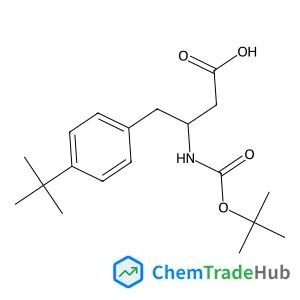
(S)-3-((tert-Butoxycarbonyl)amino)-4-(4-(tert-butyl)phenyl)butanoic acid
CAS Number:
403661-85-8
Molecular Formula:
C19H29NO4
Fiorella L. Callari, Salvatore Sortino
A novel bichromophoric conjugate integrating a NO photodonor and a DNA intercalator in its molecular skeleton, allows the light-controlled NO delivery nearby DNA and amplifies NO release via effective photoinduced energy transfer mechanism.
Lasse Kyllönen, Arno Parviainen, Somdatta Deb, Martin Lawoko, Mikhail Gorlov, Ilkka Kilpeläinen, Alistair W. T. King
DOI: 10.1039/C3GC41273C
José I. García, Héctor García-Marín, Pascual Pérez
DOI: 10.1039/C3GC40694F
Trinadh Kaicharla, Santhivardhana Reddy Yetra, Tony Roy, Akkattu T. Biju
DOI: 10.1039/C3GC40454D
Antonio J. F. Carvalho
DOI: 10.1039/C3GC40358K
Annelies Peeters, Rob Ameloot, Dirk E. De Vos
DOI: 10.1039/C3GC40568K
Hicham Ait Rass, Nadine Essayem, Michèle Besson
DOI: 10.1039/C3GC40727F
Andrey Chernykh, Samim Alam, Anurad Jayasooriya, James Bahr
DOI: 10.1039/C3GC40605A
Haixin Guo, Youfen Lian, Lulu Yan, Xinhua Qi, Richard Lee Smith, Jr.
DOI: 10.1039/C3GC40433A
Donald J. Darensbourg, Andrew D. Yeung, Sheng-Hsuan Wei
DOI: 10.1039/C3GC40475G
When handling 4-Methyl-6-(trifluoromethyl)quinoline (CAS: 40716-16-3), safety go...
4-(3,5-Difluorophenyl)aniline is an aromatic organic compound with the CAS numbe...
5-{[4-(Trifluoromethyl)phenyl]sulfanyl}-1,2,3-thiadiazole-4-carboxylic acid can ...
The market for 4-Benzylaniline hydrochloride (CAS: 6317-57-3) is steadily growin...
[3-(Diethylsulfamoyl)phenyl]boronic acid is generally considered safe when handl...
3-Bromo-2,5-dimethoxyaniline is mainly used in the pharmaceutical and chemical i...
N-Methyl-1-(5-methyl-1H-indol-3-yl)methanamine (CAS: 915922-67-7) is subject to ...
This compound is primarily used in the pharmaceutical industry for the synthesis...
2-Methyl-2-propanyl [(1S,3R)-3-aminocyclohexyl]carbamate (CAS: 1298101-47-9) sho...
Ethyl 2-bromo-4,4,4-trifluorobutanoate (CAS: 367-33-9) is utilized in the pharma...

ChemComm publishes urgent research which is of outstanding significance and interest to experts in the field, while also appealing to the journal’s broad chemistry readership. Our communication format is ideally suited to short, urgent studies that are of such importance that they require accelerated publication. Our scope covers all topics in chemistry, and research at the interface of chemistry and other disciplines (such as materials science, nanoscience, physics, engineering and biology) where there is a significant novelty in the chemistry aspects. Major topic areas covered include: Analytical Chemistry Catalysis Chemical Biology and medicinal chemistry Computational Chemistry and Machine Learning Energy and sustainable chemistry Environmental Chemistry Green Chemistry Inorganic Chemistry Materials Chemistry Nanoscience Organic Chemistry Physical Chemistry Polymer Chemistry Supramolecular Chemistry
![6-Bromo-3-ethyl-3H-imidazo[4,5-b]pyridine structure](https://static.chemtradehub.com/structs/103/1033202-59-3-2a8f.webp "6-Bromo-3-ethyl-3H-imidazo[4,5-b]pyridine structure")
![2,4-Dichloro-6-isopropyl-5H-pyrrolo[3,4-d]pyrimidin-7(6H)-one structure](https://static.chemtradehub.com/structs/107/1079649-94-7-ad4a.webp "2,4-Dichloro-6-isopropyl-5H-pyrrolo[3,4-d]pyrimidin-7(6H)-one structure")
![6,7-Dihydro-5H-pyrrolo[1,2-a]imidazole-6-carboxylic acid structure](https://static.chemtradehub.com/structs/136/1369160-12-2-6524.webp "6,7-Dihydro-5H-pyrrolo[1,2-a]imidazole-6-carboxylic acid structure")