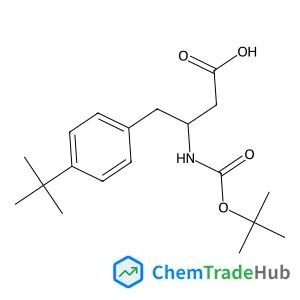
(S)-3-((tert-Butoxycarbonyl)amino)-4-(4-(tert-butyl)phenyl)butanoic acid
CAS Number:
403661-85-8
Molecular Formula:
C19H29NO4
Zhaoyong Sun, Amar Kumbhar, Kai Sun, Qingsheng Liu
A novel method to one-pot-synthesize high-quality In2O3@In2S3 core–shell nanoparticles, consisting of a step of reducing In2O3 core surface into a layer of active indium metal in high-temperature organic solution and a step of converting this layer to In2S3 using CS2, has been developed.
Qian-Rui Huang, Tomoki Nishigori, Marusu Katada, Asuka Fujii, Jer-Lai Kuo
DOI: 10.1039/C8CP02151A
Zhen Pu, Wenjie Yu, Soumendra K. Roy, Chaoyang Li, Bingyun Ao, Tianwei Liu, Maobing Shuai, Xuefeng Wang
DOI: 10.1039/C8CP91766C
DOI: 10.1039/C7CP08370J
DOI: 10.1039/C7CP06554J
Larwsk H. Gonçalves da Silva, David Hochberg
DOI: 10.1039/C8CP01828F
DOI: 10.1039/C7CP08239H
Dipankar Sukul, Aparesh Pal, Sanjoy Satpati, Utpal Adhikari
DOI: 10.1039/C7CP06848D
Dhamodaran Manikandan, S. Amirthapandian, I. S. Zhidkov, A. I. Kukharenko, S. O. Cholakh, Ramaswamy Murugan
DOI: 10.1039/C7CP07182E
Wenjing Xie, Chak-Keung Chan
DOI: 10.1039/C8CP00524A
Sampsa Vierros, Maria Sammalkorpi
DOI: 10.1039/C7CP07511A
When handling 4-Methyl-6-(trifluoromethyl)quinoline (CAS: 40716-16-3), safety go...
4-(3,5-Difluorophenyl)aniline is an aromatic organic compound with the CAS numbe...
5-{[4-(Trifluoromethyl)phenyl]sulfanyl}-1,2,3-thiadiazole-4-carboxylic acid can ...
The market for 4-Benzylaniline hydrochloride (CAS: 6317-57-3) is steadily growin...
[3-(Diethylsulfamoyl)phenyl]boronic acid is generally considered safe when handl...
3-Bromo-2,5-dimethoxyaniline is mainly used in the pharmaceutical and chemical i...
N-Methyl-1-(5-methyl-1H-indol-3-yl)methanamine (CAS: 915922-67-7) is subject to ...
This compound is primarily used in the pharmaceutical industry for the synthesis...
2-Methyl-2-propanyl [(1S,3R)-3-aminocyclohexyl]carbamate (CAS: 1298101-47-9) sho...
Ethyl 2-bromo-4,4,4-trifluorobutanoate (CAS: 367-33-9) is utilized in the pharma...

ChemComm publishes urgent research which is of outstanding significance and interest to experts in the field, while also appealing to the journal’s broad chemistry readership. Our communication format is ideally suited to short, urgent studies that are of such importance that they require accelerated publication. Our scope covers all topics in chemistry, and research at the interface of chemistry and other disciplines (such as materials science, nanoscience, physics, engineering and biology) where there is a significant novelty in the chemistry aspects. Major topic areas covered include: Analytical Chemistry Catalysis Chemical Biology and medicinal chemistry Computational Chemistry and Machine Learning Energy and sustainable chemistry Environmental Chemistry Green Chemistry Inorganic Chemistry Materials Chemistry Nanoscience Organic Chemistry Physical Chemistry Polymer Chemistry Supramolecular Chemistry
![Imidazo[1,2-c]pyrimidine structure](https://static.chemtradehub.com/structs/274/274-78-2-8b4c.webp "Imidazo[1,2-c]pyrimidine structure")
![6,7-Dihydro-5H-pyrrolo[1,2-a]imidazole-6-carboxylic acid structure](https://static.chemtradehub.com/structs/136/1369160-12-2-6524.webp "6,7-Dihydro-5H-pyrrolo[1,2-a]imidazole-6-carboxylic acid structure")