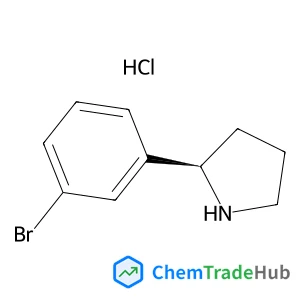
(2R)-2-(3-Bromophenyl)pyrrolidine hydrochloride (1:1)
CAS Number:
1391550-13-2
Molecular Formula:
C10H13BrClN
Gabriella Ieronimo, Giovanni Palmisano, Angelo Maspero, Alessandro Marzorati, Luca Scapinello, Norberto Masciocchi, Giancarlo Cravotto, Alessandro Barge, Marco Simonetti, Keshav Lalit Ameta, Kenneth M. Nicholas, Andrea Penoni
A straightforward indole synthesis via annulation of C-nitrosoaromatics with conjugated terminal alkynones was realised achieving a simple, highly regioselective, atom- and step economical access to 3-aroylindoles in moderate to good yields. Further functionalizations of indole scaffolds were investigated and an easy way to JWH-018, a synthetic cannabinoid, was achieved.
Hongping Li, Yonghui Chang, Wenshuai Zhu, Changwei Wang, Chao Wang, Sheng Yin, Ming Zhang
DOI: 10.1039/C5CP04172D
Seyedeh Mozhgan Seyed-Talebi, Iraj Kazeminezhad, Javad Beheshtian
DOI: 10.1039/C5CP04666A
Bhagyashree Sancheti, G. N. Pandey
DOI: 10.1039/C5CP05213K
DOI: 10.1039/C5CP03548A
C. Slavov, C. Boumrifak, C. A. Hammer, P. Trojanowski, X. Chen, W. J. Lees, J. Wachtveitl, M. Braun
DOI: 10.1039/C5CP06866E
Pascal Puech, Iann C. Gerber
DOI: 10.1039/C5CP04594K
B. Balke, S. Ouardi, S. Selle, T. Höche, C. Felser, W. Hermes, M. Schwind
DOI: 10.1039/C4CP04875J
Zhen-Yu Zhang, Xin Chen, Hai-Yu Wang, Ming Xu, Bing-Rong Gao, Qi-Dai Chen, Hong-Bo Sun
DOI: 10.1039/C5CP04333F
Aditya Sharma, Mayora Varshney, Jaehun Park, Tae Kyun Ha, Keun Hwa Chae, Hyun Joon Shin
DOI: 10.1039/C5CP05251C
Lingling Bi, Dandan Xu, Lijing Zhang, Yanhong Lin, Tengfeng Xie
DOI: 10.1039/C5CP05158D
N-(4-Methoxybenzyl)-2-pyridinamine (CAS: 52818-63-0) is increasingly being used ...
When handling Ethyl 4-(2-chlorophenyl)-1,3-thiazole-2-carboxylate, appropriate p...
Diethyldiselane (CAS: 628-39-7) is classified under the Globally Harmonized Syst...
The market for oxocopper (CAS: 12053-18-8) is primarily driven by its use in cat...
The market for 5-{[(2-Methyl-2-propanyl)oxy]carbonyl}-5-azaspiro[2.4]heptane-7-c...
2-(1-Pyrrolidinyl)-4-pyridinamine is a chemical compound with the CAS number 359...
2-(3-Pyridinyl)-1-azabicyclo[2.2.2]octane (CAS: 91556-75-1) is a crystalline sol...
(S)-Alpha-allyl-proline hydrochloride is usually synthesized via a Wittig reacti...
3-Methyl-1,2-oxazole-5-carboxylic acid (CAS: 4857-42-5) is an organic compound w...
Lys-SMCC-DM1 is synthesized via a multi-step process involving the coupling of S...

Organic & Biomolecular Chemistry (OBC) publishes original and high impact research and reviews in organic chemistry. We welcome research that shows new or significantly improved protocols or methodologies in total synthesis, synthetic methodology or physical and theoretical organic chemistry as well as research that shows a significant advance in the organic chemistry or molecular design aspects of chemical biology, catalysis, supramolecular and macromolecular chemistry, theoretical chemistry, mechanism-oriented physical organic chemistry, medicinal chemistry or natural products. Articles published in the journal should report new work which makes a highly-significant impact in the field. Routine and incremental work is generally not suitable for publication in the journal. More details about key areas of our scope are below. In all cases authors should include in their article clear rationale for why their research has been carried out.
![5'-Fluoro-[2,3'-biindolinylidene]-2',3-dione structure](https://static.chemtradehub.com/structs/251/251903-00-1-9cb1.webp "5'-Fluoro-[2,3'-biindolinylidene]-2',3-dione structure")