












Streamlined chemoenzymatic total synthesis of prioritized ganglioside cancer antigens
Literature Information
Publication Date
2018-05-14
DOI
10.1039/C8OB01087K
Impact Factor
3.876
Authors
Hai Yu, Abhishek Santra, Yanhong Li, John B. McArthur, Tamashree Ghosh, Xiaoxiao Yang, Peng G. Wang, Xi Chen
View Original
Abstract
A highly efficient streamlined chemoenzymatic strategy for total synthesis of four prioritized ganglioside cancer antigens GD2, GD3, fucosyl GM1, and GM3 from commercially available lactose and phytosphingosine is demonstrated. Lactosyl sphingosine (LacβSph) was chemically synthesized (on a 13 g scale), subjected to sequential one-pot multienzyme (OPME) glycosylation reactions with facile C18-cartridge purification, followed by improved acylation conditions to form target gangliosides, including fucosyl GM1 which has never been synthesized before.
Recommended Journals
Related Literature
Palladium-catalyzed double carbonylation of propargyl amines and aryl halides to access 1-aroyl-3-aryl-1,5-dihydro-2H-pyrrol-2-ones
Jun Ying, Zhengjie Le, Zhi-Peng Bao
2020-03-24
Research Article
DOI: 10.1039/D0QO00007H
Iodine-promoted radical alkyl sulfuration of imidazopyridines with dialkyl azo compounds and elemental sulfur
Yong-Chao Gao, Zhuo-Bin Huang, Li Xu, Zhao-Dong Li, Zhi-Sheng Lai
2019-02-01
Paper
DOI: 10.1039/C8OB03191F
Scalable electrochemical oxidant-and metal-free dehydrogenative coupling of S–H/N–H
Shanyu Tang, Yan Liu, Longjia Li, Xuanhe Ren, Jiao Li, Guanyu Yang, Heng Li, Bingxin Yuan
2019-01-10
Communication
DOI: 10.1039/C8OB03211D
A new trifluoromethylated sulfonamide phosphine ligand for Ag(i)-catalyzed enantioselective [3 + 2] cycloaddition of azomethine ylides
Yuanqi Wu, Bing Xu, Bing Liu, Zhan-Ming Zhang, Yu Liu
2018-12-20
Paper
DOI: 10.1039/C8OB02922A
Imidazole carbamate probes for affinity guided azide-transfer to metal-binding proteins
Johan Palmfeldt
2019-01-16
Communication
DOI: 10.1039/C8OB03017K
Iridium-catalyzed arylation of sulfoxonium ylides and arylboronic acids: a straightforward preparation of α-aryl ketones
Zi-Xuan Shen, Tong Che, Mei Zhong, Jia-Lin Song, Hua-Jie Kang, Hui Xie
2020-05-27
Research Article
DOI: 10.1039/D0QO00543F
A fluorogenic C4N4 probe for azide-based labelling
Hidetoshi Noda, Yasuko Asada, Masakatsu Shibasaki, Naoya Kumagai
2018-12-11
Communication
DOI: 10.1039/C8OB02695E
Copper-catalyzed trifluoromethylthiolation-peroxidation of alkenes and allenes
Yuanjin Chen, Yangyang Ma, Liangkui Li, Mingshuo Cui, Zhiping Li
2020-06-02
Research Article
DOI: 10.1039/D0QO00533A
You might also like
Compound Q&A
What industries use (1R,3S)-1,3-Cyclopentanediol (CAS: 16326-97-9)?
(1R,3S)-1,3-Cyclopentanediol finds applications in various industries. In the ph...
16326-97-9(1R,3S)-1,3-Cyclopen...
Compound Q&A
What precautions should be taken when handling N'-[4-(Dimethylamino)phenyl]-N,N-dimethyl-1,4-benzenediamine (CAS: 637-31-0)?
When handling N'-[4-(Dimethylamino)phenyl]-N,N-dimethyl-1,4-benzenediamine, it i...
637-31-0N'-[4-(Dimethylamino...
Compound Q&A
Are there alternatives to 5-(2,4-Difluorophenyl)-2-methoxypyrimidine (CAS: 1352318-16-1) in synthesis?
There are several alternatives to 5-(2,4-Difluorophenyl)-2-methoxypyrimidine in ...
1352318-16-15-(2,4-Difluoropheny...
Compound Q&A
What regulatory guidelines apply to 1-(3-Methoxyphenoxy)propan-2-ol (CAS: 382141-68-6)?
1-(3-Methoxyphenoxy)propan-2-ol (CAS: 382141-68-6) must comply with the Globally...
382141-68-61-(3-Methoxyphenoxy)...
Compound Q&A
Is Tetrodotoxin Citrate (CAS: 18660-81-6) safe?
Tetrodotoxin Citrate is extremely dangerous and should be handled with extreme c...
18660-81-6Tetrodotoxin Citrate
Compound Q&A
What are the main uses of 2-Methyl-2-propanyl [(1R,3S)-3-hydroxycyclopentyl]carbamate (CAS: 225641-84-9)?
2-Methyl-2-propanyl [(1R,3S)-3-hydroxycyclopentyl]carbamate (CAS: 225641-84-9) i...
225641-84-92-Methyl-2-propanyl ...
Compound Q&A
How should waste containing 4-(2-Hydroxyhexafluoroisopropyl)Benzoic Acid (CAS: 16261-80-6) be handled?
Waste containing 4-(2-Hydroxyhexafluoroisopropyl)Benzoic Acid (CAS: 16261-80-6) ...
16261-80-64-(2-Hydroxyhexafluo...
Compound Q&A
How is 2-Methyl-2-proanyl {(2S)-1-[(benzyloxy)amino]-3-hydroxy-3-methyl-1-oxo-2-butanyl}carbamate (CAS: 102507-19-7) typically synthesized?
2-Methyl-2-proanyl {(2S)-1-[(benzyloxy)amino]-3-hydroxy-3-methyl-1-oxo-2-butanyl...
102507-19-72-Methyl-2-propanyl ...
Compound Q&A
What is Benzeneethanamine, α-ethyl-, hydrochloride (1:1) (CAS: 20735-15-3)?
Benzeneethanamine, α-ethyl-, hydrochloride (1:1) is an organic compound with the...
20735-15-3Benzeneethanamine, α...
Compound Q&A
Are there alternatives to 3-{(E)-[4-(Dimethylamino)phenyl]diazenyl}benzoic acid (CAS: 20691-84-3) in synthesis?
In the synthesis of compounds similar to 3-{(E)-[4-(Dimethylamino)phenyl]diazeny...
20691-84-33-{(E)-[4-(Dimethyla...
Source Journal
Organic & Biomolecular Chemistry

CiteScore:
3.4
Self-citation Rate:
10.3%
Articles per Year:
1041
Organic & Biomolecular Chemistry (OBC) publishes original and high impact research and reviews in organic chemistry. We welcome research that shows new or significantly improved protocols or methodologies in total synthesis, synthetic methodology or physical and theoretical organic chemistry as well as research that shows a significant advance in the organic chemistry or molecular design aspects of chemical biology, catalysis, supramolecular and macromolecular chemistry, theoretical chemistry, mechanism-oriented physical organic chemistry, medicinal chemistry or natural products. Articles published in the journal should report new work which makes a highly-significant impact in the field. Routine and incremental work is generally not suitable for publication in the journal. More details about key areas of our scope are below. In all cases authors should include in their article clear rationale for why their research has been carried out.
Recommended Compounds
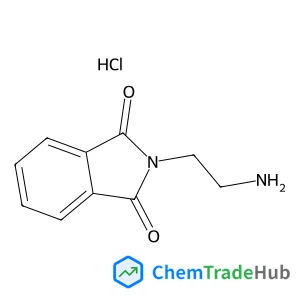
2-(2-Aminoethyl)-1H-isoindole-1,3(2H)-dione hydrochloride (1:1)
CAS Number:
30250-67-0
Molecular Formula:
C10H11ClN2O2
Recommended Suppliers






Disclaimer
This page provides academic journal information for reference and research purposes only. We are not affiliated with any journal publishers and do not handle publication submissions. For publication-related inquiries, please contact the respective journal publishers directly.
If you notice any inaccuracies in the information displayed, please contact us at support@chemtradehub.com. We will promptly review and address your concerns.