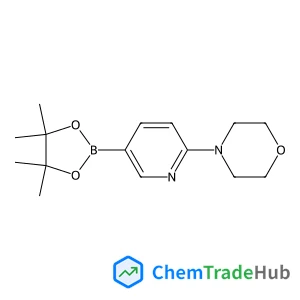
4-(5-(4,4,5,5-tetramethyl-1,3,2-dioxaborolan-2-yl)pyridin-2-yl)morpholine
CAS Number:
485799-04-0
Molecular Formula:
C15H23BN2O3
Shanyu Tang, Yan Liu, Longjia Li, Xuanhe Ren, Jiao Li, Guanyu Yang, Heng Li, Bingxin Yuan
A practical and scalable electrochemical oxidation of S–H and N–H was developed. This oxidant- and catalyst-free electrochemical process enables S–N bond formation with inexpensive nickel electrodes in an undivided cell. This procedure exhibits broad substrate scopes and good functional-group compatibility. A 50 g scale oxidative coupling augurs well for industrial applications.
Alemayehu Ambaw
DOI: 10.1039/D3FB00089C
Marco Rollo, Massimo A. G. Perini, Alessandro Sanzone, Lorenzo Polastri, Matteo Tiecco, Alejandro Torregrosa-Chinillach, Elisa Martinelli, Gianluca Ciancaleoni
DOI: 10.1039/D3SU00205E
Alina Hadi, Anjum Nawab, Feroz Alam, Sara Naqvi
DOI: 10.1039/D3FB00122A
Kannan Vignesh, Dev Kumar Yadav, D. D. Wadikar, A. D. Semwal
DOI: 10.1039/D3FB00074E
Bareera Siddiqui, Alisha Ahmad, Owais Yousuf, Kaiser Younis
DOI: 10.1039/D3FB00111C
Filipe Maciel, Hugo Pereira, Joana Silva
DOI: 10.1039/D3FB00110E
(1R,3S)-1,3-Cyclopentanediol finds applications in various industries. In the ph...
When handling N'-[4-(Dimethylamino)phenyl]-N,N-dimethyl-1,4-benzenediamine, it i...
There are several alternatives to 5-(2,4-Difluorophenyl)-2-methoxypyrimidine in ...
1-(3-Methoxyphenoxy)propan-2-ol (CAS: 382141-68-6) must comply with the Globally...
Tetrodotoxin Citrate is extremely dangerous and should be handled with extreme c...
2-Methyl-2-propanyl [(1R,3S)-3-hydroxycyclopentyl]carbamate (CAS: 225641-84-9) i...
Waste containing 4-(2-Hydroxyhexafluoroisopropyl)Benzoic Acid (CAS: 16261-80-6) ...
2-Methyl-2-proanyl {(2S)-1-[(benzyloxy)amino]-3-hydroxy-3-methyl-1-oxo-2-butanyl...
Benzeneethanamine, α-ethyl-, hydrochloride (1:1) is an organic compound with the...
In the synthesis of compounds similar to 3-{(E)-[4-(Dimethylamino)phenyl]diazeny...

Organic & Biomolecular Chemistry (OBC) publishes original and high impact research and reviews in organic chemistry. We welcome research that shows new or significantly improved protocols or methodologies in total synthesis, synthetic methodology or physical and theoretical organic chemistry as well as research that shows a significant advance in the organic chemistry or molecular design aspects of chemical biology, catalysis, supramolecular and macromolecular chemistry, theoretical chemistry, mechanism-oriented physical organic chemistry, medicinal chemistry or natural products. Articles published in the journal should report new work which makes a highly-significant impact in the field. Routine and incremental work is generally not suitable for publication in the journal. More details about key areas of our scope are below. In all cases authors should include in their article clear rationale for why their research has been carried out.
![N,N'-1,2-Ethanediylbis[2-(vinylsulfonyl)acetamide] structure](https://static.chemtradehub.com/structs/667/66710-66-5-b556.webp "N,N'-1,2-Ethanediylbis[2-(vinylsulfonyl)acetamide] structure")