












![[4-(Isobutyrylamino)phenyl]boronic acid structure](https://static.chemtradehub.com/structs/874/874219-50-8-6ab5.webp "[4-(Isobutyrylamino)phenyl]boronic acid structure")
DFT study of furfural conversion on a Re/Pt bimetallic surface: synergetic effect on the promotion of hydrodeoxygenation
Literature Information
Publication Date
2019-03-22
DOI
10.1039/C8CP07806H
Impact Factor
3.676
Authors
He Dong, P. Hu
View Original
Abstract
Density functional theory (DFT) calculations of furfural conversion were performed via hydrogenation and hydrodeoxygenation pathways on a bimetallic surface, namely, a thin oxygen-covered Re film on Pt(111). In the most stable adsorption conformation, the furyl ring component adsorbs on the Re edge site and the carbonyl oxygen also plays an important role in the adsorption strength. It was found that, while furfural conversion is kinetically favoured in the hydrogenation route to generate furfuryl alcohol, the hydrodeoxygenation mechanism to generate 2-methylfuran and water is thermodynamically favoured. Our results show that the hydrodeoxygenation product 2-methylfuran is achievable via the hydrogenation of furfural into hydroxyalkyl species, followed by C–OH bond cleavage, and successive hydrogenations of the furyl–CH intermediate. However, the production of 2-methylfuran is prohibited as the oxidised Re surface cannot accept further oxygen deposition, due to the oxygen-related species are difficult to remove in the form of water via hydrogenation. By comparing the results from the Re/Pt system to those on a monometallic flat Pt surface, we were able to demonstrate that incorporation of the oxophilic metals to active metals for hydrogenation could promote the hydrodeoxygenation route by reducing the barrier of C–O bond cleavage.
Related Literature
First C-3 lithiation of DMAP: a new entry into chemical tuning of acylation catalysts
Philippe C. Gros, Abdelatif Doudouh, Christopher Woltermann
2006-05-22
Communication
DOI: 10.1039/B605170G
[Zn(H2O)4][Zn2Sn3Se9(MeNH2)]: a robust open framework chalcogenide with a large nonlinear optical response
Manolis J. Manos, Joon I. Jang, John B. Ketterson, Mercouri G. Kanatzidis
2007-12-18
Communication
DOI: 10.1039/B712732D
Biomimetic synthesis of marine sponge metabolite spiculoic acid A and establishment of the absolute configuration of the natural product
James E. D. Kirkham, Victor Lee, Jack E. Baldwin
2006-06-12
Communication
DOI: 10.1039/B607035C
A transmembrane anion transporter selective for nitrate over chloride
Paul V. Santacroce, Oluyomi A. Okunola, Peter Y. Zavalij, Jeffery T. Davis
2006-06-26
Communication
DOI: 10.1039/B607221F
Intramolecularcation–π interactions control the conformation of nonrestricted (phenylalkyl)pyridines
Isabella Richter, Jusaku Minari, Philip Axe, John P. Lowe, Tony D. James, Kazuo Sakurai, Steven D. Bull, John S. Fossey
2008-01-08
Communication
DOI: 10.1039/B716937J
A phase separable polycarbonate polymerization catalyst
Chayanant Hongfa, Jianhua Tian, Jeremy Andreatta, Donald J. Darensbourg, David E. Bergbreiter
2007-12-17
Communication
DOI: 10.1039/B711861A
Stereoselective polymerization of rac- and meso-lactide catalyzed by sterically encumbered N-heterocyclic carbenes
Andrew P. Dove, Hongbo Li, Russell C. Pratt, Bas G. G. Lohmeijer, Darcy A. Culkin, Robert M. Waymouth, James L. Hedrick
2006-06-06
Communication
DOI: 10.1039/B601393G
Synthesis of a stable radical anion via the one electron reduction of a 1,1-bis-phosphinosulfide alkene derivative
Thibault Cantat, Frédéric Biaso, Aurélien Momin, Louis Ricard, Michel Geoffroy, Nicolas Mézailles, Pascal Le Floch
2007-12-19
Communication
DOI: 10.1039/B715380E
How to achieve self-assembly in polar solvents based on specific interactions? Some general guidelines
Thomas Rehm, Carsten Schmuck
2007-11-29
Feature Article
DOI: 10.1039/B710951M
You might also like
Compound Q&A
Are there alternatives to 1-(4-Chlorophenyl)-N-hydroxymethanimine (CAS: 3848-36-0) in synthesis?
When considering alternatives to 1-(4-Chlorophenyl)-N-hydroxymethanimine (CAS: 3...
3848-36-01-(4-Chlorophenyl)-N...
Compound Q&A
How should (1R,9S,10S,12S,14E,16S,19R,20R,21S,22R)-3,9,21-Trihydroxy-5,10,12,14,16,20,22-heptamethyl-23,24-dioxatetracyclo[17.3.1.1~6,9~.0~2,7~]tetracosa-2,5,7,14-tetraen-4-one (CAS: 183202-73-5) be stored?
This compound should be stored in a cool, dry place away from direct sunlight. I...
183202-73-5(1R,9S,10S,12S,14E,1...
Compound Q&A
How is 3-(4-Bromophenyl)-5-(2-fluorophenyl)-1,2,4-oxadiazole (CAS: 419553-16-5) typically synthesized?
3-(4-Bromophenyl)-5-(2-fluorophenyl)-1,2,4-oxadiazole is synthesized through a m...
419553-16-53-(4-Bromophenyl)-5-...
Compound Q&A
How is 5-Chloro-2-(4-chlorophenyl)-4-methyl-6-[3-(1-piperidinyl)propoxy]pyrimidine (CAS: 1639220-19-1) typically synthesized?
5-Chloro-2-(4-chlorophenyl)-4-methyl-6-[3-(1-piperidinyl)propoxy]pyrimidine (CAS...
1639220-19-15-Chloro-2-(4-chloro...
Compound Q&A
What industries use 2-Chloro-4-(difluoromethoxy)pyridine (CAS: 1206978-15-5)?
2-Chloro-4-(difluoromethoxy)pyridine is used in the pharmaceutical industry for ...
1206978-15-52-Chloro-4-(difluoro...
Compound Q&A
What regulatory guidelines apply to 3-Chloro-6-methylpyridazine (CAS: 1121-79-5)?
3-Chloro-6-methylpyridazine (CAS: 1121-79-5) is classified under the Globally Ha...
1121-79-53-Chloro-6-methylpyr...
Compound Q&A
Are there alternatives to Methyl 4,5-dimethyl-2-nitrobenzoate in synthesis?
Several alternatives can be used in the synthesis of Methyl 4,5-dimethyl-2-nitro...
90922-74-0Methyl 4,5-dimethyl-...
Compound Q&A
Are there alternatives to (2E,2'E)-3,3'-(1,4-Phenylene)bisacrylaldehyde in synthesis?
Alternatives to (2E,2'E)-3,3'-(1,4-Phenylene)bisacrylaldehyde include other acry...
63405-68-5(2E,2'E)-3,3'-(1,4-P...
Compound Q&A
What is 3-Amino-5-chloropyridin-2-ol hydrochloride (CAS: 1261906-29-9)?
3-Amino-5-chloropyridin-2-ol hydrochloride is an organic compound with the CAS n...
1261906-29-93-Amino-5-chloropyri...
Compound Q&A
What precautions should be taken when handling 6,7-Difluoro-2,3-dihydro-4H-chromen-4-one (CAS: 1092349-93-3)?
When handling 6,7-Difluoro-2,3-dihydro-4H-chromen-4-one, it is essential to wear...
1092349-93-36,7-Difluoro-2,3-dih...
Source Journal
Physical Chemistry Chemical Physics

CiteScore:
5.5
Self-citation Rate:
10.3%
Articles per Year:
3036
Physical Chemistry Chemical Physics (PCCP) is an international journal co-owned by 19 physical chemistry and physics societies from around the world. This journal publishes original, cutting-edge research in physical chemistry, chemical physics and biophysical chemistry. To be suitable for publication in PCCP, articles must include significant innovation and/or insight into physical chemistry; this is the most important criterion that reviewers and Editors will judge against when evaluating submissions. The journal has a broad scope and welcomes contributions spanning experiment, theory, computation and data science. Topical coverage includes spectroscopy, dynamics, kinetics, statistical mechanics, thermodynamics, electrochemistry, catalysis, surface science, quantum mechanics, quantum computing and machine learning. Interdisciplinary research areas such as polymers and soft matter, materials, nanoscience, energy, surfaces/interfaces, and biophysical chemistry are welcomed if they demonstrate significant innovation and/or insight into physical chemistry. Joined experimental/theoretical studies are particularly appreciated when complementary and based on up-to-date approaches.
Recommended Compounds
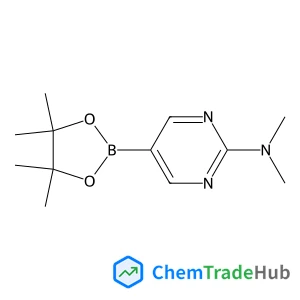
N,N-Dimethyl-5-(4,4,5,5-tetramethyl-1,3,2-dioxaborolan-2-yl)-2-pyrimidinamine
CAS Number:
1032759-30-0
Molecular Formula:
C12H20BN3O2
Recommended Suppliers




Disclaimer
This page provides academic journal information for reference and research purposes only. We are not affiliated with any journal publishers and do not handle publication submissions. For publication-related inquiries, please contact the respective journal publishers directly.
If you notice any inaccuracies in the information displayed, please contact us at support@chemtradehub.com. We will promptly review and address your concerns.