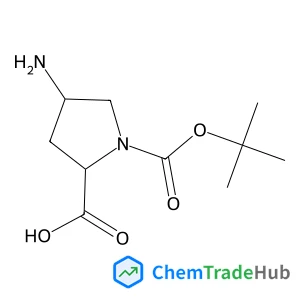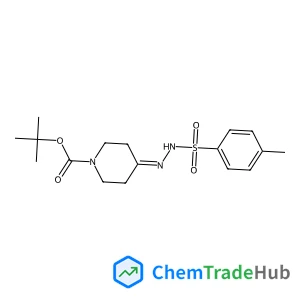
tert-Butyl 4-(2-(p-Tolylsulfonyl)hydrazono)piperidine-1-carboxylate
CAS Number:
1046478-89-0
Molecular Formula:
C17H25N3O4S
Chayanant Hongfa, Jianhua Tian, Jeremy Andreatta, Donald J. Darensbourg, David E. Bergbreiter
Polyisobutylene is shown to be a nonpolar phase tag that separates a highly colored salen Cr(III) complex from products but is otherwise kinetically similar to a low molecular weight salen Cr(III) complex in polycarbonate formation by Cr(III)-catalyzed copolymerization of CO2 and cyclohexene oxide.
Zhao-Bo Li, Shu-Ping Luo, Yi Guo, Ai-Bao Xia, Dan-Qian Xu
DOI: 10.1039/C002197K
Richard J. Hopkinson, Philippa S. Barlow, Christopher J. Schofield, Timothy D. W. Claridge
DOI: 10.1039/C0OB00208A
Zein el abidine Chamas, Emmanuel Aubert, Yves Fort, Victor Mamane
DOI: 10.1039/C0OB00390E
Anupam Bandyopadhyay, Neha Agrawal, Sachitanand M. Mali, Sandip V. Jadhav, Hosahudya N. Gopi
DOI: 10.1039/C0OB00199F
Guido Verniest, Karel Piron, Eva Van Hende, Jan Willem Thuring, Gregor Macdonald, Frederik Deroose, Norbert De Kimpe
DOI: 10.1039/C003380D
Guillaume Mercey, Remi Legay, Jean-François Lohier, Jana Sopkova-de Oliveira Santos, Jocelyne Levillain, Annie-Claude Gaumont, Mihaela Gulea
DOI: 10.1039/C003050C
Seiji Kamioka, Sakae Sugiyama, Takashi Takahashi
DOI: 10.1039/C001228A
Hong-Bin Yao, Xiao-Bo Li, Shu-Juan Liu, Shu-Hong Yu
DOI: 10.1039/B914329G
Atsushi Ohtaka, Takuto Teratani, Ryohei Fujii, Kanako Ikeshita, Osamu Shimomura
DOI: 10.1039/B915039K
(1R,3S)-1,3-Cyclopentanediol finds applications in various industries. In the ph...
When handling N'-[4-(Dimethylamino)phenyl]-N,N-dimethyl-1,4-benzenediamine, it i...
There are several alternatives to 5-(2,4-Difluorophenyl)-2-methoxypyrimidine in ...
1-(3-Methoxyphenoxy)propan-2-ol (CAS: 382141-68-6) must comply with the Globally...
Tetrodotoxin Citrate is extremely dangerous and should be handled with extreme c...
2-Methyl-2-propanyl [(1R,3S)-3-hydroxycyclopentyl]carbamate (CAS: 225641-84-9) i...
Waste containing 4-(2-Hydroxyhexafluoroisopropyl)Benzoic Acid (CAS: 16261-80-6) ...
2-Methyl-2-proanyl {(2S)-1-[(benzyloxy)amino]-3-hydroxy-3-methyl-1-oxo-2-butanyl...
Benzeneethanamine, α-ethyl-, hydrochloride (1:1) is an organic compound with the...
In the synthesis of compounds similar to 3-{(E)-[4-(Dimethylamino)phenyl]diazeny...

ChemComm publishes urgent research which is of outstanding significance and interest to experts in the field, while also appealing to the journal’s broad chemistry readership. Our communication format is ideally suited to short, urgent studies that are of such importance that they require accelerated publication. Our scope covers all topics in chemistry, and research at the interface of chemistry and other disciplines (such as materials science, nanoscience, physics, engineering and biology) where there is a significant novelty in the chemistry aspects. Major topic areas covered include: Analytical Chemistry Catalysis Chemical Biology and medicinal chemistry Computational Chemistry and Machine Learning Energy and sustainable chemistry Environmental Chemistry Green Chemistry Inorganic Chemistry Materials Chemistry Nanoscience Organic Chemistry Physical Chemistry Polymer Chemistry Supramolecular Chemistry