












Biomimetic trifunctional organocatalyst showing a great acceleration for the transesterification between vinyl ester and alcohol
Literature Information
Publication Date
2008-01-22
DOI
10.1039/B718763G
Impact Factor
6.222
Authors
Tadashi Ema, Daisuke Tanida, Tatsuya Matsukawa, Takashi Sakai
View Original
Abstract
Trifunctional organocatalysts 1a and 1b mimicking the active site of serine hydrolases showed high catalytic activity with up to a 3 700 000-fold acceleration for the acyl-transfer reactions from vinyl trifluoroacetate to alcohol.
Related Literature
Synthesis of homogeneous antifreeze glycopeptidesvia a ligation–desulfurisation strategy
James Garner, Katrina A. Jolliffe, Margaret M. Harding, Richard J. Payne
2009-10-21
Communication
DOI: 10.1039/B918021D
Regiospecific synthesis of functionalised 1,3-diarylisobenzofurans viapalladium- and rhodium-catalysed reaction of boronic acids with o-acylbenzaldehydes under thermal or microwave activation
Jérôme Jacq, Bernard Bessières, Cathy Einhorn, Jacques Einhorn
2010-08-26
Paper
DOI: 10.1039/C0OB00110D
A new building block for anion supramolecular chemistry. Study of carbazolocarbazole as anion receptor
David Curiel, Miriam Más-Montoya, Guzmán Sánchez, Raúl A. Orenes, Pedro Molina, Alberto Tárraga
2010-09-16
Communication
DOI: 10.1039/C0OB00522C
[Pb9CdCdPb9]6−: A Zintl cluster anion with an unsupported cadmium–cadmium bond
Binbin Zhou, Mark S. Denning, Thomas A. D. Chapman, John E. McGrady, Jose M. Goicoechea
2009-10-22
Communication
DOI: 10.1039/B917185A
Site-specific incorporation of perylene into an N-terminally modified light-harvesting complex II‡
Kalina Peneva, Kristina Gundlach, Andreas Herrmann, Harald Paulsen, Klaus Müllen
2010-09-06
Communication
DOI: 10.1039/C0OB00492H
Synthesis of aminomethylated 4-fluoropiperidines and 3-fluoropyrrolidines
Guido Verniest, Karel Piron, Eva Van Hende, Jan Willem Thuring, Gregor Macdonald, Frederik Deroose, Norbert De Kimpe
2010-04-21
Communication
DOI: 10.1039/C003380D
Sulfonic acid functionalized crystal-like mesoporous benzene–silica as a remarkable water-tolerant catalyst
Ayman Karam, João Carlos Alonso, Tsvetelina Ivanova Gerganova, Paula Ferreira, Nicolas Bion, Joël Barrault, François Jérôme
2009-10-06
Communication
DOI: 10.1039/B914689J
Organocatalytic kinetic resolution via intramolecular aldol reactions: Enantioselective synthesis of both enantiomers of chiral cyclohexenones
Liujuan Chen, Sanzhong Luo, Jiuyuan Li, Xin Li, Jin-Pei Cheng
2010-04-01
Paper
DOI: 10.1039/B927343C
Synthesis and structure of a magnesium–amidoborane complex and its role in catalytic formation of a new bis-aminoborane ligand
Jan Spielmann, Michael Bolte, Sjoerd Harder
2009-10-21
Communication
DOI: 10.1039/B914979A
Facile preparation of linear polystyrene-stabilized Pd nanoparticles in water
Atsushi Ohtaka, Takuto Teratani, Ryohei Fujii, Kanako Ikeshita, Osamu Shimomura
2009-10-15
Communication
DOI: 10.1039/B915039K
You might also like
Compound Q&A
What industries use (1R,3S)-1,3-Cyclopentanediol (CAS: 16326-97-9)?
(1R,3S)-1,3-Cyclopentanediol finds applications in various industries. In the ph...
16326-97-9(1R,3S)-1,3-Cyclopen...
Compound Q&A
What precautions should be taken when handling N'-[4-(Dimethylamino)phenyl]-N,N-dimethyl-1,4-benzenediamine (CAS: 637-31-0)?
When handling N'-[4-(Dimethylamino)phenyl]-N,N-dimethyl-1,4-benzenediamine, it i...
637-31-0N'-[4-(Dimethylamino...
Compound Q&A
Are there alternatives to 5-(2,4-Difluorophenyl)-2-methoxypyrimidine (CAS: 1352318-16-1) in synthesis?
There are several alternatives to 5-(2,4-Difluorophenyl)-2-methoxypyrimidine in ...
1352318-16-15-(2,4-Difluoropheny...
Compound Q&A
What regulatory guidelines apply to 1-(3-Methoxyphenoxy)propan-2-ol (CAS: 382141-68-6)?
1-(3-Methoxyphenoxy)propan-2-ol (CAS: 382141-68-6) must comply with the Globally...
382141-68-61-(3-Methoxyphenoxy)...
Compound Q&A
Is Tetrodotoxin Citrate (CAS: 18660-81-6) safe?
Tetrodotoxin Citrate is extremely dangerous and should be handled with extreme c...
18660-81-6Tetrodotoxin Citrate
Compound Q&A
What are the main uses of 2-Methyl-2-propanyl [(1R,3S)-3-hydroxycyclopentyl]carbamate (CAS: 225641-84-9)?
2-Methyl-2-propanyl [(1R,3S)-3-hydroxycyclopentyl]carbamate (CAS: 225641-84-9) i...
225641-84-92-Methyl-2-propanyl ...
Compound Q&A
How should waste containing 4-(2-Hydroxyhexafluoroisopropyl)Benzoic Acid (CAS: 16261-80-6) be handled?
Waste containing 4-(2-Hydroxyhexafluoroisopropyl)Benzoic Acid (CAS: 16261-80-6) ...
16261-80-64-(2-Hydroxyhexafluo...
Compound Q&A
How is 2-Methyl-2-proanyl {(2S)-1-[(benzyloxy)amino]-3-hydroxy-3-methyl-1-oxo-2-butanyl}carbamate (CAS: 102507-19-7) typically synthesized?
2-Methyl-2-proanyl {(2S)-1-[(benzyloxy)amino]-3-hydroxy-3-methyl-1-oxo-2-butanyl...
102507-19-72-Methyl-2-propanyl ...
Compound Q&A
What is Benzeneethanamine, α-ethyl-, hydrochloride (1:1) (CAS: 20735-15-3)?
Benzeneethanamine, α-ethyl-, hydrochloride (1:1) is an organic compound with the...
20735-15-3Benzeneethanamine, α...
Compound Q&A
Are there alternatives to 3-{(E)-[4-(Dimethylamino)phenyl]diazenyl}benzoic acid (CAS: 20691-84-3) in synthesis?
In the synthesis of compounds similar to 3-{(E)-[4-(Dimethylamino)phenyl]diazeny...
20691-84-33-{(E)-[4-(Dimethyla...
Source Journal
Chemical Communications

CiteScore:
8.6
Self-citation Rate:
4.7%
Articles per Year:
2458
ChemComm publishes urgent research which is of outstanding significance and interest to experts in the field, while also appealing to the journal’s broad chemistry readership. Our communication format is ideally suited to short, urgent studies that are of such importance that they require accelerated publication. Our scope covers all topics in chemistry, and research at the interface of chemistry and other disciplines (such as materials science, nanoscience, physics, engineering and biology) where there is a significant novelty in the chemistry aspects. Major topic areas covered include: Analytical Chemistry Catalysis Chemical Biology and medicinal chemistry Computational Chemistry and Machine Learning Energy and sustainable chemistry Environmental Chemistry Green Chemistry Inorganic Chemistry Materials Chemistry Nanoscience Organic Chemistry Physical Chemistry Polymer Chemistry Supramolecular Chemistry
Recommended Compounds
![2-{[(1R,2S)-2-Aminocyclohexyl]amino}-4-{[3-(2H-1,2,3-triazol-2-yl)phenyl]amino}-5-pyrimidinecarboxamide structure](https://static.chemtradehub.com/structs/137/1370261-96-3-40df.webp "2-{[(1R,2S)-2-Aminocyclohexyl]amino}-4-{[3-(2H-1,2,3-triazol-2-yl)phenyl]amino}-5-pyrimidinecarboxamide structure")
2-{[(1R,2S)-2-Aminocyclohexyl]amino}-4-{[3-(2H-1,2,3-triazol-2-yl)phenyl]amino}-5-pyrimidinecarboxamide
CAS Number:
1370261-96-3
Molecular Formula:
C19H23N9O
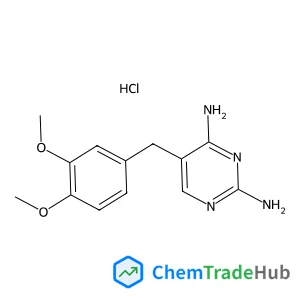
5-(3,4-Dimethoxybenzyl)-2,4-pyrimidinediamine hydrochloride (1:1)
CAS Number:
2507-23-5
Molecular Formula:
C13H17ClN4O2
Recommended Suppliers



Disclaimer
This page provides academic journal information for reference and research purposes only. We are not affiliated with any journal publishers and do not handle publication submissions. For publication-related inquiries, please contact the respective journal publishers directly.
If you notice any inaccuracies in the information displayed, please contact us at support@chemtradehub.com. We will promptly review and address your concerns.