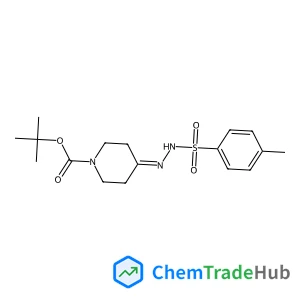
tert-Butyl 4-(2-(p-Tolylsulfonyl)hydrazono)piperidine-1-carboxylate
CAS Number:
1046478-89-0
Molecular Formula:
C17H25N3O4S
Ashima Sah, Robert Kreiter, Dave H. A. Blank, Jaap F. Vente, Johan E. ten Elshof
Unprecedented hydrothermal stability in functional membranes has been obtained with hybrid organic–inorganic nanoporous materials, enabling long-term application in energy-efficient molecular separation, including dehydration up to at least 150 °C.

Journal of Medicinal Chemistry

Israel Journal of Chemistry

Molecular Pharmacology

Journal of Heterocyclic Chemistry

Pure and Applied Chemistry

Journal of Catalysis

Proceedings of the National Academy of Sciences of the United States of America

Russian Chemical Reviews

Pharmacological Reviews

Kinetics and Catalysis
Changzheng Wu, Yi Xie
DOI: 10.1039/B910965J
Michaela Zirngast, Ulrich Flörke, Judith Baumgartner, Christoph Marschner
DOI: 10.1039/B910637E
Wei-Cheng Yuan, Jian Zuo, Shu-Pei Yuan, Jian-Qiang Zhao, Zhen-Hua Wang, Yong You
DOI: 10.1039/D0QO01335H
David H. Webber, Richard L. Brutchey
DOI: 10.1039/B912434A
Raffael Koller, Quentin Huchet, Philip Battaglia, Jan M. Welch, Antonio Togni
DOI: 10.1039/B913962A
When considering alternatives to 1-(4-Chlorophenyl)-N-hydroxymethanimine (CAS: 3...
This compound should be stored in a cool, dry place away from direct sunlight. I...
3-(4-Bromophenyl)-5-(2-fluorophenyl)-1,2,4-oxadiazole is synthesized through a m...
5-Chloro-2-(4-chlorophenyl)-4-methyl-6-[3-(1-piperidinyl)propoxy]pyrimidine (CAS...
2-Chloro-4-(difluoromethoxy)pyridine is used in the pharmaceutical industry for ...
3-Chloro-6-methylpyridazine (CAS: 1121-79-5) is classified under the Globally Ha...
Several alternatives can be used in the synthesis of Methyl 4,5-dimethyl-2-nitro...
Alternatives to (2E,2'E)-3,3'-(1,4-Phenylene)bisacrylaldehyde include other acry...
3-Amino-5-chloropyridin-2-ol hydrochloride is an organic compound with the CAS n...
When handling 6,7-Difluoro-2,3-dihydro-4H-chromen-4-one, it is essential to wear...

ChemComm publishes urgent research which is of outstanding significance and interest to experts in the field, while also appealing to the journal’s broad chemistry readership. Our communication format is ideally suited to short, urgent studies that are of such importance that they require accelerated publication. Our scope covers all topics in chemistry, and research at the interface of chemistry and other disciplines (such as materials science, nanoscience, physics, engineering and biology) where there is a significant novelty in the chemistry aspects. Major topic areas covered include: Analytical Chemistry Catalysis Chemical Biology and medicinal chemistry Computational Chemistry and Machine Learning Energy and sustainable chemistry Environmental Chemistry Green Chemistry Inorganic Chemistry Materials Chemistry Nanoscience Organic Chemistry Physical Chemistry Polymer Chemistry Supramolecular Chemistry
![[4-(Isobutyrylamino)phenyl]boronic acid structure](https://static.chemtradehub.com/structs/874/874219-50-8-6ab5.webp "[4-(Isobutyrylamino)phenyl]boronic acid structure")