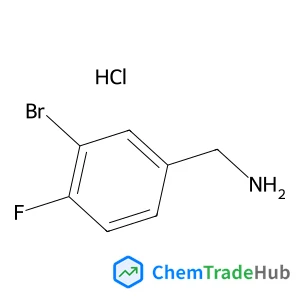
1-(3-Bromo-4-fluorophenyl)methanamine hydrochloride (1:1)
CAS Number:
202865-68-7
Molecular Formula:
C7H8BrClFN
Leandro B. Krott
Confinement has been suggested as a tool to tune the self-assembly properties of nanoparticles, surfactants, polymers and colloids. In this way, we explore the phase diagram of Janus nanoparticles confined between two parallel walls using molecular dynamics simulations. A nanoparticle was modeled as a dimer made by one monomer that interacts via a standard Lennard Jones potential and another monomer that is modeled using a two-length scale shoulder potential. This specific design of the nanoparticle exhibits distinct self-assembled structures and a water-like diffusion anomaly in the bulk. Our results indicate that besides the aggregates observed in bulk, new structures are observed under confinement. Also, the dynamic and thermodynamic behavior of the fluid phase is affected. The systems show a reentrant fluid phase and density anomaly. None of these two features were observed in bulk. Our results show that geometrical confinement leads to new structural, thermodynamical and dynamical behavior for this Janus nanoparticle.
Rosa Becerra, Robin Walsh
DOI: 10.1039/C8CP06208K
Noura Zamzam, Marius Kaucikas, Dennis J. Nürnberg, A. William Rutherford, Jasper J. van Thor
DOI: 10.1039/C8CP05627G
Kamila Akhmetova, Haiyan Fan
DOI: 10.1039/C8CP04789H
Yunli Xu, Dongchao Yang, Linjie Ding, Lizhi Yi, Shuaiwei Fan, Liqing Pan, Jia Li, Fengxia Hu, Guanghua Yu, John Q. Xiao
DOI: 10.1039/C9CP00145J
Anne-Laure Barra, Johan van Tol, Sabine Hediger, Daniel Lee, Gaël De Paëpe
DOI: 10.1039/C8CP06819D
Padmabati Mondal, Miquel Huix-Rotllant
DOI: 10.1039/C9CP00782B
Yu-Min Chen, Chih-Yuan Lin, Shiojenn Tseng
DOI: 10.1039/C9CP00266A
Sean M. Ryno, Chad Risko
DOI: 10.1039/C9CP00777F
Angela Patti, Sonia Pedotti, Giuseppe Mazzeo, Giovanna Longhi, Sergio Abbate, Lorenzo Paoloni, Sergio Rampino, Vincenzo Barone
DOI: 10.1039/C9CP00437H
Prateek Goel, Xiao-Gang Wang, Bo Chen, Xue-Bin Wang, Tao Zeng
DOI: 10.1039/C9CP01352K
When considering alternatives to 1-(4-Chlorophenyl)-N-hydroxymethanimine (CAS: 3...
This compound should be stored in a cool, dry place away from direct sunlight. I...
3-(4-Bromophenyl)-5-(2-fluorophenyl)-1,2,4-oxadiazole is synthesized through a m...
5-Chloro-2-(4-chlorophenyl)-4-methyl-6-[3-(1-piperidinyl)propoxy]pyrimidine (CAS...
2-Chloro-4-(difluoromethoxy)pyridine is used in the pharmaceutical industry for ...
3-Chloro-6-methylpyridazine (CAS: 1121-79-5) is classified under the Globally Ha...
Several alternatives can be used in the synthesis of Methyl 4,5-dimethyl-2-nitro...
Alternatives to (2E,2'E)-3,3'-(1,4-Phenylene)bisacrylaldehyde include other acry...
3-Amino-5-chloropyridin-2-ol hydrochloride is an organic compound with the CAS n...
When handling 6,7-Difluoro-2,3-dihydro-4H-chromen-4-one, it is essential to wear...

Physical Chemistry Chemical Physics (PCCP) is an international journal co-owned by 19 physical chemistry and physics societies from around the world. This journal publishes original, cutting-edge research in physical chemistry, chemical physics and biophysical chemistry. To be suitable for publication in PCCP, articles must include significant innovation and/or insight into physical chemistry; this is the most important criterion that reviewers and Editors will judge against when evaluating submissions. The journal has a broad scope and welcomes contributions spanning experiment, theory, computation and data science. Topical coverage includes spectroscopy, dynamics, kinetics, statistical mechanics, thermodynamics, electrochemistry, catalysis, surface science, quantum mechanics, quantum computing and machine learning. Interdisciplinary research areas such as polymers and soft matter, materials, nanoscience, energy, surfaces/interfaces, and biophysical chemistry are welcomed if they demonstrate significant innovation and/or insight into physical chemistry. Joined experimental/theoretical studies are particularly appreciated when complementary and based on up-to-date approaches.