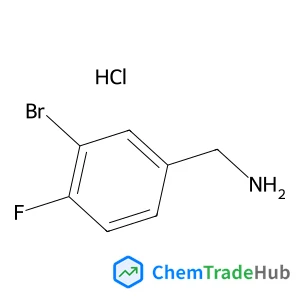
1-(3-Bromo-4-fluorophenyl)methanamine hydrochloride (1:1)
CAS Number:
202865-68-7
Molecular Formula:
C7H8BrClFN
Pushpendra Kumar, Suman Kalyan Pal
The photophysical properties of a push–pull dye and the dynamics of electron transfer across a dye and ZnO quantum dot (QD) interface have been studied using a combination of steady-state, time-resolved fluorescence and femtosecond transient absorption (TA) spectroscopies. Spectroscopic measurements, along with quantum chemical calculations, provide evidence for the photoinduced intramolecular charge transfer (ICT) in a donor–π–acceptor dye. Wavelength dependent fluorescence decay of the dye infers the solvent relaxation of the ICT state. TA spectral measurements suggest electron transfer from dye to ZnO QD through the ICT state by monitoring the dye radical cation. Multiexponential electron injection with time constants of 775 fs and 25 ps at the dye@QD interface is demonstrated using the TA kinetics results. The thermodynamics of fast and slow electron injections is discussed. Furthermore, density functional theory (DFT) and time-dependent (TD)-DFT simulations were performed to identify the dye cation radical and to get a deep insight into the experimental observations.
Oliver J. Rutt, Gareth R. Williams, Simon J. Clarke
DOI: 10.1039/B605105G
Michael R. Reithofer, Mathea S. Galanski, Vladimir B. Arion, Bernhard K. Keppler
DOI: 10.1039/B715680D
Susan E. Gibson, Jacob T. Rendell
DOI: 10.1039/B712298E
Suguru Higashida, Aiko Harada, Rikako Kawakatsu, Noriko Fujiwara, Michio Matsumura
DOI: 10.1039/B604332A
Jun-ichi Matsuo, Yumi Tanaki, Aimi Kido, Hiroyuki Ishibashi
DOI: 10.1039/B605882E
Joo-Hyun Han, Bo-Mi Koo, Jin-Woong Kim, Kyung-Do Suh
DOI: 10.1039/B715557C
Zhehong Gan
DOI: 10.1039/B716383E
Ashima Sah, Robert Kreiter, Dave H. A. Blank, Jaap F. Vente, Johan E. ten Elshof
DOI: 10.1039/B718082A
When considering alternatives to 1-(4-Chlorophenyl)-N-hydroxymethanimine (CAS: 3...
This compound should be stored in a cool, dry place away from direct sunlight. I...
3-(4-Bromophenyl)-5-(2-fluorophenyl)-1,2,4-oxadiazole is synthesized through a m...
5-Chloro-2-(4-chlorophenyl)-4-methyl-6-[3-(1-piperidinyl)propoxy]pyrimidine (CAS...
2-Chloro-4-(difluoromethoxy)pyridine is used in the pharmaceutical industry for ...
3-Chloro-6-methylpyridazine (CAS: 1121-79-5) is classified under the Globally Ha...
Several alternatives can be used in the synthesis of Methyl 4,5-dimethyl-2-nitro...
Alternatives to (2E,2'E)-3,3'-(1,4-Phenylene)bisacrylaldehyde include other acry...
3-Amino-5-chloropyridin-2-ol hydrochloride is an organic compound with the CAS n...
When handling 6,7-Difluoro-2,3-dihydro-4H-chromen-4-one, it is essential to wear...

Physical Chemistry Chemical Physics (PCCP) is an international journal co-owned by 19 physical chemistry and physics societies from around the world. This journal publishes original, cutting-edge research in physical chemistry, chemical physics and biophysical chemistry. To be suitable for publication in PCCP, articles must include significant innovation and/or insight into physical chemistry; this is the most important criterion that reviewers and Editors will judge against when evaluating submissions. The journal has a broad scope and welcomes contributions spanning experiment, theory, computation and data science. Topical coverage includes spectroscopy, dynamics, kinetics, statistical mechanics, thermodynamics, electrochemistry, catalysis, surface science, quantum mechanics, quantum computing and machine learning. Interdisciplinary research areas such as polymers and soft matter, materials, nanoscience, energy, surfaces/interfaces, and biophysical chemistry are welcomed if they demonstrate significant innovation and/or insight into physical chemistry. Joined experimental/theoretical studies are particularly appreciated when complementary and based on up-to-date approaches.