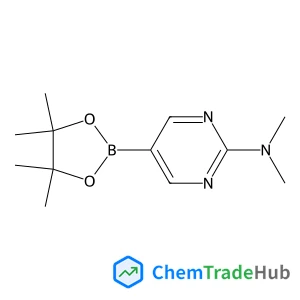
N,N-Dimethyl-5-(4,4,5,5-tetramethyl-1,3,2-dioxaborolan-2-yl)-2-pyrimidinamine
CAS Number:
1032759-30-0
Molecular Formula:
C12H20BN3O2
Suresh Kondati Natarajan, Jörg Behler
Solid–liquid interfaces have received considerable attention in recent years due to their central role in many technologically relevant fields like electrochemistry, heterogeneous catalysis and corrosion. As the chemical processes in these examples take place primarily at the interface, understanding the structural and dynamical properties of the interfacial water molecules is of vital importance. Here, we use a first-principles quality high-dimensional neural network potential built from dispersion-corrected density functional theory data in molecular dynamics simulations to investigate water–copper interfaces as a prototypical case. After performing convergence tests concerning the required supercell size and water film diameter, we investigate numerous properties of the interfacial water molecules at the low-index copper (111), (100) and (110) surfaces. These include density profiles, hydrogen bond properties, lateral mean squared displacements and residence times of the water molecules at the surface. We find that in general the copper–water interaction is rather weak with the strongest interactions observed at the Cu(110) surface, followed by the Cu(100) and Cu(111) surfaces. The distribution of the water molecules in the first hydration layer exhibits a double peak structure. In all cases, the molecules closest to the surface are predominantly allocated on top of the metal sites and are aligned nearly parallel with the oxygen pointing slightly to the surface. The more distant molecules in the first hydration layer at the Cu(111) and Cu(100) surfaces are mainly found in between the top sites, whereas at the Cu(110) surface most of these water molecules are found above the trenches of the close packed atom rows at the surface.
DOI: 10.1039/C8CP06780E
Michael D. LaCount, Mark T. Lusk
DOI: 10.1039/C9CP00329K
Nicolas Schaeffer, German Pérez-Sánchez, Helena Passos, José R. B. Gomes, Nicolas Papaiconomou, João A. P. Coutinho
DOI: 10.1039/C8CP07750A
J. N. Han, X. He, Z. Q. Fan, Z. H. Zhang
DOI: 10.1039/C8CP06471G
He Dong, P. Hu
DOI: 10.1039/C8CP07806H
David Zanuy, Carlos A. Ferreira
DOI: 10.1039/C9CP00567F
Rongxing He, Wei Shen, Ming Li, Tao Zhang
DOI: 10.1039/C9CP00452A
Elsa Quartapelle Procopio, Thomas Moehl, Kazuteru Nonomura, Anders Hagfeldt
DOI: 10.1039/C9CP00856J
David Fuks, Yaniv Gelbstein
DOI: 10.1039/C9CP00764D
Olaf W. Morawski, Andrzej L. Sobolewski, Daniel T. Gryko
DOI: 10.1039/C9CP00978G
When considering alternatives to 1-(4-Chlorophenyl)-N-hydroxymethanimine (CAS: 3...
This compound should be stored in a cool, dry place away from direct sunlight. I...
3-(4-Bromophenyl)-5-(2-fluorophenyl)-1,2,4-oxadiazole is synthesized through a m...
5-Chloro-2-(4-chlorophenyl)-4-methyl-6-[3-(1-piperidinyl)propoxy]pyrimidine (CAS...
2-Chloro-4-(difluoromethoxy)pyridine is used in the pharmaceutical industry for ...
3-Chloro-6-methylpyridazine (CAS: 1121-79-5) is classified under the Globally Ha...
Several alternatives can be used in the synthesis of Methyl 4,5-dimethyl-2-nitro...
Alternatives to (2E,2'E)-3,3'-(1,4-Phenylene)bisacrylaldehyde include other acry...
3-Amino-5-chloropyridin-2-ol hydrochloride is an organic compound with the CAS n...
When handling 6,7-Difluoro-2,3-dihydro-4H-chromen-4-one, it is essential to wear...

Physical Chemistry Chemical Physics (PCCP) is an international journal co-owned by 19 physical chemistry and physics societies from around the world. This journal publishes original, cutting-edge research in physical chemistry, chemical physics and biophysical chemistry. To be suitable for publication in PCCP, articles must include significant innovation and/or insight into physical chemistry; this is the most important criterion that reviewers and Editors will judge against when evaluating submissions. The journal has a broad scope and welcomes contributions spanning experiment, theory, computation and data science. Topical coverage includes spectroscopy, dynamics, kinetics, statistical mechanics, thermodynamics, electrochemistry, catalysis, surface science, quantum mechanics, quantum computing and machine learning. Interdisciplinary research areas such as polymers and soft matter, materials, nanoscience, energy, surfaces/interfaces, and biophysical chemistry are welcomed if they demonstrate significant innovation and/or insight into physical chemistry. Joined experimental/theoretical studies are particularly appreciated when complementary and based on up-to-date approaches.