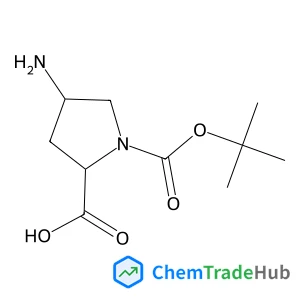
(2R,4R)-1-Boc-4-Aminopyrrolidine-2-carboxylic acid
CAS Number:
132622-98-1
Molecular Formula:
C10H18N2O4
Mn-MOF-74 has great potential to catalyze selective catalytic reduction (SCR) reaction with NH3 being the reductant (NH3-SCR). However, the reaction mechanism, in particular the adsorptive properties of key reactive species in Mn-MOF-74, remains ambiguous. Besides, the effects of impurities such as H2O and SO2 on the process need further investigation. In this paper, based on density functional theory (DFT) calculations, we studied the adsorption characteristics of six NH3-SCR related small gases, namely NH3, NO2, NO, O2, H2O and SO2. DFT results show that the Mn-MOF-74 structure can bind these molecules relatively strongly in the following order: NH3 > NO2 > NO > O2, allowing for subsequent NH3-SCR reaction. In addition, a possible pathway of NO conversion to NO2 was calculated. Investigation on competitive adsorption of NH3 and H2O, NH3 and SO2 reveals that both H2O and SO2 are probable to replace NH3 under certain conditions, indicating that the two impurity gases may affect the activity of the NH3-SCR reaction. Compared with H2O, SO2 can displace NH3 more easily and should not be neglected.
Mohammad Aarabi, Reza Omidyan, Satchin Soorkia, Gilles Grégoire, Maria-Elisa Crestoni, Aurélien de la Lande, Benoît Soep, Niloufar Shafizadeh
DOI: 10.1039/C8CP06210B
Shuchang Wu, Yangming Lin, Bingwei Zhong, Guodong Wen, Hongyang Liu, Dang Sheng Su
DOI: 10.1039/C8CP06175K
I. Hanghofer, M. Brinek, S. L. Eisbacher, B. Bitschnau, M. Volck, V. Hennige, D. Rettenwander
DOI: 10.1039/C9CP00664H
Sean M. Ryno, Chad Risko
DOI: 10.1039/C9CP00777F
Adebayo A. Adeleke, Yansun Yao
DOI: 10.1039/C8CP07288D
Weiliang Wang
DOI: 10.1039/C9CP01232J
Jin-Hyoung Kim, So-Yoen Kim, Ho-Jin Son, Sang Ook Kang
DOI: 10.1039/C8CP07759B
Yu Chen, Junyi Liu, Jiabing Yu
DOI: 10.1039/C8CP04669G
Marco Fioroni, Robert E. Savage, Nathan J. DeYonker
DOI: 10.1039/C9CP00547A
Paweł Piotr Michałowski, Piotr Knyps, Paweł Ciepielewski, Piotr Caban, Ewa Dumiszewska, Jacek Baranowski
DOI: 10.1039/C9CP00613C
When considering alternatives to 1-(4-Chlorophenyl)-N-hydroxymethanimine (CAS: 3...
This compound should be stored in a cool, dry place away from direct sunlight. I...
3-(4-Bromophenyl)-5-(2-fluorophenyl)-1,2,4-oxadiazole is synthesized through a m...
5-Chloro-2-(4-chlorophenyl)-4-methyl-6-[3-(1-piperidinyl)propoxy]pyrimidine (CAS...
2-Chloro-4-(difluoromethoxy)pyridine is used in the pharmaceutical industry for ...
3-Chloro-6-methylpyridazine (CAS: 1121-79-5) is classified under the Globally Ha...
Several alternatives can be used in the synthesis of Methyl 4,5-dimethyl-2-nitro...
Alternatives to (2E,2'E)-3,3'-(1,4-Phenylene)bisacrylaldehyde include other acry...
3-Amino-5-chloropyridin-2-ol hydrochloride is an organic compound with the CAS n...
When handling 6,7-Difluoro-2,3-dihydro-4H-chromen-4-one, it is essential to wear...

Physical Chemistry Chemical Physics (PCCP) is an international journal co-owned by 19 physical chemistry and physics societies from around the world. This journal publishes original, cutting-edge research in physical chemistry, chemical physics and biophysical chemistry. To be suitable for publication in PCCP, articles must include significant innovation and/or insight into physical chemistry; this is the most important criterion that reviewers and Editors will judge against when evaluating submissions. The journal has a broad scope and welcomes contributions spanning experiment, theory, computation and data science. Topical coverage includes spectroscopy, dynamics, kinetics, statistical mechanics, thermodynamics, electrochemistry, catalysis, surface science, quantum mechanics, quantum computing and machine learning. Interdisciplinary research areas such as polymers and soft matter, materials, nanoscience, energy, surfaces/interfaces, and biophysical chemistry are welcomed if they demonstrate significant innovation and/or insight into physical chemistry. Joined experimental/theoretical studies are particularly appreciated when complementary and based on up-to-date approaches.
![[4-(Isobutyrylamino)phenyl]boronic acid structure](https://static.chemtradehub.com/structs/874/874219-50-8-6ab5.webp "[4-(Isobutyrylamino)phenyl]boronic acid structure")
![2-{[(1R,2S)-2-Aminocyclohexyl]amino}-4-{[3-(2H-1,2,3-triazol-2-yl)phenyl]amino}-5-pyrimidinecarboxamide structure](https://static.chemtradehub.com/structs/137/1370261-96-3-40df.webp "2-{[(1R,2S)-2-Aminocyclohexyl]amino}-4-{[3-(2H-1,2,3-triazol-2-yl)phenyl]amino}-5-pyrimidinecarboxamide structure")