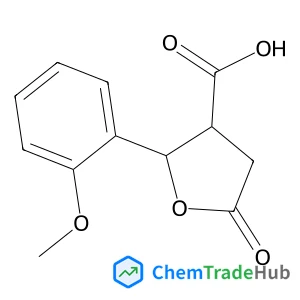
trans-2-(2-Methoxyphenyl)-5-oxotetrahydrofuran-3-carboxylic acid
CAS Number:
99226-02-5
Molecular Formula:
C12H12O5
Tim M. Becker, Azahara Luna-Triguero, Jose Manuel Vicent-Luna, Li-Chiang Lin, David Dubbeldam, Sofia Calero, Thijs J. H. Vlugt
The separation of light olefins from paraffins via cryogenic distillation is a very energy intensive process. Solid adsorbents and especially metal–organic frameworks with open metal sites have the potential to significantly lower the required energy. Specifically, M-MOF-74 has drawn considerable attention for application in olefin/paraffin separation. To investigate how the separation proceeds on a molecular level and to design better materials, molecular simulation can be a useful tool. Unfortunately, it is still a challenge to model the adsorption behavior of many adsorbates in metal–organic frameworks with open metal sites. Previously, the inclusion of explicit polarization has been suggested to improve the quality of classical force fields for such systems. Here, the potential of polarizable force fields for the description of olefins and paraffins in metal–organic frameworks with open metal sites is investigated. In particular, heats of adsorption, binding geometries, and adsorption isotherms are calculated for C2H4, C2H6, C3H6, and C3H8 in M-MOF-74 (with M = Co, Mn, Fe, and Ni). In this study, no force field parameters are adjusted to improve the model. The results show that including explicit polarization significantly improves the description of the adsorption in comparison to non-polarizable generic force fields which do not consider explicit polarization. The study also reveals that simulation predictions are sensitive to the assigned repulsive potential and framework charges. A fully re-parametrized polarizable force field may have the capability to improve the predictions even further.
P. S. Miedema, I. Alonso Calafell, C. Schüßler-Langeheine, M. Beye
DOI: 10.1039/C9CP03593A
Yuefeng Zhang, Yong Zhao, Caiyun Wang, Zengxi Wei, Junliang Yang
DOI: 10.1039/C9CP03692J
Ruihan Wang
DOI: 10.1039/C9CP04673A
Andrea Gardin, Alberta Ferrarini
DOI: 10.1039/D0CP90053B
Mohsen Yarmohammadi, Kavoos Mirabbaszadeh
DOI: 10.1039/C9CP03655E
Samantha K. Callear
DOI: 10.1039/C9CP05993H
Skandar Taj, Diane Baird, Alexander Rosu-Finsen, Martin R. S. McCoustra
DOI: 10.1039/C9CP90226K
DOI: 10.1039/D0CP00241K
6-(3-Fluorophenyl)picolinic acid is generally considered safe for laboratory use...
(3R)-3-Pyrrolidinol is used in the pharmaceutical industry as a precursor for dr...
When handling (4R,5R)-4,5-Diethoxycarbonyl-2,2-dimethyldioxolane (CAS: 59779-75-...
1-(6-Chloroimidazo[1,2-b]pyridazin-3-yl)ethanone is often synthesized via a mult...
The market for N-Ethyl-3,4-dimethylbenzylamine (CAS: 39180-83-1) remains steady,...
Tert-butyl 3-(pyrrolidin-1-yl)azetidine-1-carboxylate is a chemical compound wit...
1-Bromo-3-chloro-2,4-dimethoxybenzene (CAS: 1228956-93-1) falls under the classi...
The safety of 8-Bromo-2-methyl-3,4-dihydroisoquinolin-1(2H)-one (CAS: 1368622-07...
Benzyl [(3S)-2,6-dioxo-3-piperidinyl]carbamate is generally safe when handled wi...
1-{[4-(4,4,5,5-Tetramethyl-1,3,2-dioxaborolan-2-yl)phenyl]sulfonyl}pyrrolidine s...

Physical Chemistry Chemical Physics (PCCP) is an international journal co-owned by 19 physical chemistry and physics societies from around the world. This journal publishes original, cutting-edge research in physical chemistry, chemical physics and biophysical chemistry. To be suitable for publication in PCCP, articles must include significant innovation and/or insight into physical chemistry; this is the most important criterion that reviewers and Editors will judge against when evaluating submissions. The journal has a broad scope and welcomes contributions spanning experiment, theory, computation and data science. Topical coverage includes spectroscopy, dynamics, kinetics, statistical mechanics, thermodynamics, electrochemistry, catalysis, surface science, quantum mechanics, quantum computing and machine learning. Interdisciplinary research areas such as polymers and soft matter, materials, nanoscience, energy, surfaces/interfaces, and biophysical chemistry are welcomed if they demonstrate significant innovation and/or insight into physical chemistry. Joined experimental/theoretical studies are particularly appreciated when complementary and based on up-to-date approaches.