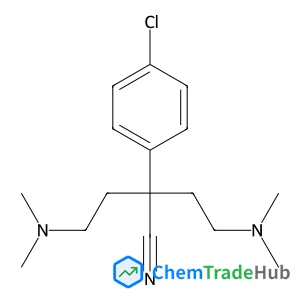
2-(4-Chlorophenyl)-4-(dimethylamino)-2-(2-(dimethylamino)ethyl)butanenitrile
CAS Number:
1246816-57-8
Molecular Formula:
C16H24ClN3
Clinton G. Wiener, Zhe Qiang, Yanfeng Xia, Bryan D. Vogt
Confinement of water to nanoscale dimensions enables substantial supercooling through disruption of the hydrogen bonding network. However, there remain questions associated with the importance of the nature of the water–surface interactions relative to physical confinement defined by the pore geometry on the dynamics of supercooled water. Here, a simple route to tune the surface wetting properties through nitrogen doping of carbon is reported. This method leads to nearly indistinguishable mesopore sizes to enable separation of surface wettability and pore size effects. Quasielastic neutron scattering (QENS) is used to probe the proton dynamics of water confined within the mesopores with an average diameter of 4.85 ± 0.05 nm as a function of temperature from 267 K to 189 K. The motions of water in the mesopores follow jump-diffusion. For the temperatures examined, the diffusivity of water in the mesopores decreases with increasing nitrogen doping of the carbon framework. The activation energy associated with proton dynamics increases by approximately 30% with N-doping when compared to the undoped carbon surface, which is attributed to the enhanced surface wettability (favorable interactions between water and pore surface). This acts to provide an energy barrier for the water motions. This work suggests that the influence of surface chemistry on the dynamics of supercooled water confined in mesopores is less than the influence of nanopore size.
M. Furlani, I. Albinsson, J. L. Ratnasekera, B.-E. Mellander
DOI: 10.1039/C6CP00013D
Niki Vergadou, Jörg-Rüdiger Hill
DOI: 10.1039/C5CP05892A
Morten M. Smedskjaer, Haizheng Tao, Lars R. Jensen, Xiujian Zhao
DOI: 10.1039/C6CP00749J
Lars H. Andersen, Jørgen Houmøller, Hjalte V. Kiefer, Elie Lattouf, Mark H. Stockett
DOI: 10.1039/C6CP00433D
Xiaojun Li, Pieterjan Claes, Marko Haertelt, Peter Lievens, Ewald Janssens
DOI: 10.1039/C5CP07298K
Jyun-Yi Wu, Li-Jen Chen, Yan-Ping Chen, Shiang-Tai Lin
DOI: 10.1039/C5CP06419H
DOI: 10.1039/C5CP02190A
Michael K. M. Ward, David M. Rowley
DOI: 10.1039/C5CP07329D
Mikail Aslan, Jack B. A. Davis, Roy L. Johnston
DOI: 10.1039/C6CP00342G
Carlos A. Castañeda, Apurva Chaturvedi, Christina M. Camara, Joseph E. Curtis, Susan Krueger, David Fushman
DOI: 10.1039/C5CP04601G
This compound is mainly used as an intermediate in the synthesis of antipsychoti...
Waste containing 1-(D-Ribofuranosyl)-1,4-dihydro-3-pyridinecarboxamide (CAS: 191...
2-Methyl-2-propanyl 3-bromo-3-(hydroxymethyl)-1-azetidinecarboxylate (CAS: 20079...
N-(4-Chloro-2-pyridinyl)acetamide (CAS: 245056-66-0) is a chemical compound with...
5-Chloro-2-hydroxybenzoic acid, also known as 5-chlorosalicylic acid, is an arom...
When handling 1,1-Dichloro-1-fluoroethane (CAS: 1717-00-6), it is important to u...
Fmoc-(2S,3R)-3-phenylpyrrolidine-2-carboxylic acid is a white crystalline solid ...
4-Amino-5-bromo-2-pyridinecarboxylic acid is primarily used as a precursor in th...
Handling this compound should be done with personal protective equipment (PPE) i...
When handling 8-bromo-2,2-dimethyl-3,4-dihydro-2H-1,4-benzoxazin-3-one, use prop...

Physical Chemistry Chemical Physics (PCCP) is an international journal co-owned by 19 physical chemistry and physics societies from around the world. This journal publishes original, cutting-edge research in physical chemistry, chemical physics and biophysical chemistry. To be suitable for publication in PCCP, articles must include significant innovation and/or insight into physical chemistry; this is the most important criterion that reviewers and Editors will judge against when evaluating submissions. The journal has a broad scope and welcomes contributions spanning experiment, theory, computation and data science. Topical coverage includes spectroscopy, dynamics, kinetics, statistical mechanics, thermodynamics, electrochemistry, catalysis, surface science, quantum mechanics, quantum computing and machine learning. Interdisciplinary research areas such as polymers and soft matter, materials, nanoscience, energy, surfaces/interfaces, and biophysical chemistry are welcomed if they demonstrate significant innovation and/or insight into physical chemistry. Joined experimental/theoretical studies are particularly appreciated when complementary and based on up-to-date approaches.
![6-Benzyl-4,5,6,7-tetrahydro-1H-pyrazolo[3,4-c]pyridin-3(2H)-one structure](https://static.chemtradehub.com/structs/909/909187-64-0-f54f.webp "6-Benzyl-4,5,6,7-tetrahydro-1H-pyrazolo[3,4-c]pyridin-3(2H)-one structure")