













Edge morphology induced rectifier diode effect in C3N nanoribbon
Literature Information
Publication Date
2018-10-24
DOI
10.1039/C8CP05209C
Impact Factor
3.676
Authors
View Original
Abstract
The two-dimensional material C3N has a honeycomb structure similar to graphene, but its heterogeneity of carbon and nitrogen elements makes it multifunctional. By performing a first-principles study, we find that edge morphology induces interesting electronic transport properties in step-like heterojunction devices composed of width-variable zigzag C3N nanoribbons. As long as the right part has an edge of all-carbon morphology, negative differential resistance and rectification effects will occur. If both edges are not of all-carbon morphology due to the presence of N atoms, a forward-conducting and reverse-blocking rectifier diode behavior will appear. These phenomena originate from the peculiar electronic structure of the zigzag C3N nanoribbons. The number of energy bands crossing the Fermi level gradually decreases from 2 to 0 as the number of all-carbon edges decreases, realizing a transition from metal to semiconductor. The band gap determines the cut-off region at low bias and the presence of an interface barrier causes the cut-off state to continue under high reverse bias. Diverse edge morphologies, simple cutting methods and rich electronic transport properties make C3N materials competitive in nanodevice applications.
Related Literature
Resonance signatures in the body-frame valence photoionization of CF4
C. S. Trevisan, R. R. Lucchese, W. Iskandar, R. Moshammer, R. Strom, T. Severt, B. Jochim, D. Reedy, M. Weller, A. L. Landers, J. B. Williams, I. Ben-Itzhak, R. Dörner, D. Slaughter, Th. Weber, T. N. Rescigno
2018-07-25
Paper
DOI: 10.1039/C8CP03637C
Investigation of copper precursors in the synthesis of higher alcohols from syngas over CuZnAl catalysts without promoters
Yong-Jun Liu, Lei Jia, Wei Huang
2018-06-26
Paper
DOI: 10.1039/C8CP02296H
Unravelling the enigma of ultrafast excited state relaxation in non-emissive aggregating conjugated polymers
Benjamin D. Datko, Maksim Y. Livshits, Zhen Zhang, Dana Portlock, Yang Qin, Jeffrey J. Rack, John K. Grey
2018-08-09
Paper
DOI: 10.1039/C8CP04061C
Uptake of water by an acid–base nanoparticle: theoretical and experimental studies of the methanesulfonic acid–methylamine system
Jing Xu, Véronique Perraud, Barbara J. Finlayson-Pitts
2018-08-13
Paper
DOI: 10.1039/C8CP03634A
Chiral effects on the final step of an octahedron-shaped coordination capsule self-assembly
Y. Matsumura, S. Iuchi, S. Hiraoka
2018-01-25
Communication
DOI: 10.1039/C7CP08237A
Visible-light-driven CO2 photoreduction over ZnxCd1−xS solid solution coupling with tetra(4-carboxyphenyl)porphyrin iron(iii) chloride
Xuehua Zhang, Chunchao Hou, Lin Lin
2018-05-25
Paper
DOI: 10.1039/C8CP02774A
Formation of ozone by solid state reactions
Lahouari Krim, Mindaguas Jonusas, Gianfranco Vidali
2018-06-15
Paper
DOI: 10.1039/C8CP03020K
Improving the activity of gold nanoparticles for the water-gas shift reaction using TiO2–Y2O3: an example of catalyst design
Jose J. Plata, Francisca Romero-Sarria, Javier Amaya Suárez, Antonio M. Márquez, Óscar H. Laguna, José A. Odriozola, Javier Fdez Sanz
2018-08-03
Paper
DOI: 10.1039/C8CP03706J
Computational prediction of a high ZT of n-type Mg3Sb2-based compounds with isotropic thermoelectric conduction performance
Juan Li, Shuqi Zheng, Teng Fang, Luo Yue, Shuai Zhang, Guiwu Lu
2018-02-12
Paper
DOI: 10.1039/C7CP08680F
Mechanisms of reinforcement in polymer nanocomposites
N. Molinari, A. P. Sutton
2018-08-31
Paper
DOI: 10.1039/C8CP03281E
You might also like
Compound Q&A
How should waste containing 4-Bromo-3-methyl-2-thiophenecarboxylic acid (CAS: 265652-39-9) be handled?
Waste containing 4-Bromo-3-methyl-2-thiophenecarboxylic acid (CAS: 265652-39-9) ...
265652-39-94-Bromo-3-methyl-2-t...
Compound Q&A
What industries use (2S,5S,2'S,5'S)-1,1'-(1,2-Ethanediyl)bis(2,5-dimethylphospholane) (CAS: 136779-26-5)?
(2S,5S,2'S,5'S)-1,1'-(1,2-Ethanediyl)bis(2,5-dimethylphospholane) is primarily u...
136779-26-5(2S,5S,2'S,5'S)-1,1'...
Compound Q&A
What industries use Ethyl 2-(2-bromo-5-fluorophenyl)acetate (CAS: 1214910-61-8)?
Ethyl 2-(2-bromo-5-fluorophenyl)acetate (CAS: 1214910-61-8) is used in the pharm...
1214910-61-8Ethyl 2-(2-bromo-5-f...
Compound Q&A
How is 4-Methyl-2-benzofuran-1,3-dione (CAS: 4792-30-7) typically synthesized?
4-Methyl-2-benzofuran-1,3-dione (CAS: 4792-30-7) can be synthesized through seve...
4792-30-74-Methyl-2-benzofura...
Compound Q&A
What industries use 4,6-Dichloroquinoline-3-carbonitrile (CAS: 936498-04-3)?
4,6-Dichloroquinoline-3-carbonitrile (CAS: 936498-04-3) is used in the pharmaceu...
936498-04-34,6-Dichloroquinolin...
Compound Q&A
What are the main uses of Chloro[tris(para-trifluoromethylphenyl)phosphine]gold(I) (CAS: 385815-83-8)?
Chloro[tris(para-trifluoromethylphenyl)phosphine]gold(I) is primarily used in or...
385815-83-8Chloro[tris(para-tri...
Compound Q&A
Is 2-Bromo-5-nitrofuran (CAS: 823-73-4) safe?
2-Bromo-5-nitrofuran (CAS: 823-73-4) is generally considered safe when handled w...
823-73-42-Bromo-5-nitrofuran
Compound Q&A
How should 5-Bromo-2,3,4-trifluorobenzoic acid (CAS: 212631-85-1) be stored?
5-Bromo-2,3,4-trifluorobenzoic acid should be stored in a cool, dry place away f...
212631-85-15-Bromo-2,3,4-triflu...
Compound Q&A
What are the main uses of Zinc bis(aminoacetate) (CAS: 7214-08-6)?
Zinc bis(aminoacetate) (CAS: 7214-08-6) is primarily used in the pharmaceutical ...
7214-08-6Zinc bis(aminoacetat...
Compound Q&A
How should Adamantan-1-ylmethanol (CAS: 770-71-8) be stored?
Adamantan-1-ylmethanol should be stored in a cool, dry, and well-ventilated plac...
770-71-8Adamantan-1-ylmethan...
Source Journal
Physical Chemistry Chemical Physics

CiteScore:
5.5
Self-citation Rate:
10.3%
Articles per Year:
3036
Physical Chemistry Chemical Physics (PCCP) is an international journal co-owned by 19 physical chemistry and physics societies from around the world. This journal publishes original, cutting-edge research in physical chemistry, chemical physics and biophysical chemistry. To be suitable for publication in PCCP, articles must include significant innovation and/or insight into physical chemistry; this is the most important criterion that reviewers and Editors will judge against when evaluating submissions. The journal has a broad scope and welcomes contributions spanning experiment, theory, computation and data science. Topical coverage includes spectroscopy, dynamics, kinetics, statistical mechanics, thermodynamics, electrochemistry, catalysis, surface science, quantum mechanics, quantum computing and machine learning. Interdisciplinary research areas such as polymers and soft matter, materials, nanoscience, energy, surfaces/interfaces, and biophysical chemistry are welcomed if they demonstrate significant innovation and/or insight into physical chemistry. Joined experimental/theoretical studies are particularly appreciated when complementary and based on up-to-date approaches.
Recommended Compounds
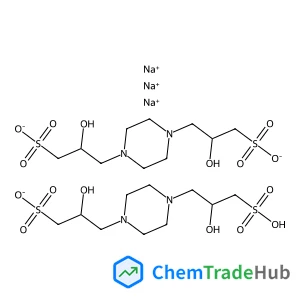
3,3'-(Piperazine-1,4-diyl)bis(2-hydroxypropane-1-sulfonic acid) Sodium Salt
CAS Number:
108321-08-0
Molecular Formula:
C20H41N4Na3O16S4
![5-(2-Phenylpyrazolo[1,5-a]pyridin-3-yl)-2H-pyrazolo[3,4-c]pyridazin-3-amine structure](https://static.chemtradehub.com/structs/865/865362-74-9-0091.webp "5-(2-Phenylpyrazolo[1,5-a]pyridin-3-yl)-2H-pyrazolo[3,4-c]pyridazin-3-amine structure")
5-(2-Phenylpyrazolo[1,5-a]pyridin-3-yl)-2H-pyrazolo[3,4-c]pyridazin-3-amine
CAS Number:
865362-74-9
Molecular Formula:
C18H13N7
Recommended Suppliers





Disclaimer
This page provides academic journal information for reference and research purposes only. We are not affiliated with any journal publishers and do not handle publication submissions. For publication-related inquiries, please contact the respective journal publishers directly.
If you notice any inaccuracies in the information displayed, please contact us at support@chemtradehub.com. We will promptly review and address your concerns.