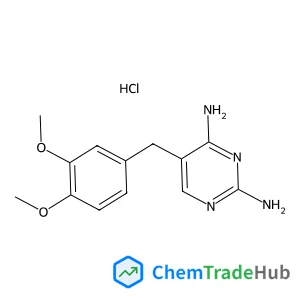
5-(3,4-Dimethoxybenzyl)-2,4-pyrimidinediamine hydrochloride (1:1)
CAS Number:
2507-23-5
Molecular Formula:
C13H17ClN4O2
Jarich Haitjema, Lianjia Wu, Laurent Nahon, Sonia Castellanos
Correction for ‘UV and VUV-induced fragmentation of tin-oxo cage ions’ by Jarich Haitjema et al., Phys. Chem. Chem. Phys., 2021, 23, 20909–20918, https://doi.org/10.1039/D1CP03148A.
Yong Seok Hwang, Valery I. Levitas
DOI: 10.1039/C6CP03897B
DOI: 10.1039/C6CP90249A
Andrej Junginger, Rigoberto Hernandez
DOI: 10.1039/C6CP02532C
Yousuke Ooyama, Kensuke Furue, Toshiaki Enoki, Masahiro Kanda, Yohei Adachi, Joji Ohshita
DOI: 10.1039/C6CP06513A
Hacan Ali Ahmad, Sébastien Thomas, Philippe Bazin, Aurélie Vicente, Christian Fernandez, Hussein Awala, Svetlana Mintova
DOI: 10.1039/C6CP05766G
David R. Bell, Rui Qi, Zhifeng Jing, Jin Yu Xiang, Christopher Mejias, Michael J. Schnieders, Jay W. Ponder, Pengyu Ren
DOI: 10.1039/C6CP02509A
When considering alternatives to 1-(4-Chlorophenyl)-N-hydroxymethanimine (CAS: 3...
This compound should be stored in a cool, dry place away from direct sunlight. I...
3-(4-Bromophenyl)-5-(2-fluorophenyl)-1,2,4-oxadiazole is synthesized through a m...
5-Chloro-2-(4-chlorophenyl)-4-methyl-6-[3-(1-piperidinyl)propoxy]pyrimidine (CAS...
2-Chloro-4-(difluoromethoxy)pyridine is used in the pharmaceutical industry for ...
3-Chloro-6-methylpyridazine (CAS: 1121-79-5) is classified under the Globally Ha...
Several alternatives can be used in the synthesis of Methyl 4,5-dimethyl-2-nitro...
Alternatives to (2E,2'E)-3,3'-(1,4-Phenylene)bisacrylaldehyde include other acry...
3-Amino-5-chloropyridin-2-ol hydrochloride is an organic compound with the CAS n...
When handling 6,7-Difluoro-2,3-dihydro-4H-chromen-4-one, it is essential to wear...

Physical Chemistry Chemical Physics (PCCP) is an international journal co-owned by 19 physical chemistry and physics societies from around the world. This journal publishes original, cutting-edge research in physical chemistry, chemical physics and biophysical chemistry. To be suitable for publication in PCCP, articles must include significant innovation and/or insight into physical chemistry; this is the most important criterion that reviewers and Editors will judge against when evaluating submissions. The journal has a broad scope and welcomes contributions spanning experiment, theory, computation and data science. Topical coverage includes spectroscopy, dynamics, kinetics, statistical mechanics, thermodynamics, electrochemistry, catalysis, surface science, quantum mechanics, quantum computing and machine learning. Interdisciplinary research areas such as polymers and soft matter, materials, nanoscience, energy, surfaces/interfaces, and biophysical chemistry are welcomed if they demonstrate significant innovation and/or insight into physical chemistry. Joined experimental/theoretical studies are particularly appreciated when complementary and based on up-to-date approaches.
![[4-(Isobutyrylamino)phenyl]boronic acid structure](https://static.chemtradehub.com/structs/874/874219-50-8-6ab5.webp "[4-(Isobutyrylamino)phenyl]boronic acid structure")