












![1-[3-(4-Morpholinylsulfonyl)phenyl]methanamine structure](https://static.chemtradehub.com/structs/933/933989-32-3-51af.webp "1-[3-(4-Morpholinylsulfonyl)phenyl]methanamine structure")
Pressure-dependent kinetics of methyl formate reactions with OH at combustion, atmospheric and interstellar temperatures
Literature Information
Publication Date
2018-09-24
DOI
10.1039/C8CP04114H
Impact Factor
3.676
Authors
Junjun Wu, Liuhao Ma
View Original
Abstract
We report the first theoretical characterization of the pressure-dependence of hydrogen abstraction from methyl formate (MF) by a hydroxyl radical (OH) at combustion, atmospheric and interstellar temperatures. The reaction kinetics of MF + OH over a broad temperature range of 20–2000 K were studied using Rice–Ramsperger–Kassel–Marcus/master equation (RRKM/ME) theory. The M06-2x/ma-TZVP density functional method was adopted to construct the potential energy surface. The multi-structural torsional (MS-T) method was employed to account for the multi-conformer and torsional coupling effects. The barrier-less entrance channel forming an H-bonded complex was treated by phase state theory using long-range isotropic potential. The inner channel converting the complex into products was treated by both transition state theory and variational transition state theory in conjunction with asymmetric Eckart tunneling. We calculated the rate coefficients at the high-pressure and low-pressure limits, as well as by the pre-equilibrium model (PEM). The rate coefficients at 20–2000 K and 0.001–100 bar were determined and compared with the previous experimental results. Our calculations show a fairly good agreement with the measurements at 22–1344 K: a small deviation of <25% at combustion temperatures and a factor of 1.5–2.2 at interstellar temperatures. Besides providing an improved rate coefficient determination at combustion temperatures, we elucidate the pressure-dependence of the rate coefficient at atmospheric and interstellar temperatures.
Related Literature
Gas phase equilibrium structure of histamine
Anatolii N. Rykov, Olga E. Grikina, Leonid S. Khaikin
2016-01-19
Paper
DOI: 10.1039/C5CP07719B
Homonuclear decoupling for spectral simplification of carbon-13 enriched molecules in solution-state NMR enhanced by dissolution DNP
Aurélien Bornet, Sami Jannin
2016-03-31
Paper
DOI: 10.1039/C5CP07884A
Electrophoresis of pH-regulated nanoparticles: impact of the Stern layer
Lanju Mei, Tzung-Han Chou, Yu-Shen Cheng, Ming-Jiang Huang, Li-Hsien Yeh, Shizhi Qian
2015-10-14
Paper
DOI: 10.1039/C5CP05728K
A systematic study on Pt based, subnanometer-sized alloy cluster catalysts for alkane dehydrogenation: effects of intermetallic interaction
Andreas W. Hauser, Paul R. Horn, Martin Head-Gordon, Alexis T. Bell
2016-03-09
Paper
DOI: 10.1039/C6CP00360E
Hierarchical mesoporous NiCo2O4 hollow nanocubes for supercapacitors
Chuanbao Cao, Jianhua Hou, Huazhang Zhai
2016-01-28
Paper
DOI: 10.1039/C5CP07997G
Multi-probe relaxation dispersion measurements increase sensitivity to protein dynamics
R. Bryn Fenwick, David Oyen, Peter E. Wright
2015-09-24
Paper
DOI: 10.1039/C5CP04670J
New insights into water oxidation reactions from photocatalysis, electrocatalysis to chemical catalysis: an example of iron-based oxides doped with foreign elements
Jingwei Huang, Xiaoqiang Du, YingYing Feng, Yukun Zhao
2016-03-18
Communication
DOI: 10.1039/C6CP01543C
Robust half-metallic ferromagnetism and curvature dependent magnetic coupling in fluorinated boron nitride nanotubes
Chunsheng Guo, Yu Zhou, Xin-Qiang Shi, Li-Yong Gan, Hong Jiang
2016-04-04
Paper
DOI: 10.1039/C6CP01477A
A medium range order structural connection to the configurational heat capacity of borate–silicate mixed glasses
Morten M. Smedskjaer, Haizheng Tao, Lars R. Jensen, Xiujian Zhao
2016-03-15
Paper
DOI: 10.1039/C6CP00749J
Enhanced electron extraction capability of polymer solar cells via modifying the cathode buffer layer with inorganic quantum dots
Zhiqi Li, Shujun Li, Zhihui Zhang, Xinyuan Zhang, Jingfeng Li, Chunyu Liu, Wenbin Guo, Shengping Ruan
2016-04-04
Paper
DOI: 10.1039/C6CP00989A
You might also like
Compound Q&A
What are the main uses of 1-(3-Aminophenyl)-3-[(3R)-1-(3,3-dimethyl-2-oxobutyl)-2-oxo-5-(2-pyridinyl)-2,3-dihydro-1H-1,4-benzodiazepin-3-yl]urea (CAS: 155412-88-7)?
This compound is mainly used as an intermediate in the synthesis of antipsychoti...
155412-88-71-(3-Aminophenyl)-3-...
Compound Q&A
How should waste containing 1-(D-Ribofuranosyl)-1,4-dihydro-3-pyridinecarboxamide (CAS: 19132-12-8) be handled?
Waste containing 1-(D-Ribofuranosyl)-1,4-dihydro-3-pyridinecarboxamide (CAS: 191...
19132-12-81-(D-Ribofuranosyl)-...
Compound Q&A
What regulatory guidelines apply to 2-Methyl-2-propanyl 3-bromo-3-(hydroxymethyl)-1-azetidinecarboxylate (CAS: 2007919-81-3)?
2-Methyl-2-propanyl 3-bromo-3-(hydroxymethyl)-1-azetidinecarboxylate (CAS: 20079...
2007919-81-32-Methyl-2-propanyl ...
Compound Q&A
What is N-(4-Chloro-2-pyridinyl)acetamide (CAS: 245056-66-0)?
N-(4-Chloro-2-pyridinyl)acetamide (CAS: 245056-66-0) is a chemical compound with...
245056-66-0N-(4-Chloro-2-pyridi...
Compound Q&A
What is 5-Chloro-2-hydroxybenzoic acid (CAS: 321-14-2)?
5-Chloro-2-hydroxybenzoic acid, also known as 5-chlorosalicylic acid, is an arom...
321-14-25-Chloro-2-hydroxybe...
Compound Q&A
What precautions should be taken when handling 1,1-Dichloro-1-fluoroethane (CAS: 1717-00-6)?
When handling 1,1-Dichloro-1-fluoroethane (CAS: 1717-00-6), it is important to u...
1717-00-61,1-Dichloro-1-fluor...
Compound Q&A
What are the physical and chemical properties of Fmoc-(2S,3R)-3-phenylpyrrolidine-2-carboxylic acid (CAS: 281655-32-1)?
Fmoc-(2S,3R)-3-phenylpyrrolidine-2-carboxylic acid is a white crystalline solid ...
281655-32-1Fmoc-(2S,3R)-3-pheny...
Compound Q&A
What are the main uses of 4-Amino-5-bromo-2-pyridinecarboxylic acid (CAS: 1363381-01-4)?
4-Amino-5-bromo-2-pyridinecarboxylic acid is primarily used as a precursor in th...
1363381-01-44-Amino-5-bromo-2-py...
Compound Q&A
What precautions should be taken when handling (S)-tert-butyl 2-((2-(4-bromophenyl)-2-oxoethyl)carbamoyl)pyrrolidine-1-carboxylate (CAS: 1007881-98-2)?
Handling this compound should be done with personal protective equipment (PPE) i...
1007881-98-2(S)-tert-butyl 2-((2...
Compound Q&A
What precautions should be taken when handling 8-bromo-2,2-dimethyl-3,4-dihydro-2H-1,4-benzoxazin-3-one (CAS: 688363-73-7)?
When handling 8-bromo-2,2-dimethyl-3,4-dihydro-2H-1,4-benzoxazin-3-one, use prop...
688363-73-78-bromo-2,2-dimethyl...
Source Journal
Physical Chemistry Chemical Physics

CiteScore:
5.5
Self-citation Rate:
10.3%
Articles per Year:
3036
Physical Chemistry Chemical Physics (PCCP) is an international journal co-owned by 19 physical chemistry and physics societies from around the world. This journal publishes original, cutting-edge research in physical chemistry, chemical physics and biophysical chemistry. To be suitable for publication in PCCP, articles must include significant innovation and/or insight into physical chemistry; this is the most important criterion that reviewers and Editors will judge against when evaluating submissions. The journal has a broad scope and welcomes contributions spanning experiment, theory, computation and data science. Topical coverage includes spectroscopy, dynamics, kinetics, statistical mechanics, thermodynamics, electrochemistry, catalysis, surface science, quantum mechanics, quantum computing and machine learning. Interdisciplinary research areas such as polymers and soft matter, materials, nanoscience, energy, surfaces/interfaces, and biophysical chemistry are welcomed if they demonstrate significant innovation and/or insight into physical chemistry. Joined experimental/theoretical studies are particularly appreciated when complementary and based on up-to-date approaches.
Recommended Compounds

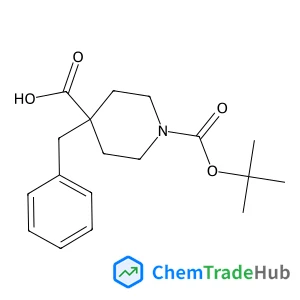
4-Benzyl-1-(tert-butoxycarbonyl)piperidine-4-carboxylic acid
CAS Number:
170838-87-6
Molecular Formula:
C18H25NO4
Recommended Suppliers




Disclaimer
This page provides academic journal information for reference and research purposes only. We are not affiliated with any journal publishers and do not handle publication submissions. For publication-related inquiries, please contact the respective journal publishers directly.
If you notice any inaccuracies in the information displayed, please contact us at support@chemtradehub.com. We will promptly review and address your concerns.