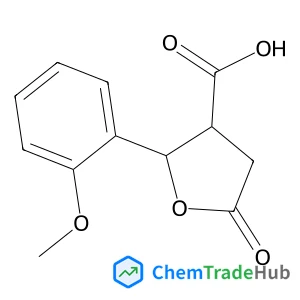
trans-2-(2-Methoxyphenyl)-5-oxotetrahydrofuran-3-carboxylic acid
CAS Number:
99226-02-5
Molecular Formula:
C12H12O5
Qiao-Zhi Li, Ling He, Shigeru Nagase, Xiang Zhao
Recent reports pointed out that the formal La2C2n (2n = 92–106) series can exist stably as carbide cluster metallofullerenes (CCMFs) La2C2@C2n−2 with their successful crystallographic characterization. Herein, we suggest that the corresponding dimetallofullerenes (di-EMFs) La2@C2n possessing the lowest potential energies are also plausible candidates because of their favorability in statistical thermodynamics. This can be demonstrated in our present theoretical investigations on La2C94 and previously reported other La2C2n (2n = 92, 96–100) series by density functional theory calculations and statistical mechanics analyses. Nevertheless, it was noted that these thermodynamically favorable La2@C2n isomers turned out to be kinetically unstable radicals due to the presence of one unpaired electron on the carbon cage, making them missing fullerenes and difficult to be captured in their pristine forms, except for the experimentally obtained La2@D5(450)-C100 that has no unpaired electron. Such kinetic instability could be modified by electron reduction (the products were denoted as [La2@C2n]−) or other similar exterior functionalization with ˙CF3 and benzyl radicals, resulting in La–La bonded and paramagnetic species capable of being captured. On the basis of these approaches, carbon cages D3(85)-C92, Cs(120)-C94, D2(186)-C96, and C2(157)-C96 are predicted to be feasibly captured as both pristine CCMF species and electron reduced di-EMF derivatives.
Zhenzhen Guo, Nuoyi Zheng, Liyun Zhang, Zhijun Xia, Dehua Wang, Jianfen Shen, Hua Yan, Shuchang Wu, Hongyang Liu
DOI: 10.1039/D0CP00186D
Marco Sauermoser, Signe Kjelstrup, Bruno G. Pollet, Eirik G. Flekkøy
DOI: 10.1039/C9CP05394H
Giovanni Di Liberto, Sergio Tosoni, Gianfranco Pacchioni
DOI: 10.1039/C9CP03930A
Leonardo Silva-Dias, Alejandro Lopez-Castillo
DOI: 10.1039/D0CP00650E
Germán Molpeceres, Johannes Kästner
DOI: 10.1039/D0CP00250J
Debkumar Rana, Patrice Donfack, Vladislav Jovanov, Veit Wagner, Arnulf Materny
DOI: 10.1039/C9CP03736E
Ming-Hsiu Wu, Wan-Jou Chou, Jian-Syun Huang, Darwin Barayang Putungan, Shi-Hsin Lin
DOI: 10.1039/C9CP03893K
Mohammad Aarabi, Satchin Soorkia, Gilles Grégoire, Aurélien de la Lande, Benoît Soep, Reza Omidyan, Niloufar Shafizadeh
DOI: 10.1039/C9CP03608C
O. Palumbo, A. Cimini, J.-B. Brubach, P. Roy, A. Paolone
DOI: 10.1039/D0CP00907E
Fabian Düll, Manuel Meusel, Florian Späth, Simon Schötz, Udo Bauer, Philipp Bachmann, Johann Steinhauer, Hans-Peter Steinrück, Andreas Bayer, Christian Papp
DOI: 10.1039/C9CP04095A
6-(3-Fluorophenyl)picolinic acid is generally considered safe for laboratory use...
(3R)-3-Pyrrolidinol is used in the pharmaceutical industry as a precursor for dr...
When handling (4R,5R)-4,5-Diethoxycarbonyl-2,2-dimethyldioxolane (CAS: 59779-75-...
1-(6-Chloroimidazo[1,2-b]pyridazin-3-yl)ethanone is often synthesized via a mult...
The market for N-Ethyl-3,4-dimethylbenzylamine (CAS: 39180-83-1) remains steady,...
Tert-butyl 3-(pyrrolidin-1-yl)azetidine-1-carboxylate is a chemical compound wit...
1-Bromo-3-chloro-2,4-dimethoxybenzene (CAS: 1228956-93-1) falls under the classi...
The safety of 8-Bromo-2-methyl-3,4-dihydroisoquinolin-1(2H)-one (CAS: 1368622-07...
Benzyl [(3S)-2,6-dioxo-3-piperidinyl]carbamate is generally safe when handled wi...
1-{[4-(4,4,5,5-Tetramethyl-1,3,2-dioxaborolan-2-yl)phenyl]sulfonyl}pyrrolidine s...

Physical Chemistry Chemical Physics (PCCP) is an international journal co-owned by 19 physical chemistry and physics societies from around the world. This journal publishes original, cutting-edge research in physical chemistry, chemical physics and biophysical chemistry. To be suitable for publication in PCCP, articles must include significant innovation and/or insight into physical chemistry; this is the most important criterion that reviewers and Editors will judge against when evaluating submissions. The journal has a broad scope and welcomes contributions spanning experiment, theory, computation and data science. Topical coverage includes spectroscopy, dynamics, kinetics, statistical mechanics, thermodynamics, electrochemistry, catalysis, surface science, quantum mechanics, quantum computing and machine learning. Interdisciplinary research areas such as polymers and soft matter, materials, nanoscience, energy, surfaces/interfaces, and biophysical chemistry are welcomed if they demonstrate significant innovation and/or insight into physical chemistry. Joined experimental/theoretical studies are particularly appreciated when complementary and based on up-to-date approaches.