


![(2E)-4-[(1R,2S,8R,19S,21R)-14-Hydroxy-11-isopropenyl-8,23,23-trimethyl-5-(3-methyl-2-buten-1-yl)-16,20-dioxo-3,7,22-trioxaheptacyclo[17.4.1.1~8,12~.0~2,17~.0~2,21~.0~4,15~.0~6,13~]pentacosa-4(15),5,13
,17-tetraen-21-yl]-2-methyl-2-butenoic acid structure](https://static.chemtradehub.com/structs/173/173867-04-4-d2d3.webp "(2E)-4-[(1R,2S,8R,19S,21R)-14-Hydroxy-11-isopropenyl-8,23,23-trimethyl-5-(3-methyl-2-buten-1-yl)-16,20-dioxo-3,7,22-trioxaheptacyclo[17.4.1.1~8,12~.0~2,17~.0~2,21~.0~4,15~.0~6,13~]pentacosa-4(15),5,13
,17-tetraen-21-yl]-2-methyl-2-butenoic acid structure")
Water binding to FeIII hemes studied in a cooled ion trap: characterization of a strong ‘weak’ ligand
Literature Information
Publication Date
2019-09-02
DOI
10.1039/C9CP03608C
Impact Factor
3.676
Authors
Mohammad Aarabi, Satchin Soorkia, Gilles Grégoire, Aurélien de la Lande, Benoît Soep, Reza Omidyan, Niloufar Shafizadeh
View Original
Abstract
The interaction of a water molecule with ferric heme—iron protoporphyrin ([PP FeIII]+) has been investigated in the gas phase in an ion trap and studied theoretically by density functional theory. It is found that the interaction of water with ferric heme leads to a stable [PP-FeIII–H2O]+ complex in the intermediate spin state (S = 3/2), in the same state as its unligated [PP-FeIII]+ homologue, without spin crossing during water attachment. Using the Van’t Hoff equation, the reaction enthalpy for the formation of a Fe–OH2 bond has been determined for [PP-FeIII–H2O]+ and [PP-FeIII–(H2O)2]+. The corrected binding energy for a single Fe–H2O bond is −12.2 ± 0.6 kcal mol−1, while DFT calculations at the OPBE level yield −11.7 kcal mol−1. The binding energy of the second ligation yielding a six coordinated FeIII atom is decreased with a bond energy of −9 ± 0.9 kcal mol−1, well reproduced by calculations as −7.1 kcal mol−1. However, calculations reveal features of a weaker bond type, such as a rather long Fe–O bond with 2.28 Å for the [PP-FeIII–H2O]+ complex and the absence of a spin change by complexation. Thus despite a strong bond with H2O, the FeIII atom does not show, through theoretical modelling, a strong acceptor character in its half filled 3dz2 orbital. It is also observed that the binding properties of H2O to hemes seem strikingly specific to ferric heme and we have shown, experimentally and theoretically, that the affinity of H2O for protonated heme [H PP-Fe]+, an intermediate between FeIII and FeII, is strongly reduced compared to that for ferric heme.
Recommended Journals

Crystallography Reports

Russian Journal of Applied Chemistry

New Journal of Chemistry

Current Opinion in Colloid & Interface Science

Russian Journal of Coordination Chemistry

Current Opinion in Solid State & Materials Science

Russian Journal of General Chemistry

Nature Medicine

Russian Chemical Bulletin

Chemistry Education Research and Practice
Related Literature
The impact of doping rates on the morphologies of silver and gold nanowires grown in helium nanodroplets
Alexander Volk, Philipp Thaler, Daniel Knez, Andreas W. Hauser, Johannes Steurer, Werner Grogger, Ferdinand Hofer, Wolfgang E. Ernst
2015-11-12
Paper
DOI: 10.1039/C5CP06248A
Photoelectron spectroscopy and density functional calculations of CnSm− (n = 2–7; m = 1, 2) clusters
Xi-Ling Xu, Xiao-Jiao Deng, Hong-Guang Xu, Wei-Jun Zheng
2015-10-27
Paper
DOI: 10.1039/C5CP04482K
Pure and almost pure NIR emission of Tm and Tm,Yb–CeO2 under UV, X-ray and NIR up-conversion excitation: key roles of level selective antenna sensitization and charge-compensation
Daniel Avram, Bogdan Cojocaru, Adriana Urda, Ion Tiseanu, Mihaela Florea, Carmen Tiseanu
2015-09-15
Communication
DOI: 10.1039/C5CP03458B
Chemical modification of graphene aerogels for electrochemical capacitor applications
Jin-Yong Hong, Jeong Jae Wie, Yu Xu, Ho Seok Park
2015-10-30
Perspective
DOI: 10.1039/C5CP04203H
Order and disorder in quaternary atomic laminates from first-principles calculations
Martin Dahlqvist, Johanna Rosen
2015-11-03
Paper
DOI: 10.1039/C5CP06021D
Solvent-shared pairs of densely charged ions induce intense but short-range supra-additive slowdown of water rotation
Ana Vila Verde, Mark Santer, Reinhard Lipowsky
2015-11-25
Paper
DOI: 10.1039/C5CP05726D
Reactive symbol sequences for a model of hydrogen combustion
Mohammad Alaghemandi
2015-11-26
Paper
DOI: 10.1039/C5CP05125H
High-performance formaldehyde gas-sensors based on three dimensional center-hollow ZnO
Linqi Shi, Jiabao Cui, Fei Zhao, Dejun Wang, Tengfeng Xie, Yanhong Lin
2015-10-29
Paper
DOI: 10.1039/C5CP05935F
Correction: Molecular dynamics simulation study of distribution and dynamics of aqueous solutions of uranyl ions: the effect of varying temperature and concentration
Manish Chopra, Niharendu Choudhury
2015-12-10
Correction
DOI: 10.1039/C5CP90224J
An EPR study of ampullosporin A, a medium-length peptaibiotic, in bicelles and vesicles
Annalisa Dalzini, Fernando Formaggio, Claudio Toniolo, Marina Gobbo, Anna Lisa Maniero
2015-11-19
Paper
DOI: 10.1039/C5CP04136H
You might also like
Compound Q&A
Is 6-(3-Fluorophenyl)picolinic acid (CAS: 887982-40-3) safe?
6-(3-Fluorophenyl)picolinic acid is generally considered safe for laboratory use...
887982-40-36-(3-Fluorophenyl)pi...
Compound Q&A
What industries use (3R)-3-Pyrrolidinol (CAS: 2799-21-5)?
(3R)-3-Pyrrolidinol is used in the pharmaceutical industry as a precursor for dr...
2799-21-5(3R)-3-Pyrrolidinol
Compound Q&A
What precautions should be taken when handling (4R,5R)-4,5-Diethoxycarbonyl-2,2-dimethyldioxolane (CAS: 59779-75-8)?
When handling (4R,5R)-4,5-Diethoxycarbonyl-2,2-dimethyldioxolane (CAS: 59779-75-...
59779-75-8(4R,5R)-4,5-Diethoxy...
Compound Q&A
How is 1-(6-Chloroimidazo[1,2-b]pyridazin-3-yl)ethanone (CAS: 90734-71-7) typically synthesized?
1-(6-Chloroimidazo[1,2-b]pyridazin-3-yl)ethanone is often synthesized via a mult...
90734-71-71-(6-Chloroimidazo[1...
Compound Q&A
What is the market or research trend for N-Ethyl-3,4-dimethylbenzylamine (CAS: 39180-83-1)?
The market for N-Ethyl-3,4-dimethylbenzylamine (CAS: 39180-83-1) remains steady,...
39180-83-1N-Ethyl-3,4-dimethyl...
Compound Q&A
What is Tert-butyl 3-(pyrrolidin-1-yl)azetidine-1-carboxylate (CAS: 1019008-21-9)?
Tert-butyl 3-(pyrrolidin-1-yl)azetidine-1-carboxylate is a chemical compound wit...
1019008-21-9Tert-butyl 3-(pyrrol...
Compound Q&A
What regulatory guidelines apply to 1-Bromo-3-chloro-2,4-dimethoxybenzene (CAS: 1228956-93-1)?
1-Bromo-3-chloro-2,4-dimethoxybenzene (CAS: 1228956-93-1) falls under the classi...
1228956-93-11-Bromo-3-chloro-2,4...
Compound Q&A
Is 8-Bromo-2-methyl-3,4-dihydroisoquinolin-1(2H)-one (CAS: 1368622-07-4) safe?
The safety of 8-Bromo-2-methyl-3,4-dihydroisoquinolin-1(2H)-one (CAS: 1368622-07...
1368622-07-48-Bromo-2-methyl-3,4...
Compound Q&A
Is Benzyl [(3S)-2,6-dioxo-3-piperidinyl]carbamate (CAS: 22785-43-9) safe?
Benzyl [(3S)-2,6-dioxo-3-piperidinyl]carbamate is generally safe when handled wi...
22785-43-9Benzyl [(3S)-2,6-dio...
Compound Q&A
How should 1-{[4-(4,4,5,5-Tetramethyl-1,3,2-dioxaborolan-2-yl)phenyl]sulfonyl}pyrrolidine (CAS: 928657-21-0) be stored?
1-{[4-(4,4,5,5-Tetramethyl-1,3,2-dioxaborolan-2-yl)phenyl]sulfonyl}pyrrolidine s...
928657-21-01-{[4-(4,4,5,5-Tetra...
Source Journal
Physical Chemistry Chemical Physics

CiteScore:
5.5
Self-citation Rate:
10.3%
Articles per Year:
3036
Physical Chemistry Chemical Physics (PCCP) is an international journal co-owned by 19 physical chemistry and physics societies from around the world. This journal publishes original, cutting-edge research in physical chemistry, chemical physics and biophysical chemistry. To be suitable for publication in PCCP, articles must include significant innovation and/or insight into physical chemistry; this is the most important criterion that reviewers and Editors will judge against when evaluating submissions. The journal has a broad scope and welcomes contributions spanning experiment, theory, computation and data science. Topical coverage includes spectroscopy, dynamics, kinetics, statistical mechanics, thermodynamics, electrochemistry, catalysis, surface science, quantum mechanics, quantum computing and machine learning. Interdisciplinary research areas such as polymers and soft matter, materials, nanoscience, energy, surfaces/interfaces, and biophysical chemistry are welcomed if they demonstrate significant innovation and/or insight into physical chemistry. Joined experimental/theoretical studies are particularly appreciated when complementary and based on up-to-date approaches.
Recommended Compounds
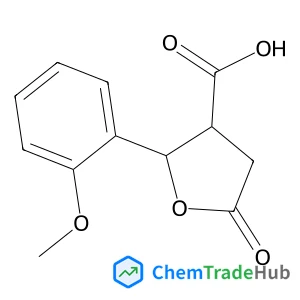
trans-2-(2-Methoxyphenyl)-5-oxotetrahydrofuran-3-carboxylic acid
CAS Number:
99226-02-5
Molecular Formula:
C12H12O5
Recommended Suppliers






Disclaimer
This page provides academic journal information for reference and research purposes only. We are not affiliated with any journal publishers and do not handle publication submissions. For publication-related inquiries, please contact the respective journal publishers directly.
If you notice any inaccuracies in the information displayed, please contact us at support@chemtradehub.com. We will promptly review and address your concerns.