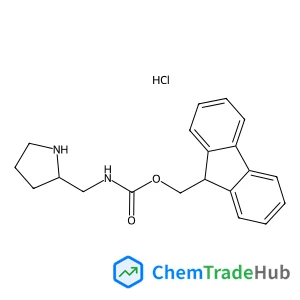
(S)-(9H-Fluoren-9-yl)methyl (pyrrolidin-2-ylmethyl)carbamate hydrochloride
CAS Number:
1217813-15-4
Molecular Formula:
C20H23ClN2O2
M. Oldenburg, A. Turshatov, D. Busko, M. Jakoby, R. Haldar, K. Chen, G. Emandi, M. O. Senge, C. Wöll, J. M. Hodgkiss
We present two approaches to enhance the photoluminescence quantum yield (PLQY) of surface-anchored metal–organic frameworks (SURMOFs). In the first approach we fabricate SURMOFs from a mix of an emissive linker with an optically-inert linker of equivalent length, diluting the emissive linker while maintaining the SURMOF structure. This approach enhances the internal PLQY. However, the increase in internal PLQY is achieved at the expense of a drastic reduction in optical absorption, thus the external PLQY remains low. To overcome this limitation, a second approach is explored wherein energy-accepting guest chromophores are infiltrated into the framework of the active linker. At the correct acceptor concentration, an internal PLQY of 52% – three times higher than the previous approach – is achieved. Additionally, the absorption remains strong leading to an external PLQY of 8%, an order of magnitude better than the previous approach. Using this strategy, we demonstrate that SURMOFs can achieve PLQYs similar to their precursor chromophores in solution. This is of relevance to SURMOFs as emitter layers in general, and we examine the optimized emitter layer as part of a photon upconversion (UC) SURMOF heterostructure. Surprisingly, the same PLQY is not observed after triplet–triplet annihilation in the UC heterostructure as after its normal photoexcitation (although the UC layers exhibit low thresholds consistent with those reported in our previous work). We discuss the potential bottlenecks in energy transport that could lead to this unexpected reduction in PLQY after excitation via triplet–triplet annihilation, and how future design of SURMOF UC multilayers could overcome these limitations.

Journal of Enzyme inhibition and Medicinal Chemistry

Foundations of Chemistry

European Journal of Organic Chemistry

Nature Reviews Drug Discovery

Green Chemistry

Angewandte Chemie International Edition

Current Pharmaceutical Biotechnology

Advanced Engineering Materials

Contact Lens & Anterior Eye

Coloration Technology
Chunxiao Wu, Shanfu Lu, Jin Zhang, Yan Xiang
DOI: 10.1039/C7CP07744K
Chang Zhu, Qian Wang, Jiena Yun, Qiaoli Hu, Gang Yang
DOI: 10.1039/C8CP02286K
Y. Matsumura, S. Iuchi, S. Hiraoka
DOI: 10.1039/C7CP08237A
Aleksander P. Stupak, Thomas Blaudeck, Eduard I. Zenkevich, Stefan Krause, Christian von Borczyskowski
DOI: 10.1039/C8CP02846J
Andrea Arsiccio, Roberto Pisano
DOI: 10.1039/C7CP08029H
Matthias Grünbacher, Lukas Schlicker, Maged F. Bekheet, Aleksander Gurlo, Bernhard Klötzer, Simon Penner
DOI: 10.1039/C8CP04350G
Sayyed Jalil Mahdizadeh, Golnoosh Akhlamadi
DOI: 10.1039/C8CP02820F
Henry A. Cortes
DOI: 10.1039/C8CP01211C
DOI: 10.1039/C8CP02814A
German L. Perlovich, Tatyana V. Volkova
DOI: 10.1039/C8CP03716G
Waste containing N-Methoxy-N-methyl-1,3-thiazole-5-carboxamide (CAS: 898825-89-3...
N-(4-Biphenylyl)dibenzo[b,d]furan-4-amine should be stored in a tightly sealed c...
The market for 3-Acetamido-5-amino-2,4,6-triiodobenzoic acid (CAS: 1713-07-1) is...
Benzyl 2-O-acetyl-3,4,6-tri-O-benzyl-beta-D-galactopyranoside (CAS: 61820-03-9) ...
2-Ethylpiperazine dihydrochloride (CAS: 438050-52-3) is regulated under the Glob...
1,1'-[1,3-Phenylenebis(methylene)]bis(3-methyl-1H-pyrrole-2,5-dione) (CAS: 11946...
Several alternatives can be used in the synthesis of 5-Fluoro-2-(1-pyrrolidinyl)...
Proper personal protective equipment (PPE) must be worn when handling this compo...
When handling 6-Bromoimidazo[1,2-a]pyridin-8-amine, it is important to wear appr...
Alternatives to (2S,4R)-4-(4-Nitrobenzyl)pyrrolidine-2-carboxylic acid hydrochlo...

Physical Chemistry Chemical Physics (PCCP) is an international journal co-owned by 19 physical chemistry and physics societies from around the world. This journal publishes original, cutting-edge research in physical chemistry, chemical physics and biophysical chemistry. To be suitable for publication in PCCP, articles must include significant innovation and/or insight into physical chemistry; this is the most important criterion that reviewers and Editors will judge against when evaluating submissions. The journal has a broad scope and welcomes contributions spanning experiment, theory, computation and data science. Topical coverage includes spectroscopy, dynamics, kinetics, statistical mechanics, thermodynamics, electrochemistry, catalysis, surface science, quantum mechanics, quantum computing and machine learning. Interdisciplinary research areas such as polymers and soft matter, materials, nanoscience, energy, surfaces/interfaces, and biophysical chemistry are welcomed if they demonstrate significant innovation and/or insight into physical chemistry. Joined experimental/theoretical studies are particularly appreciated when complementary and based on up-to-date approaches.