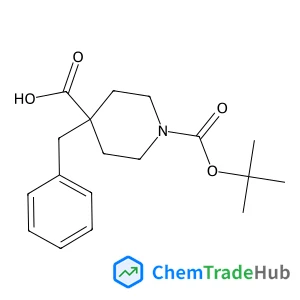
4-Benzyl-1-(tert-butoxycarbonyl)piperidine-4-carboxylic acid
CAS Number:
170838-87-6
Molecular Formula:
C18H25NO4
Chantal Sleiman, Gisèle El Dib, Marzio Rosi, Dimitrios Skouteris, Nadia Balucani, André Canosa
The reaction between cyano radicals (which are ubiquitous in interstellar clouds) and methylamine (a molecule detected in various interstellar sources) has been investigated in a synergistic experimental and theoretical study. The reaction has been found to be very fast in the entire range of temperatures investigated (23–297 K) by using a CRESU apparatus coupled to pulsed laser photolysis – laser induced fluorescence. The global experimental rate coefficient is given by In addition, dedicated electronic structure calculations of the underlying potential energy surface have been performed, together with capture theory and RRKM calculations. The experimental data have been interpreted in the light of the theoretical calculations and the product branching ratio has been established. According to the present study, in the range of temperatures investigated the title reaction is an efficient interstellar route of formation of cyanamide, NH2CN, another interstellar species. The second most important channel is the one leading to methyl cyanamide, CH3NHCN (an isomer of aminoacetonitrile), via a CN/H exchange mechanism with a yield of 12% of the global reaction in the entire range of temperatures explored. For a possible inclusion in future astrochemical models we suggest, by referring to the usual expression the following values: α = 3.68 × 10⁻¹² cm3 molec−1 s−1, β = −1.80, γ = 7.79 K for the channel leading to NH2CN + CH3; α = 5.05 × 10⁻¹³ cm3 molec−1 s−1, β = −1.82, γ = 7.93 K for the channel leading to CH3NHCN + H.
Ji Ho Jang, M. Orbán, Shutao Wang, Do Sung Huh
DOI: 10.1039/C4CP03083D
Lu Shen, Jonny Dadras
DOI: 10.1039/C4CP01877J
A. Mughal, J. K. El Demellawi, Sahraoui Chaieb
DOI: 10.1039/C4CP02966F
Laurens D. A. Siebbeles
DOI: 10.1039/C4CP90174F
Madhu Seetharaman S, Puvvala Nagarjuna, P. Naresh Kumar, Surya Prakash Singh, Melepurath Deepa, Manoj A. G. Namboothiry
DOI: 10.1039/C4CP03726J
Guido Fratesi, Michele Alagia, Gian Paolo Brivio, Luca Floreano
DOI: 10.1039/C4CP01625D
Adrien Nicolaï, Bobby G. Sumpter, Vincent Meunier
DOI: 10.1039/C4CP01051E
Umberto Marini Bettolo Marconi, Michele Monteferrante, Simone Melchionna
DOI: 10.1039/C4CP03680H
Manuel Caravaca, Pilar Sanchez-Andrada, Antonio Soto, Mateo Alajarin
DOI: 10.1039/C4CP02079K
G. S. Shakurov, E. P. Chukalina, M. N. Popova, B. Z. Malkin, A. M. Tkachuk
DOI: 10.1039/C4CP03437F
This compound is mainly used as an intermediate in the synthesis of antipsychoti...
Waste containing 1-(D-Ribofuranosyl)-1,4-dihydro-3-pyridinecarboxamide (CAS: 191...
2-Methyl-2-propanyl 3-bromo-3-(hydroxymethyl)-1-azetidinecarboxylate (CAS: 20079...
N-(4-Chloro-2-pyridinyl)acetamide (CAS: 245056-66-0) is a chemical compound with...
5-Chloro-2-hydroxybenzoic acid, also known as 5-chlorosalicylic acid, is an arom...
When handling 1,1-Dichloro-1-fluoroethane (CAS: 1717-00-6), it is important to u...
Fmoc-(2S,3R)-3-phenylpyrrolidine-2-carboxylic acid is a white crystalline solid ...
4-Amino-5-bromo-2-pyridinecarboxylic acid is primarily used as a precursor in th...
Handling this compound should be done with personal protective equipment (PPE) i...
When handling 8-bromo-2,2-dimethyl-3,4-dihydro-2H-1,4-benzoxazin-3-one, use prop...

Physical Chemistry Chemical Physics (PCCP) is an international journal co-owned by 19 physical chemistry and physics societies from around the world. This journal publishes original, cutting-edge research in physical chemistry, chemical physics and biophysical chemistry. To be suitable for publication in PCCP, articles must include significant innovation and/or insight into physical chemistry; this is the most important criterion that reviewers and Editors will judge against when evaluating submissions. The journal has a broad scope and welcomes contributions spanning experiment, theory, computation and data science. Topical coverage includes spectroscopy, dynamics, kinetics, statistical mechanics, thermodynamics, electrochemistry, catalysis, surface science, quantum mechanics, quantum computing and machine learning. Interdisciplinary research areas such as polymers and soft matter, materials, nanoscience, energy, surfaces/interfaces, and biophysical chemistry are welcomed if they demonstrate significant innovation and/or insight into physical chemistry. Joined experimental/theoretical studies are particularly appreciated when complementary and based on up-to-date approaches.
![2,6-Bis({(2R)-2-[hydroxy(diphenyl)methyl]-1-pyrrolidinyl}methyl)-4-methylphenol structure](https://static.chemtradehub.com/structs/877/877395-58-9-70bf.webp "2,6-Bis({(2R)-2-[hydroxy(diphenyl)methyl]-1-pyrrolidinyl}methyl)-4-methylphenol structure")