












Ultrafast excited-state dynamics of 2,5-dimethylpyrrole
Literature Information
Publication Date
2018-03-30
DOI
10.1039/C8CP00883C
Impact Factor
3.676
Authors
Zhichao Chen, Zhigang He, Kaijun Yuan, Dongxu Dai, Xueming Yang, Guorong Wu
View Original
Abstract
The ultrafast excited-state dynamics of 2,5-dimethylpyrrole following excitation at wavelengths in the range of 265.7–216.7 nm is studied using the time-resolved photoelectron imaging method. It is found that excitation at longer wavelengths (265.7–250.2 nm) results in the population of the S1(1πσ*) state, which decays out of the photoionization window in about 90 fs. At shorter pump wavelengths (242.1–216.7 nm), the assignments are less clear-cut. We tentatively assign the initially photoexcited state(s) to the 1π3p Rydberg state(s) which has lifetimes of 159 ± 20, 125 ± 15, 102 ± 10 and 88 ± 10 fs for the pump wavelengths of 242.1, 238.1, 232.6 and 216.7 nm, respectively. Internal conversion to the S1(1πσ*) state represents at most a minor decay channel. The methyl substitution effects on the decay dynamics of the excited states of pyrrole are also discussed. Methyl substitution on the pyrrole ring seems to enhance the direct internal conversion from the 1π3p Rydberg state to the ground state, while methyl substitution on the N atom has less influence and the internal conversion to the S1(πσ*) state represents a main channel.
Related Literature
Interaction of thiophene with a molybdenum disulfide catalyst—an inelastic neutron scattering study
Paper
DOI: 10.1039/A902617G
The thermal unimolecular decomposition rate constants of ethoxy radicals
Paper
DOI: 10.1039/A901768B
Effect of defect clustering on the high-pressure behaviour of wüstite. High-pressure X-ray diffraction and lattice energy simulations
Camilla Haavik, Svein Stølen, Michael Hanfland, C. Richard A. Catlow
2000-10-26
Paper
DOI: 10.1039/B006026G
Nature of the lowest triplet states of 4′-substituted N-phenylphenothiazine derivatives
Paweł Borowicz, Jerzy Herbich, Andrzej Kapturkiewicz, Romana Anulewicz-Ostrowska, Jacek Nowacki, Günter Grampp
2000-09-08
Paper
DOI: 10.1039/B005058J
Trapped hydrogen atoms radiolytically formed in natural and synthetic kaolinites: an electron paramagnetic resonance study
Kazumi Toriyama, Anders Lund, Masaharu Okazaki
2000-09-20
Paper
DOI: 10.1039/B005413P
Inhibition by gaseous impurities of hydrogen absorption by Pd and by internally oxidized Pd–Al alloys
Kurt L. Shanahan
2000-10-06
Paper
DOI: 10.1039/B004353M
You might also like
Compound Q&A
What precautions should be taken when handling 4-(2-Furylmethyl)thiomorpholine 1,1-dioxide (CAS: 79206-94-3)?
When handling 4-(2-Furylmethyl)thiomorpholine 1,1-dioxide (CAS: 79206-94-3), it ...
79206-94-34-(2-Furylmethyl)thi...
Compound Q&A
What precautions should be taken when handling 4-Chloro-N-[2-(4-morpholinyl)ethyl]benzamide (CAS: 71320-77-9)?
When handling 4-Chloro-N-[2-(4-morpholinyl)ethyl]benzamide (CAS: 71320-77-9), it...
71320-77-94-Chloro-N-[2-(4-mor...
Compound Q&A
How should waste containing 2-[2-(2-Methoxyethoxy)ethoxy]ethyl 4-methylbenzenesulfonate (CAS: 62921-74-8) be handled?
Waste containing this compound (CAS: 62921-74-8) should be handled according to ...
62921-74-82-[2-(2-Methoxyethox...
Compound Q&A
How should waste containing (S)-Methyl 2-amino-3-cyclohexylpropanoate be handled?
Waste containing (S)-Methyl 2-amino-3-cyclohexylpropanoate should be collected i...
40056-18-6(S)-Methyl 2-amino-3...
Compound Q&A
How is 5-({4-[(2S,4R)-4-Hydroxy-2-methyltetrahydro-2H-pyran-4-yl]-2-thienyl}sulfanyl)-1-methyl-1,3-dihydro-2H-indol-2-one (CAS: 166882-70-8) typically synthesized?
This compound can be synthesized using a multi-step process involving the conjug...
166882-70-85-({4-[(2S,4R)-4-Hyd...
Compound Q&A
Are there alternatives to (2E)-3-(3,4-Dichlorophenyl)acrylic acid (CAS: 7312-27-8) in synthesis?
There are several alternatives to (2E)-3-(3,4-Dichlorophenyl)acrylic acid in syn...
7312-27-8(2E)-3-(3,4-Dichloro...
Compound Q&A
How should Ethyl 6-(2-nitrophenyl)imidazo[2,1-b][1,3]thiazole-3-carboxylate (CAS: 925437-84-9) be stored?
Ethyl 6-(2-nitrophenyl)imidazo[2,1-b][1,3]thiazole-3-carboxylate (CAS: 925437-84...
925437-84-9Ethyl 6-(2-nitrophen...
Compound Q&A
How should waste containing 2-(1,3-Thiazol-2-yl)ethanamine (CAS: 18453-07-1) be handled?
Waste containing 2-(1,3-Thiazol-2-yl)ethanamine (CAS: 18453-07-1) should be coll...
18453-07-12-(1,3-Thiazol-2-yl)...
Compound Q&A
How is Methyl 5-iodo-2-methylbenzoate (CAS: 103440-54-6) typically synthesized?
Methyl 5-iodo-2-methylbenzoate can be synthesized through the iodination of meth...
103440-54-6Methyl 5-iodo-2-meth...
Compound Q&A
How is 5-Chloro[1,2,4]triazolo[1,5-a]pyridine (CAS: 1427399-34-5) typically synthesized?
5-Chloro[1,2,4]triazolo[1,5-a]pyridine is commonly synthesized via the condensat...
1427399-34-55-Chloro[1,2,4]triaz...
Source Journal
Physical Chemistry Chemical Physics

CiteScore:
5.5
Self-citation Rate:
10.3%
Articles per Year:
3036
Physical Chemistry Chemical Physics (PCCP) is an international journal co-owned by 19 physical chemistry and physics societies from around the world. This journal publishes original, cutting-edge research in physical chemistry, chemical physics and biophysical chemistry. To be suitable for publication in PCCP, articles must include significant innovation and/or insight into physical chemistry; this is the most important criterion that reviewers and Editors will judge against when evaluating submissions. The journal has a broad scope and welcomes contributions spanning experiment, theory, computation and data science. Topical coverage includes spectroscopy, dynamics, kinetics, statistical mechanics, thermodynamics, electrochemistry, catalysis, surface science, quantum mechanics, quantum computing and machine learning. Interdisciplinary research areas such as polymers and soft matter, materials, nanoscience, energy, surfaces/interfaces, and biophysical chemistry are welcomed if they demonstrate significant innovation and/or insight into physical chemistry. Joined experimental/theoretical studies are particularly appreciated when complementary and based on up-to-date approaches.
Recommended Compounds
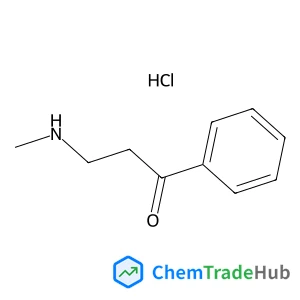
3-(Methylamino)-1-phenyl-1-propanone hydrochloride (1:1)
CAS Number:
2538-50-3
Molecular Formula:
C10H14ClNO
Recommended Suppliers





Disclaimer
This page provides academic journal information for reference and research purposes only. We are not affiliated with any journal publishers and do not handle publication submissions. For publication-related inquiries, please contact the respective journal publishers directly.
If you notice any inaccuracies in the information displayed, please contact us at support@chemtradehub.com. We will promptly review and address your concerns.