











The role of unique spatial structure in the volume phase transition behavior of poly(N-isopropylacrylamide)-based interpenetrating polymer network microgels including a thermosensitive poly(ionic liquid)
Literature Information
Publication Date
2018-02-23
DOI
10.1039/C8CP00340H
Impact Factor
3.676
Authors
View Original
Abstract
Well-defined poly(N-isopropylacrylamide)/poly(tributylhexylphosphonium 3-sulfopropylmethacrylate) (PNIPAM/P[P4,4,4,6][MC3S]) interpenetrating polymer network (IPN) microgels were synthesized by two-step precipitation polymerization, and the thermally induced phase transition mechanism of IPN microgels was investigated using dynamic light scattering (DLS), temperature-dependent IR spectroscopy together with the perturbation correlation moving window (PCMW) technique and two dimensional correlation spectroscopy (2Dcos). For comparison, PNIPAM/P[P4,4,4,6][MC3S] polymer mixture was also studied to reveal the influence of the complex spatial network of IPN on the thermoresponsive behavior. Due to the strong hydrophilic feature of P[P4,4,4,6][MC3S] and the special IPN structure, PNIPAM and P[P4,4,4,6][MC3S] moieties exhibited different phase transition tendencies during heating. In detail, the dehydration behavior of the PNIPAM part seemed gradual and continuous, whereas that of ester CO in the P[P4,4,4,6][MC3S] part became sharp. The two components dehydrated independently and successively in the polymer mixture without any mutual interaction. The collapse of the P[P4,4,4,6][MC3S] network at the second transition stage increased the amount of intramolecular hydrogen bonding (amide CO⋯D–N) in the PNIPAM moiety. Additionally, the electrostatic interaction in the P[P4,4,4,6][MC3S] network played a non-ignorable role in enhancing the swelling property of PNIPAM/P[P4,4,4,6][MC3S] IPN microgels.
Recommended Journals
Related Literature
One-step access to N-enoxyimides by gold-catalysed addition of N-hydroxyimides to terminal alkynes
Coralie Duchemin, Nicolai Cramer
2018-12-06
Research Article
DOI: 10.1039/C8QO01179F
Heteropore covalent organic frameworks: a new class of porous organic polymers with well-ordered hierarchical porosities
Rong-Ran Liang, Xin Zhao
2018-09-17
Review Article
DOI: 10.1039/C8QO00830B
Oxidative C(sp3)–H amidation of tertiary arylamines with nitriles
Binzhou Lin, Shanshan Shi, Yiqun Cui, Yupei Liu, Guo Tang
2018-09-03
Research Article
DOI: 10.1039/C8QO00794B
Copper-catalyzed decarboxylative and oxidative decarbonylative cross-coupling between cinnamic acids and aliphatic aldehydes
Zaigang Luo, Xinxin Han, Yuyu Fang, Peng Liu, Chengtao Feng, Zhong Li, Xuemei Xu
2018-10-08
Research Article
DOI: 10.1039/C8QO00927A
Aryne triggered dearomatization reaction of isoquinolines and quinolines with chloroform‡
Jiajing Tan, Binbin Liu, Shuaisong Su
2018-09-19
Research Article
DOI: 10.1039/C8QO00838H
Dual photoredox and nickel-catalyzed desymmetric C–O coupling reactions: visible light-mediated enantioselective synthesis of 1,4-benzodioxanes
Quan-Quan Zhou, Fu-Dong Lu, Dan Liu, Liang-Qiu Lu
2018-09-17
Research Article
DOI: 10.1039/C8QO00805A
A new dehydrogenative [4 + 1] annulation between para-quinone methides (p-QMs) and iodonium ylides for the synthesis of 2,3-dihydrobenzofurans
Yan-Jie Xiong, Shao-Qing Shi, Wen-Juan Hao, Shu-Jiang Tu, Bo Jiang
2018-10-25
Research Article
DOI: 10.1039/C8QO00950C
DDQ-mediated regioselective C–S bond formation: efficient access to allylic sulfides
Chunsheng Li, Jianxiao Li, Chaowei Tan, Wanqing Wu, Huanfeng Jiang
2018-09-18
Research Article
DOI: 10.1039/C8QO00799C
Stereoselective synthesis of a 9-O-sulfo Neu5Gc-capped O-linked oligosaccharide found on the sea urchin egg receptor
Anindya Das, Pei-Jhen Li, Avijit K. Adak, Hsin-Ru Wu, Mohammad Tarique Anwar, Pei-Yun Chiang, Chung-Ming Sun, Jih-Ru Hwu, Chun-Cheng Lin
2018-11-09
Research Article
DOI: 10.1039/C8QO00996A
You might also like
Compound Q&A
Is 2-(2-chloroacetamido)-3-phenylpropanoic acid (CAS: 7765-11-9) safe?
2-(2-Chloroacetamido)-3-phenylpropanoic acid (CAS: 7765-11-9) is generally consi...
7765-11-92-(2-chloroacetamido...
Compound Q&A
Is 2-(Benzyloxy)-5-bromobenzoic acid (CAS: 62176-31-2) safe?
2-(Benzyloxy)-5-bromobenzoic acid can be handled safely if appropriate precautio...
62176-31-22-(Benzyloxy)-5-brom...
Compound Q&A
What is (4-Methyl-1,2,5-oxadiazol-3-yl)methanamine hydrochloride (CAS: 1159825-48-5)?
(4-Methyl-1,2,5-oxadiazol-3-yl)methanamine hydrochloride is a chemical compound ...
1159825-48-5(4-Methyl-1,2,5-oxad...
Compound Q&A
What is 2-(5-Hexylthiophen-2-yl)-4,4,5,5-tetramethyl-1,3,2-dioxaborolane (CAS: 917985-54-7)?
2-(5-Hexylthiophen-2-yl)-4,4,5,5-tetramethyl-1,3,2-dioxaborolane (CAS: 917985-54...
917985-54-72-(5-Hexylthiophen-2...
Compound Q&A
Are there alternatives to 4-(8-Methyl-9H-1,3-dioxolo[4,5-h][2,3]benzodiazepin-5-yl)benzenamine (CAS: 102771-26-6) in synthesis?
While 4-(8-Methyl-9H-1,3-dioxolo[4,5-h][2,3]benzodiazepin-5-yl)benzenamine (CAS:...
102771-26-64-(8-Methyl-9H-1,3-d...
Compound Q&A
What is the market or research trend for tert-butyl 3-hydroxy-4,5,7,8-tetrahydro-2H-pyrazolo[3,4-d]azepine-6-carboxylate (CAS: 851376-80-2)?
The market for tert-butyl 3-hydroxy-4,5,7,8-tetrahydro-2H-pyrazolo[3,4-d]azepine...
851376-80-2tert-butyl 3-hydroxy...
Compound Q&A
How should waste containing 3,5-Diamino-1H-pyrazole-4-carbonitrile (CAS: 6844-58-2) be handled?
Waste containing 3,5-Diamino-1H-pyrazole-4-carbonitrile (CAS: 6844-58-2) should ...
6844-58-23,5-Diamino-1H-pyraz...
Compound Q&A
How is (6-Fluoro-3-pyridinyl)boronic acid (CAS: 351019-18-6) typically synthesized?
(6-Fluoro-3-pyridinyl)boronic acid can be synthesized through the reaction of 6-...
351019-18-6(6-Fluoro-3-pyridiny...
Compound Q&A
What industries use Dibenzyl carbonimidoylbiscarbamate (CAS: 10065-79-9)?
Dibenzyl carbonimidoylbiscarbamate (CAS: 10065-79-9) finds applications in vario...
10065-79-9Dibenzyl carbonimido...
Compound Q&A
What is the market or research trend for (beta,beta,2,3,4,5,6-~2~H_7_)Phenylalanine (CAS: 74228-83-4)?
The market for (beta,beta,2,3,4,5,6-~2~H_7_)Phenylalanine (CAS: 74228-83-4) is g...
74228-83-4(beta,beta,2,3,4,5,6...
Source Journal
Physical Chemistry Chemical Physics

CiteScore:
5.5
Self-citation Rate:
10.3%
Articles per Year:
3036
Physical Chemistry Chemical Physics (PCCP) is an international journal co-owned by 19 physical chemistry and physics societies from around the world. This journal publishes original, cutting-edge research in physical chemistry, chemical physics and biophysical chemistry. To be suitable for publication in PCCP, articles must include significant innovation and/or insight into physical chemistry; this is the most important criterion that reviewers and Editors will judge against when evaluating submissions. The journal has a broad scope and welcomes contributions spanning experiment, theory, computation and data science. Topical coverage includes spectroscopy, dynamics, kinetics, statistical mechanics, thermodynamics, electrochemistry, catalysis, surface science, quantum mechanics, quantum computing and machine learning. Interdisciplinary research areas such as polymers and soft matter, materials, nanoscience, energy, surfaces/interfaces, and biophysical chemistry are welcomed if they demonstrate significant innovation and/or insight into physical chemistry. Joined experimental/theoretical studies are particularly appreciated when complementary and based on up-to-date approaches.
Recommended Compounds
![(1R)-N-((1R)-1-Phenylethyl)-1-[4-(tert-butyldimethylsilyloxymethyl)cyclohexyl]ethan-1-amine structure](https://static.chemtradehub.com/structs/672/672314-45-3-47ef.webp "(1R)-N-((1R)-1-Phenylethyl)-1-[4-(tert-butyldimethylsilyloxymethyl)cyclohexyl]ethan-1-amine structure")
(1R)-N-((1R)-1-Phenylethyl)-1-[4-(tert-butyldimethylsilyloxymethyl)cyclohexyl]ethan-1-amine
CAS Number:
672314-45-3
Molecular Formula:
C23H41NOSi
![Ethyl ({[(2-methyl-2-propanyl)oxy]carbonyl}amino)(2-pyridinyl)acetate structure](https://static.chemtradehub.com/structs/313/313490-90-3-dd15.webp "Ethyl ({[(2-methyl-2-propanyl)oxy]carbonyl}amino)(2-pyridinyl)acetate structure")
Ethyl ({[(2-methyl-2-propanyl)oxy]carbonyl}amino)(2-pyridinyl)acetate
CAS Number:
313490-90-3
Molecular Formula:
C14H20N2O4
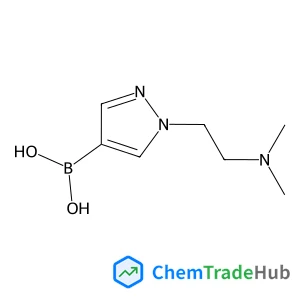
(1-(2-(Dimethylamino)ethyl)-1H-pyrazol-4-yl)boronic acid
CAS Number:
1086063-73-1
Molecular Formula:
C7H14BN3O2
Recommended Suppliers






Disclaimer
This page provides academic journal information for reference and research purposes only. We are not affiliated with any journal publishers and do not handle publication submissions. For publication-related inquiries, please contact the respective journal publishers directly.
If you notice any inaccuracies in the information displayed, please contact us at support@chemtradehub.com. We will promptly review and address your concerns.