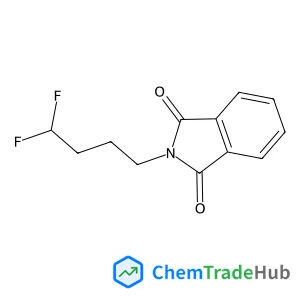
2-(4,4-Difluorobutyl)-1H-isoindole-1,3(2H)-dione
CAS Number:
1265341-14-7
Molecular Formula:
C12H11F2NO2
Ravikumar A, Panneerselvam P
We describe a highly sensitive fluorescence biosensor incorporating polydopamine nanotubes (PDNTs) based on the mechanism of exonuclease III (Exo III) assisted signal amplification for the determination of Hg2+ in aqueous solution. Fluorescent probes of FAM labeled ssDNA (FAM-ssDNA) adsorbed on the PDNTs act as an efficient quencher. In the presence of Hg2+, the FAM-ssDNA can bind to Hg2+ to form double stranded DNA (dsDNA) via the formation of T–Hg2+–T base pairs. Then, the dsDNA was removed from the surface of the PDNTs to restore the fluorescence. The release of the dsDNA was triggered by Exo III digestion. At the same time, the liberated Hg2+ mediates a new cycle of digestion. This assay is ultrasensitive for the selective recognition of Hg2+, and a detection limit as low as 10 pM was achieved. In addition, the fluorescent biosensing system also displays remarkable specificity to Hg2+ in the presence of other possible competing ions. This approach was applied to the determination of Hg2+ in real water samples with good recovery and high efficiency for practical analysis.
Anastasiia I. Fadeeva, Vitaly A. Gorbunov, Alexander V. Myshlyavtsev
DOI: 10.1039/D1CP03111B
Simone Ghidinelli, Giuseppe Mazzeo, Stefan E. Boiadjiev, David A. Lightner
DOI: 10.1039/D1CP02571F
Emanuele Marsili, Antonio Prlj, Basile F. E. Curchod
DOI: 10.1039/D1CP02185K
Cecilie L. Andersen, Evanildo G. Lacerda, Jr, Jørn B. Christensen, Stephan P. A. Sauer, Ole Hammerich
DOI: 10.1039/D1CP02315B
Prokopis C. Andrikopoulos, Aditya S. Chaudhari, Yingliang Liu, Patrick E. Konold, John T. M. Kennis, Bohdan Schneider, Gustavo Fuertes
DOI: 10.1039/D1CP00447F
Martin Hladík, Antonín Fejfar, Héctor Vázquez
DOI: 10.1039/D1CP01654G
Alejandro Herrera-Carbajal, Ventura Rodríguez-Lugo, Juan Hernández-Ávila, Ariadna Sánchez-Castillo
DOI: 10.1039/D1CP00519G
Ping Zhao, Bo Jin, Qingchun Zhang, Rufang Peng
DOI: 10.1039/D1CP03466A
Jian-Hua Huang, Dan-Dan Sun, Rong-Xing Lu
DOI: 10.1039/D1CP00089F
Jose L. C. Fajín, Ana S. Moura, M. Natália D. S. Cordeiro
DOI: 10.1039/D1CP00729G
N-(4-Methoxybenzyl)-2-pyridinamine (CAS: 52818-63-0) is increasingly being used ...
When handling Ethyl 4-(2-chlorophenyl)-1,3-thiazole-2-carboxylate, appropriate p...
Diethyldiselane (CAS: 628-39-7) is classified under the Globally Harmonized Syst...
The market for oxocopper (CAS: 12053-18-8) is primarily driven by its use in cat...
The market for 5-{[(2-Methyl-2-propanyl)oxy]carbonyl}-5-azaspiro[2.4]heptane-7-c...
2-(1-Pyrrolidinyl)-4-pyridinamine is a chemical compound with the CAS number 359...
2-(3-Pyridinyl)-1-azabicyclo[2.2.2]octane (CAS: 91556-75-1) is a crystalline sol...
(S)-Alpha-allyl-proline hydrochloride is usually synthesized via a Wittig reacti...
3-Methyl-1,2-oxazole-5-carboxylic acid (CAS: 4857-42-5) is an organic compound w...
Lys-SMCC-DM1 is synthesized via a multi-step process involving the coupling of S...

Analyst publishes analytical and bioanalytical research that reports premier fundamental discoveries and inventions, and the applications of those discoveries, unconfined by traditional discipline barriers.