












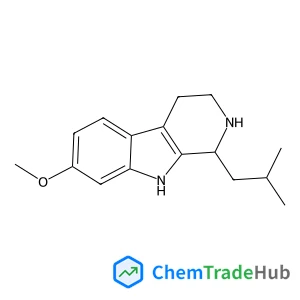
1-Isobutyl-7-methoxy-2,3,4,9-tetrahydro-1H-beta-carboline
CAS Number:
175975-76-5
Molecular Formula:
C16H22N2O
Hosein Monshat
Photonic crystals (PhCs) and plasmonic nanostructures offer the unprecedented capability to control the interaction of light and biomolecules at the nanoscale. Based on PhC and plasmonic phenomena, a variety of analytical techniques have been demonstrated and successfully implemented in many fields, such as biological sciences, clinical diagnosis, drug discovery, and environmental monitoring. During the past decades, PhC and plasmonic technologies have progressed in parallel with their pros and cons. The merging of photonic crystals with plasmonics will significantly improve biosensor performances and enlarge the linear detection range of analytical targets. Here, we review the state-of-the-art biosensors that combine PhC and plasmonic nanomaterials for quantitative analysis. The optical mechanisms of PhCs, plasmonic crystals, and metal nanoparticles (NPs) are presented, along with their integration and potential applications. By explaining the optical coupling of photonic crystals and plasmonics, the review manifests how PhC–plasmonic hybrid biosensors can achieve the advantages, including high sensitivity, low cost, and short assay time as well. The review also discusses the challenges and future opportunities in this fascinating field.
Prokopis C. Andrikopoulos, Aditya S. Chaudhari, Yingliang Liu, Patrick E. Konold, John T. M. Kennis, Bohdan Schneider, Gustavo Fuertes
DOI: 10.1039/D1CP00447F
Deanna Myers, Sabrina Chee, James N. Smith
DOI: 10.1039/D1CP01704G
Bing-Qian Shan, Jia-Feng Zhou, Meng Ding, Xiao-Dan Hu
DOI: 10.1039/D1CP01792F
DOI: 10.1039/D1CP01445E
K. Kondratenko, I. Carlescu, P.-E. Danjou, Y. Boussoualem, A. Simion, B. Duponchel, J. F. Blach, C. Legrand, N. Hurduc, A. Daoudi
DOI: 10.1039/D1CP01427G
Zhendong Li
DOI: 10.1039/D1CP01075A
Diandong Tang, Lin Shen, Wei-Hai Fang
DOI: 10.1039/D1CP01374B
Matthew Szydagis, Cecilia Levy, Yujia Huang, Alvine C. Kamaha, Corwin C. Knight, Gregory R. C. Rischbieter
DOI: 10.1039/D1CP01083B
Lisa Djuandhi, Neeraj Sharma, Bruce C. C. Cowie, Thanh V. Nguyen, Aditya Rawal
DOI: 10.1039/D1CP01838H
N-(4-Methoxybenzyl)-2-pyridinamine (CAS: 52818-63-0) is increasingly being used ...
When handling Ethyl 4-(2-chlorophenyl)-1,3-thiazole-2-carboxylate, appropriate p...
Diethyldiselane (CAS: 628-39-7) is classified under the Globally Harmonized Syst...
The market for oxocopper (CAS: 12053-18-8) is primarily driven by its use in cat...
The market for 5-{[(2-Methyl-2-propanyl)oxy]carbonyl}-5-azaspiro[2.4]heptane-7-c...
2-(1-Pyrrolidinyl)-4-pyridinamine is a chemical compound with the CAS number 359...
2-(3-Pyridinyl)-1-azabicyclo[2.2.2]octane (CAS: 91556-75-1) is a crystalline sol...
(S)-Alpha-allyl-proline hydrochloride is usually synthesized via a Wittig reacti...
3-Methyl-1,2-oxazole-5-carboxylic acid (CAS: 4857-42-5) is an organic compound w...
Lys-SMCC-DM1 is synthesized via a multi-step process involving the coupling of S...

Analyst publishes analytical and bioanalytical research that reports premier fundamental discoveries and inventions, and the applications of those discoveries, unconfined by traditional discipline barriers.
![5'-Fluoro-[2,3'-biindolinylidene]-2',3-dione structure](https://static.chemtradehub.com/structs/251/251903-00-1-9cb1.webp "5'-Fluoro-[2,3'-biindolinylidene]-2',3-dione structure")





