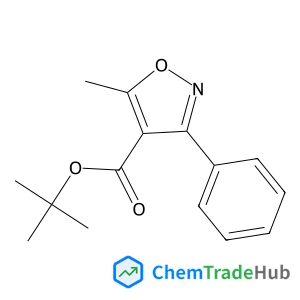
2-Methyl-2-propanyl 5-methyl-3-phenyl-1,2-oxazole-4-carboxylate
CAS Number:
211429-79-7
Molecular Formula:
C15H17NO3
Ho-Wang Ip, Hak-Fun Chow, Dietmar Kuck
Systematic studies on the role of substituents in the bay-bridging cycloheptatriene ring formation around the tribenzotriquinacene (TBTQ) core via the non-typical Scholl reaction were carried out. The electronic effect of the substituents was found to be the predominant factor that controls the ease of the cyclization reaction, while the steric effect of methoxy groups in the bay regions of the TBTQ core appears to be also significant but less important. In several cases with insufficient electronic activation and/or unfavorable steric restriction, single bay-bridging occurred with or without concomitant bridgehead hydroxylation. Alternatively, an unprecedented ring opening/closure of the TBTQ skeleton by electrophilic ipso-attack was found to intervene in other cases. Starting from the electronically and sterically most favorable precursor, a 1,4,8-tris-(2,3,4-trimethoxyphenyl)-TBTQ derivative, a new wizard-hat-shaped, three-fold bay-bridged TBTQ nanographene core bearing nine methoxy groups at the molecular periphery was synthesized with high efficiency.
Renata Costa, Carlos M. Pereira, M. Natália D. S. Cordeiro
DOI: 10.1039/C8CP01541D
Sijia S. Dong, Laura Gagliardi, Donald G. Truhlar
DOI: 10.1039/C7CP07275A
Kirstin D. Doney, Dongfeng Zhao, John F. Stanton, Harold Linnartz
DOI: 10.1039/C7CP06131E
A. Moissette
DOI: 10.1039/C7CP07968K
Sulgiye Park, Cameron L. Tracy, Fuxiang Zhang, Changyong Park, Sergey N. Tkachev, Maik Lang, Rodney C. Ewing
DOI: 10.1039/C7CP08664D
Srikanth Revoju, Subhayan Biswas, Bertil Eliasson, Ganesh D. Sharma
DOI: 10.1039/C7CP08653A
Alexey Koltsov, Jean-Michel Mataigne
DOI: 10.1039/C7CP08636A
Larwsk H. Gonçalves da Silva, David Hochberg
DOI: 10.1039/C8CP01828F
Mausumi Mahapatra, David C. Grinter, Fang Xu, Si Luo, Robert M. Palomino, Shyam Kattel, Iradwikanari Waluyo, Ping Liu, Dario J. Stacchiola, Sanjaya D. Senanayake
DOI: 10.1039/C8CP01614C
When handling 4-Methyl-6-(trifluoromethyl)quinoline (CAS: 40716-16-3), safety go...
4-(3,5-Difluorophenyl)aniline is an aromatic organic compound with the CAS numbe...
5-{[4-(Trifluoromethyl)phenyl]sulfanyl}-1,2,3-thiadiazole-4-carboxylic acid can ...
The market for 4-Benzylaniline hydrochloride (CAS: 6317-57-3) is steadily growin...
[3-(Diethylsulfamoyl)phenyl]boronic acid is generally considered safe when handl...
3-Bromo-2,5-dimethoxyaniline is mainly used in the pharmaceutical and chemical i...
N-Methyl-1-(5-methyl-1H-indol-3-yl)methanamine (CAS: 915922-67-7) is subject to ...
This compound is primarily used in the pharmaceutical industry for the synthesis...
2-Methyl-2-propanyl [(1S,3R)-3-aminocyclohexyl]carbamate (CAS: 1298101-47-9) sho...
Ethyl 2-bromo-4,4,4-trifluorobutanoate (CAS: 367-33-9) is utilized in the pharma...

Organic Chemistry Frontiers publishes high-quality research from across organic chemistry. Emphases are placed on studies that make significant contributions to the field of organic chemistry by reporting either new or significantly improved protocols or methodologies. Topics include, but are not limited to the following: Organic synthesis Development of synthetic methodologies Catalysis Natural products Functional organic materials Supramolecular and macromolecular chemistry Physical and computational organic chemistry
![6,7-Dihydro-5H-pyrrolo[1,2-a]imidazole-6-carboxylic acid structure](https://static.chemtradehub.com/structs/136/1369160-12-2-6524.webp "6,7-Dihydro-5H-pyrrolo[1,2-a]imidazole-6-carboxylic acid structure")