












Pressure-induced non-innocence in bis(1,2-dionedioximato)Pt(ii) complexes: an experimental and theoretical study of their insulator–metal transitions
Literature Information
Publication Date
2020-03-05
DOI
10.1039/C9CP06749C
Impact Factor
3.676
Authors
Helen Benjamin, Jonathan G. Richardson, Stephen A. Moggach, Sergejs Afanasjevs, Lisette Warren, Mark R. Warren, David R. Allan, Carole A. Morrison, Konstantin V. Kamenev, Neil Robertson
View Original
Abstract
Bis(1,2-dionedioximato) complexes of Pt(II) are known for their propensity to form linear chains of metal complexes in the solid state, and under the application of pressure members of the family display interesting optical and conductive properties. Two examples, Pt(bqd)2 and Pt(dmg)2, are known to undergo insulator-to-metal-to-insulator transitions, with the metallic state reached at 0.8–1.4 GPa and 5 GPa, respectively. Previous interpretations of these materials’ behaviour focused on the role of the filled dz2 and vacant p orbitals on platinum, with little consideration to the role of the ligand. Here, the pressure-structural behaviour of Pt(bqd)2 is investigated through single crystal X-ray diffraction, the first such study on this material. The difference in conductive behaviour under pressure between Pt(bqd)2 and Pt(dmg)2 is then interpreted through a combination of experimental and computational methods, including conductivity measurements under high pressure and electronic structure calculations. Our computational work reveals the significant contribution from ligand low-lying vacant π-orbitals to the frontier orbitals and bands in these complexes, and provides an explanation for the experimentally observed re-entrant insulator-to-metal-to-insulator transitions, and the differences in behaviour between the two compounds.
Related Literature
Sequential removal and recovery of cadmium ions (Cd2+) using photocatalysis and reduction crystallization from the aqueous phase
Vivek Kumar, Ravinder Kumar Wanchoo, Amrit Pal Toor
2021-06-28
Paper
DOI: 10.1039/D1RE00149C
Preparation of an aminographene–aliphatic hydroxyl-terminated polysiloxane hybrid for synergistic enhancement of the mechanical and tribological performance of monomer casting nylon 6
Chengjie Li, Minghui Guo, Ying Dai, Peikuan Xu, Bin Shi, Dewang Hou, Ruiguang Li
2021-10-06
Paper
DOI: 10.1039/D1RE00336D
Performance polymers from renewable monomers: high molecular weight poly(pentadecalactone) for fiber applications
Matthijs de Geus, Inge van der Meulen, Bart Goderis, Kristof van Hecke, Marko Dorschu, Harm van der Werff, Cor E. Koning
2010-01-20
Paper
DOI: 10.1039/B9PY00360F
Process intensification of ozonolysis reactions using dedicated microstructured reactors
Dominique M. Roberge, Paul Hanselmann, Petteri Elsner
2021-08-18
Communication
DOI: 10.1039/D1RE00264C
Microplasma synthesized gold nanoparticles for surface enhanced Raman spectroscopic detection of methylene blue
Xuanhe Li, Wei-Hung Chiang, Kuan Chang, Hujun Xu
2021-11-12
Paper
DOI: 10.1039/D1RE00446H
Micelles with surface conjugated RGDpeptide and crosslinked polyurea core viaRAFT polymerization
Hien T. T. Duong, T. L. Uyen Nguyen, Martina H. Stenzel
2009-11-25
Paper
DOI: 10.1039/B9PY00210C
Selective surface functionalization of polystyrene by inner-shell monochromatic irradiation and oxygen exposure
Daniel Eduardo Weibel, Felipe Kessler, Gunar Vingre da Silva Mota
2010-02-08
Paper
DOI: 10.1039/B9PY00342H
Steps, hops and turns: examining the effects of channel shapes on mass transfer in continuous electrochemical reactors
Hamish R. Stephen, Sarah Boyall, Christiane Schotten, Richard A. Bourne, Nikil Kapur, Charlotte E. Willans
2022-01-06
Communication
DOI: 10.1039/D1RE00530H
Ultrasonic process intensification during the preparation of dimethyl carbonate based on the alcoholysis of ethylene carbonate and the kinetic behavior of dimethyl carbonate
Yueyue He, Huaigang Cheng, Zihe Pan, Fangqin Cheng
2021-08-12
Paper
DOI: 10.1039/D1RE00219H
You might also like
Compound Q&A
What precautions should be taken when handling lithium chloride hydrate (1:1:1) (CAS: 16712-20-2)?
When handling lithium chloride hydrate (1:1:1) (CAS: 16712-20-2), it is importan...
16712-20-2Lithium chloride hyd...
Compound Q&A
Is 4-(4H-1,2,4-Triazol-4-yl)piperidine (CAS: 690261-92-8) safe?
4-(4H-1,2,4-Triazol-4-yl)piperidine is generally considered safe for use in phar...
690261-92-84-(4H-1,2,4-Triazol-...
Compound Q&A
How should waste containing 1,3-Thiazole-2-carboxamide (CAS: 16733-85-0) be handled?
Waste containing 1,3-Thiazole-2-carboxamide (CAS: 16733-85-0) should be collecte...
16733-85-01,3-Thiazole-2-carbo...
Compound Q&A
What regulatory guidelines apply to 5-(Difluoromethyl)-2-fluorobenzonitrile (CAS: 934175-58-3)?
5-(Difluoromethyl)-2-fluorobenzonitrile (CAS: 934175-58-3) is subject to regulat...
934175-58-35-(Difluoromethyl)-2...
Compound Q&A
How is Methyl 3-acetamido-2-thiophenecarboxylate (CAS: 22288-79-5) typically synthesized?
Methyl 3-acetamido-2-thiophenecarboxylate can be synthesized by the reaction of ...
22288-79-5Methyl 3-acetamido-2...
Compound Q&A
What is 4-Isoquinolinecarbonitrile (CAS: 34846-65-6)?
4-Isoquinolinecarbonitrile is a chemical compound with the CAS number 34846-65-6...
34846-65-64-Isoquinolinecarbon...
Compound Q&A
How should Methyl 1H-1,2,3-triazole-4-carboxylate (CAS: 877309-59-6) be stored?
Store Methyl 1H-1,2,3-triazole-4-carboxylate (CAS: 877309-59-6) in a cool, dry p...
877309-59-6Methyl 1H-1,2,3-tria...
Compound Q&A
What regulatory guidelines apply to 6-Bromo[1,3]thiazolo[5,4-b]pyridin-2-amine (CAS: 1160791-13-8)?
6-Bromo[1,3]thiazolo[5,4-b]pyridin-2-amine (CAS: 1160791-13-8) is subject to the...
1160791-13-86-Bromo[1,3]thiazolo...
Compound Q&A
Is (2S,3S)-2-Ammonio-3-(3,4-dihydroxyphenyl)-3-hydroxypropanoate (CAS: 23651-95-8) safe?
(2S,3S)-2-Ammonio-3-(3,4-dihydroxyphenyl)-3-hydroxypropanoate (CAS: 23651-95-8) ...
23651-95-8(2S,3S)-2-Ammonio-3-...
Compound Q&A
What are the physical and chemical properties of 7-bromo-3-methyl-3,4-dihydroquinazolin-4-one (CAS: 1293987-84-4)?
7-Bromo-3-methyl-3,4-dihydroquinazolin-4-one is a solid with a crystalline form....
1293987-84-47-bromo-3-methyl-3,4...
Source Journal
Physical Chemistry Chemical Physics

CiteScore:
5.5
Self-citation Rate:
10.3%
Articles per Year:
3036
Physical Chemistry Chemical Physics (PCCP) is an international journal co-owned by 19 physical chemistry and physics societies from around the world. This journal publishes original, cutting-edge research in physical chemistry, chemical physics and biophysical chemistry. To be suitable for publication in PCCP, articles must include significant innovation and/or insight into physical chemistry; this is the most important criterion that reviewers and Editors will judge against when evaluating submissions. The journal has a broad scope and welcomes contributions spanning experiment, theory, computation and data science. Topical coverage includes spectroscopy, dynamics, kinetics, statistical mechanics, thermodynamics, electrochemistry, catalysis, surface science, quantum mechanics, quantum computing and machine learning. Interdisciplinary research areas such as polymers and soft matter, materials, nanoscience, energy, surfaces/interfaces, and biophysical chemistry are welcomed if they demonstrate significant innovation and/or insight into physical chemistry. Joined experimental/theoretical studies are particularly appreciated when complementary and based on up-to-date approaches.
Recommended Compounds
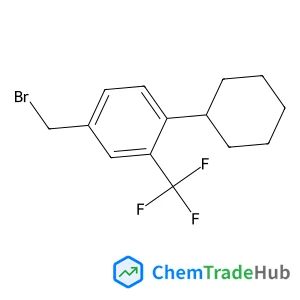
4-(Bromomethyl)-1-cyclohexyl-2-(trifluoromethyl)benzene
CAS Number:
800381-60-6
Molecular Formula:
C14H16BrF3
![8-Bromo-6-fluoro[1,2,4]triazolo[1,5-a]pyridin-2-amine structure](https://static.chemtradehub.com/structs/125/1257705-51-3-9f4a.webp "8-Bromo-6-fluoro[1,2,4]triazolo[1,5-a]pyridin-2-amine structure")
8-Bromo-6-fluoro[1,2,4]triazolo[1,5-a]pyridin-2-amine
CAS Number:
1257705-51-3
Molecular Formula:
C6H4BrFN4
Recommended Suppliers




Disclaimer
This page provides academic journal information for reference and research purposes only. We are not affiliated with any journal publishers and do not handle publication submissions. For publication-related inquiries, please contact the respective journal publishers directly.
If you notice any inaccuracies in the information displayed, please contact us at support@chemtradehub.com. We will promptly review and address your concerns.