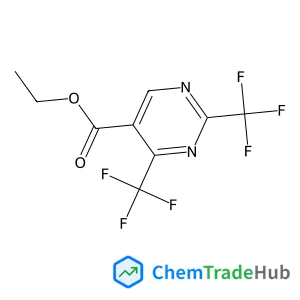
Ethyl 2,4-bis(trifluoromethyl)-5-pyrimidinecarboxylate
CAS Number:
188781-15-9
Molecular Formula:
C9H6F6N2O2
Alexander Ostermann, Tobias M. Gasser, Thomas Loerting, Jörg Petrasch
Gas hydrates are usually synthesized by bringing together a pressurized gas and liquid or solid water. In both cases, the transport of gas or water to the hydrate growth site is hindered once an initial film of hydrate has grown at the water–gas interface. A seemingly forgotten gas-phase technique overcomes this problem by slowly depositing water vapor on a cold surface in the presence of the pressurized guest gas. Despite being used for the synthesis of low-formation-pressure hydrates, it has not yet been tested for hydrates of CO2 and CH4. Moreover, the potential of the technique for the study of hydrate decomposition has not been recognized yet. We employ two advanced implementations of the condensation technique to form hydrates of CO2 and CH4 and demonstrate the applicability of the process for the study of hydrate decomposition and the phenomenon of self-preservation. Our results show that CO2 and CH4 hydrate samples deposited on graphite at 261–265 K are almost pure hydrates with an ice fraction of less than 8%. Rapid depressurization experiments with thin deposits (approx. 330 μm thickness) of CO2 hydrate on an aluminum surface at 265 K yield identical dissociation curves when the deposition is done at identical pressure. However, hydrates deposited at 1 MPa almost completely withstand decomposition after rapid depressurization to 0.1 MPa, while samples deposited at 2 MPa decompose 7 times faster. Therefore, this synthesis technique is not only applicable for the study of hydrate decomposition but can also be used for the controlled deposition of a super-preserved hydrate.
Rong-Mei Kong, Xiao-Bing Zhang, Liang-Liang Zhang, Xiao-Yong Jin, Shuang-Yan Huan, Guo-Li Shen, Ru-Qin Yu
DOI: 10.1039/B911163H
Tetsuya Nakagawa, Yasuchika Hasegawa, Tsuyoshi Kawai
DOI: 10.1039/B912469A
Nicolas A. Uhlich, Peter Sommer, Claudia Bühr, Stefan Schürch, Jean-Louis Reymond, Tamis Darbre
DOI: 10.1039/B912291E
Martin B. Duriska, Suzanne M. Neville, Stuart R. Batten
DOI: 10.1039/B910994C
Martin R. Lohe, Marcus Rose, Stefan Kaskel
DOI: 10.1039/B910175F
Il Joon Lee, Jeong Wu Yi, Byeang Hyean Kim
DOI: 10.1039/B908624B
Stuart Kennedy, Scott J. Dalgarno
DOI: 10.1039/B909456C
Ekaterina V. Skorb, Dmitry V. Sviridov, Helmuth Möhwald, Dmitry G. Shchukin
DOI: 10.1039/B914257F
Xin Shu, Zhe An, Lianying Wang, Jing He
DOI: 10.1039/B909301J
When handling lithium chloride hydrate (1:1:1) (CAS: 16712-20-2), it is importan...
4-(4H-1,2,4-Triazol-4-yl)piperidine is generally considered safe for use in phar...
Waste containing 1,3-Thiazole-2-carboxamide (CAS: 16733-85-0) should be collecte...
5-(Difluoromethyl)-2-fluorobenzonitrile (CAS: 934175-58-3) is subject to regulat...
Methyl 3-acetamido-2-thiophenecarboxylate can be synthesized by the reaction of ...
4-Isoquinolinecarbonitrile is a chemical compound with the CAS number 34846-65-6...
Store Methyl 1H-1,2,3-triazole-4-carboxylate (CAS: 877309-59-6) in a cool, dry p...
6-Bromo[1,3]thiazolo[5,4-b]pyridin-2-amine (CAS: 1160791-13-8) is subject to the...
(2S,3S)-2-Ammonio-3-(3,4-dihydroxyphenyl)-3-hydroxypropanoate (CAS: 23651-95-8) ...
7-Bromo-3-methyl-3,4-dihydroquinazolin-4-one is a solid with a crystalline form....

Physical Chemistry Chemical Physics (PCCP) is an international journal co-owned by 19 physical chemistry and physics societies from around the world. This journal publishes original, cutting-edge research in physical chemistry, chemical physics and biophysical chemistry. To be suitable for publication in PCCP, articles must include significant innovation and/or insight into physical chemistry; this is the most important criterion that reviewers and Editors will judge against when evaluating submissions. The journal has a broad scope and welcomes contributions spanning experiment, theory, computation and data science. Topical coverage includes spectroscopy, dynamics, kinetics, statistical mechanics, thermodynamics, electrochemistry, catalysis, surface science, quantum mechanics, quantum computing and machine learning. Interdisciplinary research areas such as polymers and soft matter, materials, nanoscience, energy, surfaces/interfaces, and biophysical chemistry are welcomed if they demonstrate significant innovation and/or insight into physical chemistry. Joined experimental/theoretical studies are particularly appreciated when complementary and based on up-to-date approaches.
![[(2R)-6,6-Dimethyl-2-morpholinyl]methanol hydrochloride (1:1) structure](https://static.chemtradehub.com/structs/141/1416444-88-6-e06a.webp "[(2R)-6,6-Dimethyl-2-morpholinyl]methanol hydrochloride (1:1) structure")