












Visible-light responsive hydrogen-bonded supramolecular polymers based on ortho-tetrafluorinated azobenzene
Literature Information
Publication Date
2017-11-13
DOI
10.1039/C7PY01612C
Impact Factor
5.582
Authors
Meng-Di Lin, Jie Wei, Li-Juan Liu, Meng-Yan Yun, Lin Wu, Si-Tai Zheng, Huan-Huan Yin, Li-Chun Kong
View Original
Abstract
Novel visible-light responsive hydrogen-bonded supramolecular polymers have been successfully constructed by using a linear molecule, which consists of two ureido-pyrimidinone (UPy) moieties connected by a photochromic ortho-tetrafluorinated azobenzene (TFAB) linker. Benefiting from the visible-light responsive feature of the TFAB unit, reversible photoisomerization between the two isomers of the monomer can be achieved. The E-isomer prefers to form a linear supramolecular polymer through the intermolecular quadruple hydrogen bonding interactions between UPys, whereas the Z-isomer facilely forms a cyclic dimer. Therefore, the polymerization mechanisms and properties of such supramolecular polymers, e.g. reversible visible-light induced gel–sol transformation behaviour, can be regulated by the reversible visible-light triggered E/Z photo-isomerization of the TFAB chromophore.
Related Literature
Thiation of 2′-deoxy-5,6-dihydropyrimidine nucleosides with Lawesson’s reagent: Characterisation of oxathiaphosphepane intermediates
Frédéric Peyrane, Jean-Louis Fourrey, Pascale Clivio
2003-02-21
Communication
DOI: 10.1039/B211405D
Anionic triazacyclononanes: new supporting ligands in main group and transition metal organometallic chemistry
Joseph A. R. Schmidt, Garth R. Giesbrecht, Chunming Cui, John Arnold
2002-11-28
Feature Article
DOI: 10.1039/B208525A
Novel and efficient chiral sulfideoxathiane ligands for palladium-catalyzed asymmetric allylic alkylation
Yuko Okuyama, Hiroto Nakano, Kouichi Takahashi, Hiroshi Hongo, Chizuko Kabuto
2003-01-17
Communication
DOI: 10.1039/B211031H
Construction of extended networks with a trimeric pyrazole synthon
Ishtvan Boldog, Eduard B. Rusanov, Joachim Sieler, Steffen Blaurock, Konstantin V. Domasevitch
2003-02-25
Communication
DOI: 10.1039/B212540D
Beta zeolite supported on silicon carbide for Friedel–Crafts fixed-bed reactions
Gauthier Winé, Joseph Matta, Jean-Philippe Tessonnier, Cuong Pham-Huu, Marc-Jacques Ledoux
2003-01-16
Communication
DOI: 10.1039/B209858J
Structural characterization of the first hydrothermally synthesized plutonium compound, PuO2(IO3)2·H2O
Wolfgang Runde, Thomas E. Albrecht-Schmitt, Brian L. Scott
2003-01-16
Communication
DOI: 10.1039/B211018K
Reversible C–C bond formation: solid state structure of the aldol-like addition product of adamantanone to a 1,5-diazapentadienyllithium, and its solution state retro-aldol dissociation
Lee-Jon Ball, Anthony P. Dickie, Francis S. Mair, David A. Middleton, Robin G. Pritchard
2003-02-19
Communication
DOI: 10.1039/B211745B
Yttrium alkyl complexes with a sterically demanding benzamidinate ligand: synthesis, structure and catalytic ethene polymerisation
Sergio Bambirra, Daan van Leusen, Auke Meetsma, Bart Hessen, Jan H. Teuben
2003-01-17
Communication
DOI: 10.1039/B208502J
Fraction of the CoMoS phases accessible to NO in Co–Mo hydrodesulfurization catalysts
Yasuaki Okamoto, Masatoshi Kawano, Takeshi Kubota
2003-04-07
Communication
DOI: 10.1039/B301487H
Optical and electrical properties of the wide gap, n-type semiconductors: ZnBi2O6 and MgBi2O6
Hiroshi Mizoguchi, Nattamai S. P. Bhuvanesh, Patrick M. Woodward
2003-04-07
Communication
DOI: 10.1039/B300635B
You might also like
Compound Q&A
What precautions should be taken when handling 4-(2-Furylmethyl)thiomorpholine 1,1-dioxide (CAS: 79206-94-3)?
When handling 4-(2-Furylmethyl)thiomorpholine 1,1-dioxide (CAS: 79206-94-3), it ...
79206-94-34-(2-Furylmethyl)thi...
Compound Q&A
What precautions should be taken when handling 4-Chloro-N-[2-(4-morpholinyl)ethyl]benzamide (CAS: 71320-77-9)?
When handling 4-Chloro-N-[2-(4-morpholinyl)ethyl]benzamide (CAS: 71320-77-9), it...
71320-77-94-Chloro-N-[2-(4-mor...
Compound Q&A
How should waste containing 2-[2-(2-Methoxyethoxy)ethoxy]ethyl 4-methylbenzenesulfonate (CAS: 62921-74-8) be handled?
Waste containing this compound (CAS: 62921-74-8) should be handled according to ...
62921-74-82-[2-(2-Methoxyethox...
Compound Q&A
How should waste containing (S)-Methyl 2-amino-3-cyclohexylpropanoate be handled?
Waste containing (S)-Methyl 2-amino-3-cyclohexylpropanoate should be collected i...
40056-18-6(S)-Methyl 2-amino-3...
Compound Q&A
How is 5-({4-[(2S,4R)-4-Hydroxy-2-methyltetrahydro-2H-pyran-4-yl]-2-thienyl}sulfanyl)-1-methyl-1,3-dihydro-2H-indol-2-one (CAS: 166882-70-8) typically synthesized?
This compound can be synthesized using a multi-step process involving the conjug...
166882-70-85-({4-[(2S,4R)-4-Hyd...
Compound Q&A
Are there alternatives to (2E)-3-(3,4-Dichlorophenyl)acrylic acid (CAS: 7312-27-8) in synthesis?
There are several alternatives to (2E)-3-(3,4-Dichlorophenyl)acrylic acid in syn...
7312-27-8(2E)-3-(3,4-Dichloro...
Compound Q&A
How should Ethyl 6-(2-nitrophenyl)imidazo[2,1-b][1,3]thiazole-3-carboxylate (CAS: 925437-84-9) be stored?
Ethyl 6-(2-nitrophenyl)imidazo[2,1-b][1,3]thiazole-3-carboxylate (CAS: 925437-84...
925437-84-9Ethyl 6-(2-nitrophen...
Compound Q&A
How should waste containing 2-(1,3-Thiazol-2-yl)ethanamine (CAS: 18453-07-1) be handled?
Waste containing 2-(1,3-Thiazol-2-yl)ethanamine (CAS: 18453-07-1) should be coll...
18453-07-12-(1,3-Thiazol-2-yl)...
Compound Q&A
How is Methyl 5-iodo-2-methylbenzoate (CAS: 103440-54-6) typically synthesized?
Methyl 5-iodo-2-methylbenzoate can be synthesized through the iodination of meth...
103440-54-6Methyl 5-iodo-2-meth...
Compound Q&A
How is 5-Chloro[1,2,4]triazolo[1,5-a]pyridine (CAS: 1427399-34-5) typically synthesized?
5-Chloro[1,2,4]triazolo[1,5-a]pyridine is commonly synthesized via the condensat...
1427399-34-55-Chloro[1,2,4]triaz...
Source Journal
Polymer Chemistry

CiteScore:
8.6
Self-citation Rate:
7.3%
Articles per Year:
457
Polymer Chemistry welcomes submissions in all areas of polymer science that have a strong focus on macromolecular chemistry. Manuscripts may cover a broad range of fields, yet no direct application focus is required.
Recommended Compounds
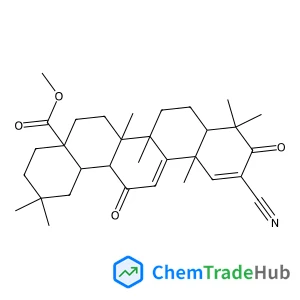
Methyl 2-cyano-3,12-dioxooleana-1,9(11)-dien-28-oate
CAS Number:
218600-53-4
Molecular Formula:
C32H43NO4
Recommended Suppliers






Disclaimer
This page provides academic journal information for reference and research purposes only. We are not affiliated with any journal publishers and do not handle publication submissions. For publication-related inquiries, please contact the respective journal publishers directly.
If you notice any inaccuracies in the information displayed, please contact us at support@chemtradehub.com. We will promptly review and address your concerns.