












Effect of catalyst type on molecular weight increase and coloration of poly(ethylene furanoate) biobased polyester during melt polycondensation
Literature Information
Publication Date
2017-10-25
DOI
10.1039/C7PY01171G
Impact Factor
5.582
Authors
Zoe Terzopoulou, Elisavet Karakatsianopoulou, Nejib Kasmi, Vasileios Tsanaktsis, Nikolaos Nikolaidis, Margaritis Kostoglou, George Z. Papageorgiou, Dimitra A. Lambropoulou, Dimitrios N. Bikiaris
View Original
Abstract
In this work, the effect of the catalysts tetrabutyl titanate(IV) (TBT), titanium(IV) isopropoxide (TIS), tin(II) 2-ethylhexanoate (TEH) and dibutyltin(IV) oxide (DBTO) on the synthesis of poly(ethylene furanoate) (PEF) was studied during a two-stage melt polycondensation process. In all reactions, 2,5-dimethylfuran-dicarboxylate (DMFD) and ethylene glycol (EG) in 1 : 2 molar ratios, and 400 ppm of catalyst were used. The rate of the transesterification reaction (first stage) was evaluated by measuring the volume of the distilled methanol and for the polycondensation reaction (second stage) by the increase of intrinsic viscosity. For the first stage, all catalysts had a similar effect to methanol distillation, except for TEH which was found to be the slowest catalyst, while for the second stage TIS and TBT were found to be the most effective catalysts, followed by DBTO and TEH, which again had the lowest reactivity. Coloration of the prepared polyesters was measured using the L*a*b* colour space system and was found to be dependent on catalyst type and melt polycondensation time, with titanate catalysts yielding the highest coloration. White coloured polyesters can be obtained after dissolution in trifluroacetic acid and chloroform mixture, and precipitation in methanol. Decomposition by-products formed throughout the different processes were identified in solution and elucidated by using liquid chromatography high resolution mass spectrometry (LC-HRMS). Similar decomposition products were detected in all chromatographs and therefore concentration in samples prepared with titanate catalysts might be the cause of the higher colour intensity of these samples.
Related Literature
Hydroxide promotes ion pairing in the NaNO2–NaOH–H2O system
Trent R. Graham, Mateusz Dembowski, Hsiu-Wen Wang, Sebastian T. Mergelsberg, Emily T. Nienhuis, Jacob G. Reynolds, Calvin H. Delegard, Yihui Wei, Michelle Snyder, Ian I. Leavy, Steven R. Baum, Matthew S. Fountain, Kevin M. Rosso
2020-12-11
Paper
DOI: 10.1039/D0CP04799F
Accurate equilibrium structure of 3-aminophthalimide from gas electron diffraction and coupled-cluster computations and diverse structural effects due to electron density transfer
Nina I. Giricheva, Georgiy V. Girichev
2020-11-12
Paper
DOI: 10.1039/D0CP04423G
Enhanced magnetic anisotropy and Curie temperature of the NiI2 monolayer by applying strain: a first-principles study
Hecheng Han, Huiling Zheng, Qiushi Wang, Yu Yan
2020-10-31
Paper
DOI: 10.1039/D0CP03803B
The interaction strength of an intrinsically disordered protein domain with its binding partner is little affected by very different cosolutes
Jan Schnatwinkel, Christian Herrmann
2020-11-20
Paper
DOI: 10.1039/D0CP03040F
Pulsed neutron imaging for differentiation of ice and liquid water towards fuel cell vehicle applications
Yuki Higuchi, Daigo Setoyama, Kazuhisa Isegawa, Yusuke Tsuchikawa, Yoshihiro Matsumoto, Joseph Don Parker, Takenao Shinohara, Yasutaka Nagai
2020-12-10
Paper
DOI: 10.1039/D0CP03887C
Influence of the Coriolis effect on the properties of scattering resonances in symmetric and asymmetric isotopomers of ozone
Igor Gayday, Elizaveta Grushnikova, Dmitri Babikov
2020-11-25
Paper
DOI: 10.1039/D0CP05060A
Surface chemistry effects on work function, ionization potential and electronic affinity of Si(100), Ge(100) surfaces and SiGe heterostructures
Michele Amato, Matteo Bertocchi, Andrea Ferretti, Daniele Varsano
2020-10-30
Paper
DOI: 10.1039/D0CP04013D
First-principles studies of strongly correlated states in defect spin qubits in diamond
He Ma, Nan Sheng
2020-09-24
Paper
DOI: 10.1039/D0CP04585C
VUV excited-state dynamics of cyclic ethers as a function of ring size
Anders B. Skov, Rune Lausten
2020-10-27
Paper
DOI: 10.1039/D0CP04292G
Tuning the work function of nickel oxide using triethoxysilane functionalized monolayers
Gang Chen, Xinquan Wang, Yuting Shi, Jonathan S. Tinkham, Thomas M. Brenner, Dana C. Olson, Alan Sellinger, Thomas E. Furtak
2020-12-30
Paper
DOI: 10.1039/D0CP03306E
You might also like
Compound Q&A
Are there alternatives to 1-(4-Chlorophenyl)-N-hydroxymethanimine (CAS: 3848-36-0) in synthesis?
When considering alternatives to 1-(4-Chlorophenyl)-N-hydroxymethanimine (CAS: 3...
3848-36-01-(4-Chlorophenyl)-N...
Compound Q&A
How should (1R,9S,10S,12S,14E,16S,19R,20R,21S,22R)-3,9,21-Trihydroxy-5,10,12,14,16,20,22-heptamethyl-23,24-dioxatetracyclo[17.3.1.1~6,9~.0~2,7~]tetracosa-2,5,7,14-tetraen-4-one (CAS: 183202-73-5) be stored?
This compound should be stored in a cool, dry place away from direct sunlight. I...
183202-73-5(1R,9S,10S,12S,14E,1...
Compound Q&A
How is 3-(4-Bromophenyl)-5-(2-fluorophenyl)-1,2,4-oxadiazole (CAS: 419553-16-5) typically synthesized?
3-(4-Bromophenyl)-5-(2-fluorophenyl)-1,2,4-oxadiazole is synthesized through a m...
419553-16-53-(4-Bromophenyl)-5-...
Compound Q&A
How is 5-Chloro-2-(4-chlorophenyl)-4-methyl-6-[3-(1-piperidinyl)propoxy]pyrimidine (CAS: 1639220-19-1) typically synthesized?
5-Chloro-2-(4-chlorophenyl)-4-methyl-6-[3-(1-piperidinyl)propoxy]pyrimidine (CAS...
1639220-19-15-Chloro-2-(4-chloro...
Compound Q&A
What industries use 2-Chloro-4-(difluoromethoxy)pyridine (CAS: 1206978-15-5)?
2-Chloro-4-(difluoromethoxy)pyridine is used in the pharmaceutical industry for ...
1206978-15-52-Chloro-4-(difluoro...
Compound Q&A
What regulatory guidelines apply to 3-Chloro-6-methylpyridazine (CAS: 1121-79-5)?
3-Chloro-6-methylpyridazine (CAS: 1121-79-5) is classified under the Globally Ha...
1121-79-53-Chloro-6-methylpyr...
Compound Q&A
Are there alternatives to Methyl 4,5-dimethyl-2-nitrobenzoate in synthesis?
Several alternatives can be used in the synthesis of Methyl 4,5-dimethyl-2-nitro...
90922-74-0Methyl 4,5-dimethyl-...
Compound Q&A
Are there alternatives to (2E,2'E)-3,3'-(1,4-Phenylene)bisacrylaldehyde in synthesis?
Alternatives to (2E,2'E)-3,3'-(1,4-Phenylene)bisacrylaldehyde include other acry...
63405-68-5(2E,2'E)-3,3'-(1,4-P...
Compound Q&A
What is 3-Amino-5-chloropyridin-2-ol hydrochloride (CAS: 1261906-29-9)?
3-Amino-5-chloropyridin-2-ol hydrochloride is an organic compound with the CAS n...
1261906-29-93-Amino-5-chloropyri...
Compound Q&A
What precautions should be taken when handling 6,7-Difluoro-2,3-dihydro-4H-chromen-4-one (CAS: 1092349-93-3)?
When handling 6,7-Difluoro-2,3-dihydro-4H-chromen-4-one, it is essential to wear...
1092349-93-36,7-Difluoro-2,3-dih...
Source Journal
Polymer Chemistry

CiteScore:
8.6
Self-citation Rate:
7.3%
Articles per Year:
457
Polymer Chemistry welcomes submissions in all areas of polymer science that have a strong focus on macromolecular chemistry. Manuscripts may cover a broad range of fields, yet no direct application focus is required.
Recommended Compounds
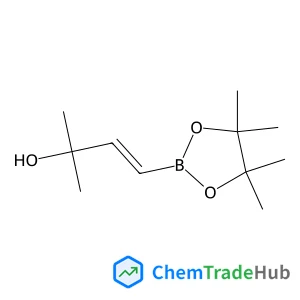
(E)-2-methyl-4-(4,4,5,5-tetramethyl-1,3,2-dioxaborolan-2-yl)but-3-en-2-ol
CAS Number:
581802-26-8
Molecular Formula:
C11H21BO3
![6-Bromo-2,3-dihydro-1H-pyrido[2,3-b][1,4]oxazine structure](https://static.chemtradehub.com/structs/120/1203499-17-5-b4d1.webp "6-Bromo-2,3-dihydro-1H-pyrido[2,3-b][1,4]oxazine structure")
6-Bromo-2,3-dihydro-1H-pyrido[2,3-b][1,4]oxazine
CAS Number:
1203499-17-5
Molecular Formula:
C7H7BrN2O
Recommended Suppliers




Disclaimer
This page provides academic journal information for reference and research purposes only. We are not affiliated with any journal publishers and do not handle publication submissions. For publication-related inquiries, please contact the respective journal publishers directly.
If you notice any inaccuracies in the information displayed, please contact us at support@chemtradehub.com. We will promptly review and address your concerns.