












Enhanced magnetic anisotropy and Curie temperature of the NiI2 monolayer by applying strain: a first-principles study
Literature Information
Publication Date
2020-10-31
DOI
10.1039/D0CP03803B
Impact Factor
3.676
Authors
Hecheng Han, Huiling Zheng, Qiushi Wang, Yu Yan
View Original
Abstract
Two-dimensional (2D) intrinsic ferromagnetic semiconductors with high magnetic anisotropy (MA) and Curie temperature (TC) are desirable for low-dimensional spintronic applications. We present here the structural stability, MA and TC of the semiconducting NiI2 monolayer under strain from −4% to 4% using first-principles calculations. The unstrained NiI2 monolayer exhibits an in-plane magnetic anisotropy energy of −0.11 meV per unit cell and a TC of 79 K. Most noteworthily, the in-plane MA and TC of the NiI2 monolayer are simultaneously enhanced under compressive strain; meanwhile, the NiI2 monolayer is still stable. In particular, when the compressive strain reaches −4%, the in-plane MA is more than three times higher than that in the unstrained system. Based on the second-order perturbation theory of spin–orbit coupling, the density of states and the orbital magnetic anisotropy contributions are analyzed, indicating that the compressive strain effect originates from the increase of the negative contribution from the spin–orbit coupling interaction between the opposite spin py and px orbitals of the I atom. This study provides a promising route for exploring new 2D ferromagnetic semiconductors with higher MA and TC.
Recommended Journals
Related Literature
Sulfate aniontemplation of a neutral pseudorotaxane assembly using an indolocarbazole threading component
Michał J. Chmielewski, Liyun Zhao, Asha Brown, David Curiel, Mark R. Sambrook, Amber L. Thompson, Sergio M. Santos, Vitor Felix, Jason J. Davis, Paul D. Beer
2008-05-09
Communication
DOI: 10.1039/B804941F
A chemo- and regio-selective three-component dihydropyrimidinone synthesis
Chris D. Bailey, Chris E. Houlden, Grégory L. J. Bar, Guy C. Lloyd-Jones, Kevin I. Booker-Milburn
2007-06-19
Communication
DOI: 10.1039/B707361E
The first urea azine molecule and its coordination to uranium in the first actinide guanidinate complexes
Claude Villiers, Pierre Thuéry, Michel Ephritikhine
2007-06-18
Communication
DOI: 10.1039/B705224C
Stereocontrolled synthesis of carbocyclesvia four successive pericyclic reactions
Roxanne Clément, Christiane M. Grisé, Louis Barriault
2008-06-06
Communication
DOI: 10.1039/B803898H
Oxygen-assisted reduction of Au species on Au/SiO2catalyst in room temperature CO oxidation
Zili Wu, Shenghu Zhou, Haoguo Zhu, Sheng Dai, Steven H. Overbury
2008-06-05
Communication
DOI: 10.1039/B803834A
Gold nanoparticles become stable to cyanide etch when coated with hybrid lipid bilayers
Sarita Sitaula, Marilyn R. Mackiewicz, Scott M. Reed
2008-05-15
Communication
DOI: 10.1039/B801525B
Self-assembled perpendicular growth of organic nanoneedles via simple vapor-phase deposition: one-step fabrication of a superhydrophobic surface
Jong Won Chung, Byeong-Kwan An, Ji Whan Kim, Jang-Joo Kim, Soo Young Park
2008-05-13
Communication
DOI: 10.1039/B802749H
Real-time monitoring of a dynamic molecular system using 1H-13C HSQCNMR spectroscopy with an optimized 13C window
Giulio Gasparini, Bruno Vitorge, Paolo Scrimin, Damien Jeannerat, Leonard J. Prins
2008-04-21
Communication
DOI: 10.1039/B803074J
Organic semiconductors based on small molecules with thermally or photochemically removable groups
Tetsuo Okujima, Noboru Ono
2008-05-19
Feature Article
DOI: 10.1039/B719964C
Influence of a diene impurity on the molecular structure of phosphate-containing polymers with medical applications
Lisbeth Grøndahl, Edeline Wentrup-Byrne
2008-05-13
Communication
DOI: 10.1039/B803223H
You might also like
Compound Q&A
Are there alternatives to 1-(4-Chlorophenyl)-N-hydroxymethanimine (CAS: 3848-36-0) in synthesis?
When considering alternatives to 1-(4-Chlorophenyl)-N-hydroxymethanimine (CAS: 3...
3848-36-01-(4-Chlorophenyl)-N...
Compound Q&A
How should (1R,9S,10S,12S,14E,16S,19R,20R,21S,22R)-3,9,21-Trihydroxy-5,10,12,14,16,20,22-heptamethyl-23,24-dioxatetracyclo[17.3.1.1~6,9~.0~2,7~]tetracosa-2,5,7,14-tetraen-4-one (CAS: 183202-73-5) be stored?
This compound should be stored in a cool, dry place away from direct sunlight. I...
183202-73-5(1R,9S,10S,12S,14E,1...
Compound Q&A
How is 3-(4-Bromophenyl)-5-(2-fluorophenyl)-1,2,4-oxadiazole (CAS: 419553-16-5) typically synthesized?
3-(4-Bromophenyl)-5-(2-fluorophenyl)-1,2,4-oxadiazole is synthesized through a m...
419553-16-53-(4-Bromophenyl)-5-...
Compound Q&A
How is 5-Chloro-2-(4-chlorophenyl)-4-methyl-6-[3-(1-piperidinyl)propoxy]pyrimidine (CAS: 1639220-19-1) typically synthesized?
5-Chloro-2-(4-chlorophenyl)-4-methyl-6-[3-(1-piperidinyl)propoxy]pyrimidine (CAS...
1639220-19-15-Chloro-2-(4-chloro...
Compound Q&A
What industries use 2-Chloro-4-(difluoromethoxy)pyridine (CAS: 1206978-15-5)?
2-Chloro-4-(difluoromethoxy)pyridine is used in the pharmaceutical industry for ...
1206978-15-52-Chloro-4-(difluoro...
Compound Q&A
What regulatory guidelines apply to 3-Chloro-6-methylpyridazine (CAS: 1121-79-5)?
3-Chloro-6-methylpyridazine (CAS: 1121-79-5) is classified under the Globally Ha...
1121-79-53-Chloro-6-methylpyr...
Compound Q&A
Are there alternatives to Methyl 4,5-dimethyl-2-nitrobenzoate in synthesis?
Several alternatives can be used in the synthesis of Methyl 4,5-dimethyl-2-nitro...
90922-74-0Methyl 4,5-dimethyl-...
Compound Q&A
Are there alternatives to (2E,2'E)-3,3'-(1,4-Phenylene)bisacrylaldehyde in synthesis?
Alternatives to (2E,2'E)-3,3'-(1,4-Phenylene)bisacrylaldehyde include other acry...
63405-68-5(2E,2'E)-3,3'-(1,4-P...
Compound Q&A
What is 3-Amino-5-chloropyridin-2-ol hydrochloride (CAS: 1261906-29-9)?
3-Amino-5-chloropyridin-2-ol hydrochloride is an organic compound with the CAS n...
1261906-29-93-Amino-5-chloropyri...
Compound Q&A
What precautions should be taken when handling 6,7-Difluoro-2,3-dihydro-4H-chromen-4-one (CAS: 1092349-93-3)?
When handling 6,7-Difluoro-2,3-dihydro-4H-chromen-4-one, it is essential to wear...
1092349-93-36,7-Difluoro-2,3-dih...
Source Journal
Physical Chemistry Chemical Physics

CiteScore:
5.5
Self-citation Rate:
10.3%
Articles per Year:
3036
Physical Chemistry Chemical Physics (PCCP) is an international journal co-owned by 19 physical chemistry and physics societies from around the world. This journal publishes original, cutting-edge research in physical chemistry, chemical physics and biophysical chemistry. To be suitable for publication in PCCP, articles must include significant innovation and/or insight into physical chemistry; this is the most important criterion that reviewers and Editors will judge against when evaluating submissions. The journal has a broad scope and welcomes contributions spanning experiment, theory, computation and data science. Topical coverage includes spectroscopy, dynamics, kinetics, statistical mechanics, thermodynamics, electrochemistry, catalysis, surface science, quantum mechanics, quantum computing and machine learning. Interdisciplinary research areas such as polymers and soft matter, materials, nanoscience, energy, surfaces/interfaces, and biophysical chemistry are welcomed if they demonstrate significant innovation and/or insight into physical chemistry. Joined experimental/theoretical studies are particularly appreciated when complementary and based on up-to-date approaches.
Recommended Compounds
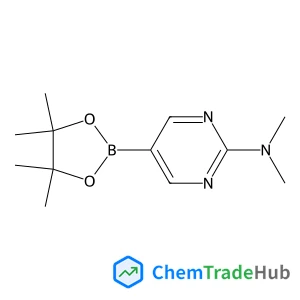
N,N-Dimethyl-5-(4,4,5,5-tetramethyl-1,3,2-dioxaborolan-2-yl)-2-pyrimidinamine
CAS Number:
1032759-30-0
Molecular Formula:
C12H20BN3O2
Recommended Suppliers





Disclaimer
This page provides academic journal information for reference and research purposes only. We are not affiliated with any journal publishers and do not handle publication submissions. For publication-related inquiries, please contact the respective journal publishers directly.
If you notice any inaccuracies in the information displayed, please contact us at support@chemtradehub.com. We will promptly review and address your concerns.