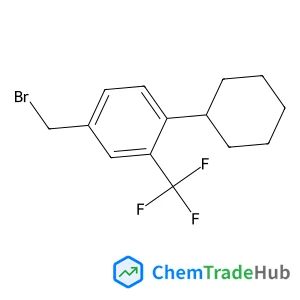
4-(Bromomethyl)-1-cyclohexyl-2-(trifluoromethyl)benzene
CAS Number:
800381-60-6
Molecular Formula:
C14H16BrF3
Qimin Jiang, Jiating Li, Wenyan Huang, Dongliang Zhang, Jianhai Chen, Hongjun Yang, Xiaoqiang Xue, Bibiao Jiang
In this paper, we report radical polymerization in the presence of a peroxide monomer for the preparation of branched vinyl polymers. The peroxide monomer, tert-butyl peroxyacetate methacrylate (BPAMA), was designed and prepared in high purity from commercially available reagents via classic organic reactions. Triple-detection size-exclusion chromatography (TD-SEC) measurements, NMR analyses, and hydrolysis experiments were used to reveal the polymerization procedure and to confirm the branching structure of the prepared polymers. Branched polymers of styrene, methyl methacrylate (MMA), and vinyl acetate (VAc) were prepared under solvent-free conditions through radical polymerization in the presence of a peroxide monomer. Furthermore, radical polymerization in the presence of the peroxide monomer can be operated in a simple polymerization composition involving only the peroxide monomer BPAMA with MMA or VAc. The obtained branched polymers exhibited high molecular weights (Mw.MALLS > 106 g mol−1) and relatively narrow molecular weight distributions (2.5 ≤ PDI ≤ 6.8). Generally, radical polymerization in the presence of a peroxide monomer as the initiator and the branching agent can make the preparation of branched vinyl polymers almost equally as facile as the preparation of their linear analogs. This approach is applicable to a wide variety of monomers and can be performed with a simple polymerization composition in the bulk under moderate conditions compared with the reported strategies.

Acta Metallurgica Sinica-English Letters

Journal of the Indian Institute of Science

Chinese Journal of Chemistry

NDT & E International

Critical Reviews in Solid State and Materials Sciences

Bioorganic & Medicinal Chemistry

Colloid Journal

Electroanalysis

Bioorganic & Medicinal Chemistry Letters

Biocatalysis and Biotransformation
Yu Shu, Ting Li, Naihua Miao, Jian Gou, Xiaochun Huang, Zhou Cui, Rui Xiong, Cuilian Wen, Jian Zhou, Baisheng Sa, Zhimei Sun
DOI: 10.1039/D3NH00450C
DOI: 10.1039/D3TA05214A
Ruonan Peng, Fengjun Xu, Richard Hailstone, Yujie Men, Ke Du
DOI: 10.1039/D3NH00365E
Marco Moors, Irina Werner, Jens Bauer, Jonas Lorenz, Kirill Yu. Monakhov
DOI: 10.1039/D3NH00345K
Fatemeh Khosravi Esmaeiltarkhani, Mohammad Dinari, Nazanin Mokhtari
DOI: 10.1039/D3NJ04674E
Chia-Hao Tsai, Shih-Hung Tung, Jhih-Min Lin
DOI: 10.1039/D3TA05836K
Kaichun Xu, Mengjie Han, Zichen Zheng, Jinyong Xu, Marc Debliquy, Chao Zhang
DOI: 10.1039/D3TA05718F
Zhanpin Zhu, Ruibing Chen
DOI: 10.1039/D3NP00012E
Jiawei Tang, Duo Wang, Jing Zhang, Litao Sun, Baisheng Sa, Bobby G. Sumpter, Jingsong Huang, Weiwei Sun
DOI: 10.1039/D3NH00364G
When handling lithium chloride hydrate (1:1:1) (CAS: 16712-20-2), it is importan...
4-(4H-1,2,4-Triazol-4-yl)piperidine is generally considered safe for use in phar...
Waste containing 1,3-Thiazole-2-carboxamide (CAS: 16733-85-0) should be collecte...
5-(Difluoromethyl)-2-fluorobenzonitrile (CAS: 934175-58-3) is subject to regulat...
Methyl 3-acetamido-2-thiophenecarboxylate can be synthesized by the reaction of ...
4-Isoquinolinecarbonitrile is a chemical compound with the CAS number 34846-65-6...
Store Methyl 1H-1,2,3-triazole-4-carboxylate (CAS: 877309-59-6) in a cool, dry p...
6-Bromo[1,3]thiazolo[5,4-b]pyridin-2-amine (CAS: 1160791-13-8) is subject to the...
(2S,3S)-2-Ammonio-3-(3,4-dihydroxyphenyl)-3-hydroxypropanoate (CAS: 23651-95-8) ...
7-Bromo-3-methyl-3,4-dihydroquinazolin-4-one is a solid with a crystalline form....

Polymer Chemistry welcomes submissions in all areas of polymer science that have a strong focus on macromolecular chemistry. Manuscripts may cover a broad range of fields, yet no direct application focus is required.